QUESTION IMAGE
Question
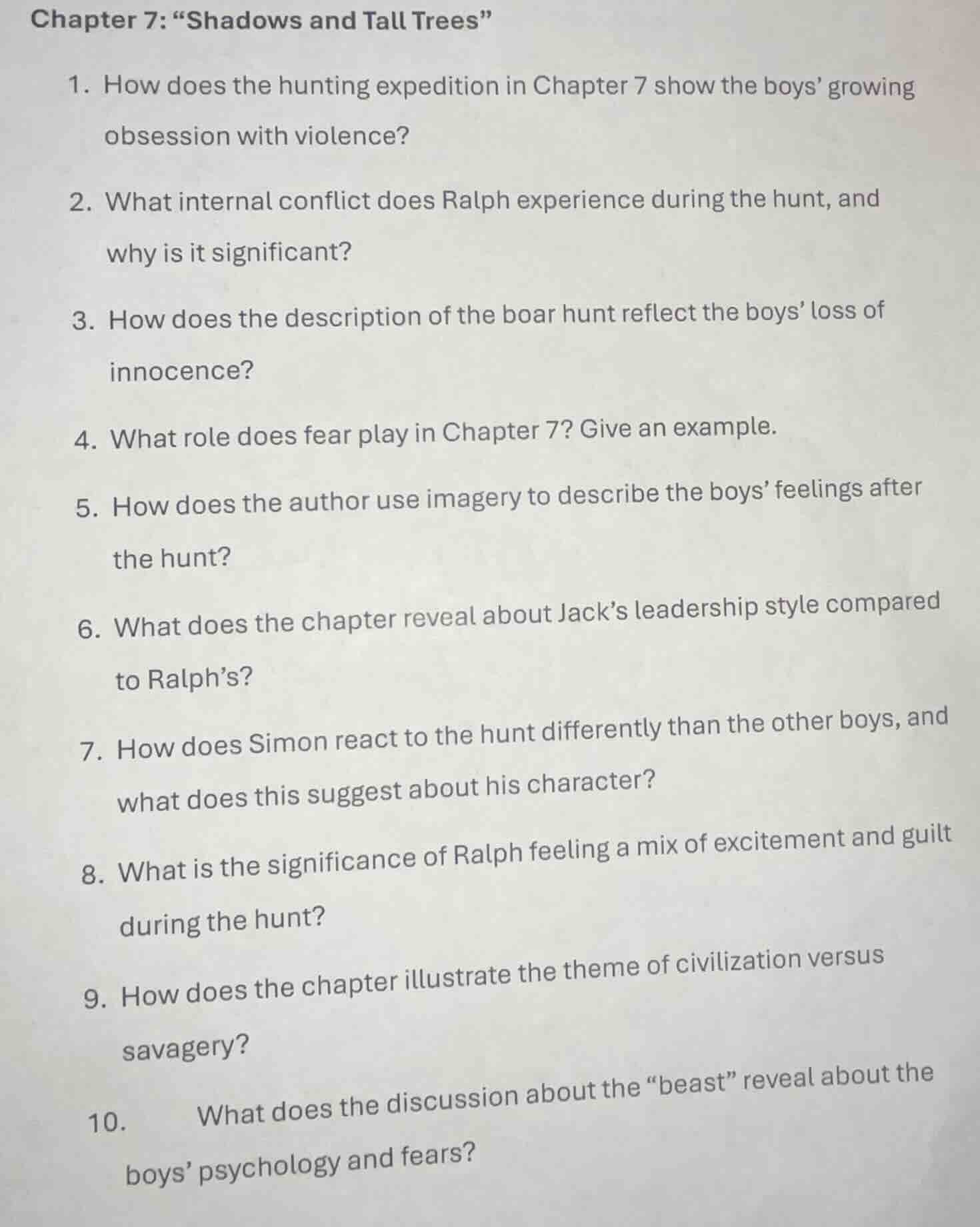
chapter 7:“shadows and tall trees”
- how does the hunting expedition in chapter 7 show the boys growing obsession with violence?
- what internal conflict does ralph experience during the hunt, and why is it significant?
- how does the description of the boar hunt reflect the boys loss of innocence?
- what role does fear play in chapter 7? give an example.
- how does the author use imagery to describe the boys feelings after the hunt?
- what does the chapter reveal about jacks leadership style compared to ralphs?
- how does simon react to the hunt differently than the other boys, and what does this suggest about his character?
- what is the significance of ralph feeling a mix of excitement and guilt during the hunt?
- how does the chapter illustrate the theme of civilization versus savagery?
- what does the discussion about the “beast” reveal about the boys psychology and fears?
Brief Explanations
- The boys abandon their rescue-focused tasks to hunt, and they take visceral joy in wounding the boar, even re-enacting the hunt violently on Robert, showing they prioritize violent thrills over order.
- Ralph struggles between his duty to maintain the signal fire (civilization) and his primal excitement in the hunt. This shows the tension between societal norms and innate savagery within even the most rational characters.
- The boys, once sheltered children, now actively pursue and harm a living creature with enthusiasm; their shift from innocence to enjoying violent, predatory acts marks their loss of childhood purity.
- Fear drives the boys' irrational actions and splits their group. For example, their fear of the "beast" makes them prioritize hunting for safety over keeping the signal fire lit, pushing them toward savagery.
- Golding uses sensory imagery: the boys' sweat, the taste of blood, and the "warm glow" of their violent triumph, mixed with the eerie quiet of the jungle, to convey their conflicting excitement and unease.
- Jack leads through manipulation of fear and indulgence in primal desires, rallying the boys with the thrill of the hunt. Ralph leads through reason and focus on rescue, prioritizing long-term survival over immediate gratification.
- Simon does not join the violent re-enactment of the hunt and shows discomfort with the boys' cruelty. This suggests he is empathetic, morally grounded, and more in touch with his humane side than the other boys.
- This mix shows that even Ralph, the symbol of civilization, has an innate pull toward savagery. It highlights that the line between order and violence is thin in all people.
- Ralph's focus on the signal fire (civilization, rescue) clashes with Jack's obsession with hunting (savagery, primal urges). The boys' choice to abandon the fire for the hunt shows civilization eroding in favor of savagery.
- The "beast" is a projection of the boys' own repressed fears and innate violent impulses. Their belief in an external beast reveals they cannot confront the savagery within themselves.

Snap & solve any problem in the app
Get step-by-step solutions on Sovi AI
Photo-based solutions with guided steps
Explore more problems and detailed explanations
- The boys abandon rescue tasks for the hunt, take joy in wounding the boar, and violently re-enact the hunt on Robert, prioritizing violent thrills over order.
- Ralph conflicts between duty to the signal fire and primal hunt excitement; it shows civilization vs. savagery tension in all people.
- The boys shift from sheltered children to enthusiastic, predatory hunters, abandoning childhood innocence for violent pleasure.
- Fear drives irrationality and division; e.g., fear of the "beast" makes boys prioritize hunting over the signal fire, pushing them toward savagery.
- Golding uses sensory imagery (sweat, blood taste, jungle quiet) to show the boys' mixed excitement and unease.
- Jack leads via fear and primal indulgence; Ralph leads via reason and focus on rescue.
- Simon avoids the violent re-enactment, showing he is empathetic, morally grounded, and humane.
- It reveals that even the rational Ralph has an innate pull toward savagery, blurring the line between order and violence.
- Ralph's focus on the signal fire (civilization) clashes with Jack's hunt obsession (savagery); the boys choosing the hunt shows civilization eroding.
- The "beast" is a projection of the boys' own repressed fears and violent impulses; they cannot confront their internal savagery.