QUESTION IMAGE
Question
characteristics of life
chapter 13 (p. 17 & 18)
for each of the pictures below, identify the characteristic of life and write a description of
the characteristic.
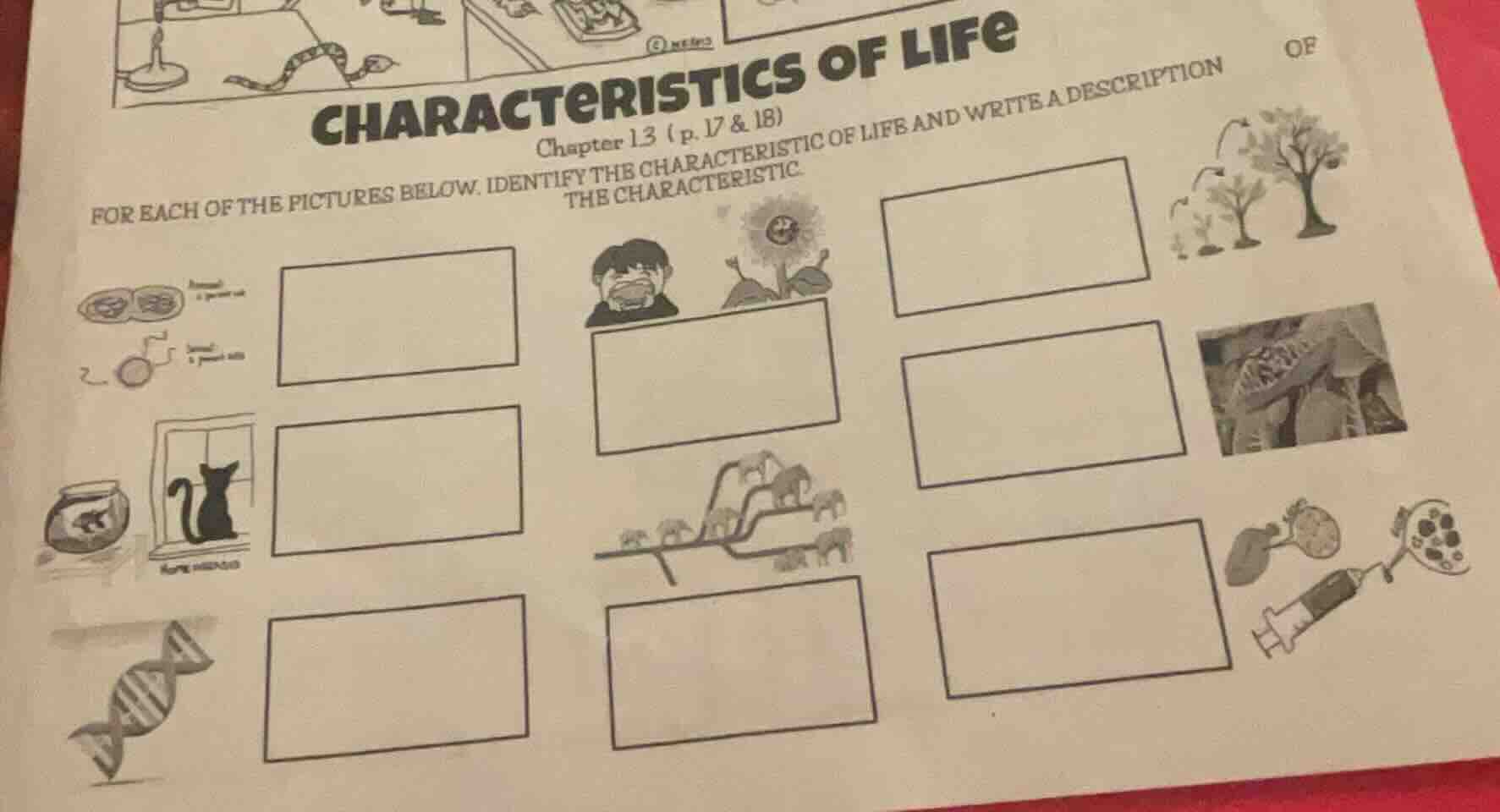
(there are several pictures with blank boxes next to them for writing descriptions, including images of cell division, a crying boy and a sunflower, a fish tank with a fish and a cat, a dna double helix, a tree growth sequence, a leaf structure, and a syringe with cells and organs.)
To solve this "Characteristics of Life" worksheet, we analyze each image based on the 8 characteristics of life (e.g., cellular organization, reproduction, growth, response to stimuli, homeostasis, metabolism, heredity, evolution):
1. First Image (Cell Division)
- Characteristic: Reproduction (or Cellular Reproduction)
- Description: The image shows a cell dividing (e.g., binary fission or mitosis), where one cell becomes two. Living things reproduce to create new organisms (or new cells, in unicellular life).
2. Second Image (Cat & Fish Tank)
- Characteristic: Response to Stimuli (or Homeostasis)
- Description: The cat (and fish) are reacting to their environment (e.g., the cat watching the fish, or the fish responding to the tank’s conditions). Living things detect and respond to changes in their surroundings.
3. Third Image (DNA Helix)
- Characteristic: Heredity (or Genetic Code)
- Description: DNA carries genetic information. Living things pass traits to offspring through DNA, ensuring species continuity.
4. Fourth Image (Crying Child & Sunflower)
- Characteristic: Response to Stimuli (or Metabolism)
- Description: The child (crying, a response) and sunflower (tracking sunlight, phototropism) react to stimuli (emotional/light changes). Alternatively, Metabolism (if the child is eating, or the plant is photosynthesizing—using energy).
5. Fifth Image (Evolutionary Tree)
- Characteristic: Evolution (or Adaptation)
- Description: The tree shows species changing over time (evolution) or adapting to environments. Populations evolve as traits favor survival/reproduction.
6. Sixth Image (Lungs & Blood Cells)
- Characteristic: Metabolism (or Homeostasis)
- Description: Lungs exchange gases (respiration, part of metabolism) to provide energy. Blood cells transport oxygen—supporting metabolic processes (using/processing energy).
7. Seventh Image (Plant Growth Stages)
- Characteristic: Growth & Development
- Description: The plant progresses from a seedling to a mature tree, increasing in size and complexity. Living things grow (cell division/elongation) and develop (mature over time).
8. Eighth Image (Syringe & Cells)
- Characteristic: Homeostasis (or Response to Stimuli)
- Description: If the syringe represents medical intervention (e.g., vaccines/blood tests), it relates to Homeostasis (maintaining internal balance) or Response to Stimuli (treating a stimulus like disease).
For each image, match the visual clue to a life characteristic (e.g., reproduction, growth, response, heredity, metabolism, evolution, homeostasis, cellular organization) and describe how the image illustrates it.
(Note: The exact characteristic depends on the image’s details—use the 8 core life characteristics to guide your analysis!)

Snap & solve any problem in the app
Get step-by-step solutions on Sovi AI
Photo-based solutions with guided steps
Explore more problems and detailed explanations
To solve this "Characteristics of Life" worksheet, we analyze each image based on the 8 characteristics of life (e.g., cellular organization, reproduction, growth, response to stimuli, homeostasis, metabolism, heredity, evolution):
1. First Image (Cell Division)
- Characteristic: Reproduction (or Cellular Reproduction)
- Description: The image shows a cell dividing (e.g., binary fission or mitosis), where one cell becomes two. Living things reproduce to create new organisms (or new cells, in unicellular life).
2. Second Image (Cat & Fish Tank)
- Characteristic: Response to Stimuli (or Homeostasis)
- Description: The cat (and fish) are reacting to their environment (e.g., the cat watching the fish, or the fish responding to the tank’s conditions). Living things detect and respond to changes in their surroundings.
3. Third Image (DNA Helix)
- Characteristic: Heredity (or Genetic Code)
- Description: DNA carries genetic information. Living things pass traits to offspring through DNA, ensuring species continuity.
4. Fourth Image (Crying Child & Sunflower)
- Characteristic: Response to Stimuli (or Metabolism)
- Description: The child (crying, a response) and sunflower (tracking sunlight, phototropism) react to stimuli (emotional/light changes). Alternatively, Metabolism (if the child is eating, or the plant is photosynthesizing—using energy).
5. Fifth Image (Evolutionary Tree)
- Characteristic: Evolution (or Adaptation)
- Description: The tree shows species changing over time (evolution) or adapting to environments. Populations evolve as traits favor survival/reproduction.
6. Sixth Image (Lungs & Blood Cells)
- Characteristic: Metabolism (or Homeostasis)
- Description: Lungs exchange gases (respiration, part of metabolism) to provide energy. Blood cells transport oxygen—supporting metabolic processes (using/processing energy).
7. Seventh Image (Plant Growth Stages)
- Characteristic: Growth & Development
- Description: The plant progresses from a seedling to a mature tree, increasing in size and complexity. Living things grow (cell division/elongation) and develop (mature over time).
8. Eighth Image (Syringe & Cells)
- Characteristic: Homeostasis (or Response to Stimuli)
- Description: If the syringe represents medical intervention (e.g., vaccines/blood tests), it relates to Homeostasis (maintaining internal balance) or Response to Stimuli (treating a stimulus like disease).
For each image, match the visual clue to a life characteristic (e.g., reproduction, growth, response, heredity, metabolism, evolution, homeostasis, cellular organization) and describe how the image illustrates it.
(Note: The exact characteristic depends on the image’s details—use the 8 core life characteristics to guide your analysis!)