QUESTION IMAGE
Question
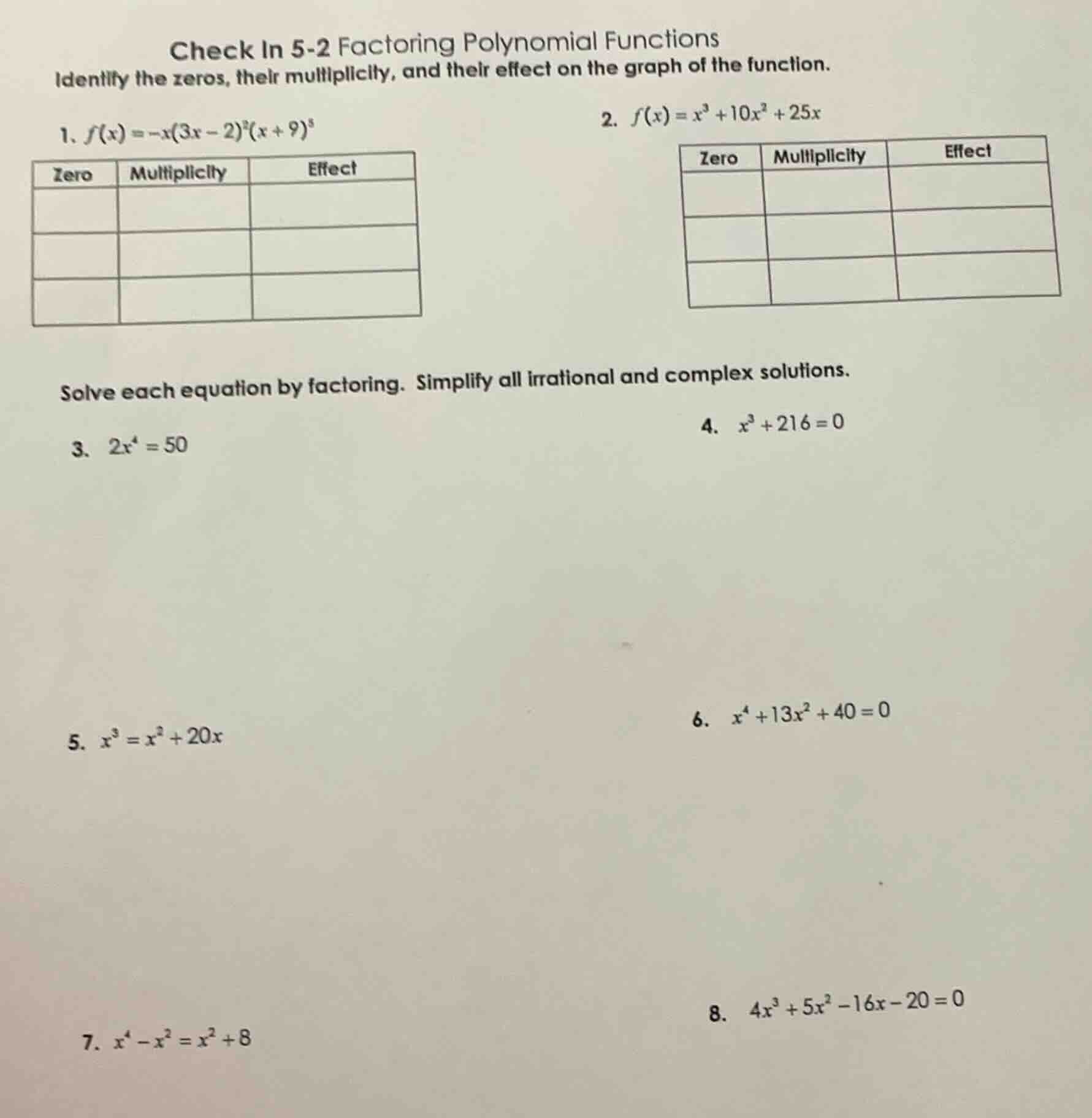
check in 5-2 factoring polynomial functions
identify the zeros, their multiplicity, and their effect on the graph of the function.
- $f(x) = -x(3x - 2)^3(x + 9)^5$
- $f(x) = x^3 + 10x^2 + 25x$
solve each equation by factoring. simplify all irrational and complex solutions.
- $2x^4 = 50$
- $x^3 + 216 = 0$
- $x^3 = x^2 + 20x$
- $x^4 + 13x^2 + 40 = 0$
- $x^4 - x^2 = x^2 + 8$
- $4x^3 + 5x^2 - 16x - 20 = 0$
Problem 1: \( f(x) = -x(3x - 2)^3(x + 9)^5 \)
Step 1: Find Zeros
To find the zeros, set each factor equal to zero:
- For \( -x = 0 \), we get \( x = 0 \).
- For \( (3x - 2)^3 = 0 \), solve \( 3x - 2 = 0 \), so \( x = \frac{2}{3} \).
- For \( (x + 9)^5 = 0 \), solve \( x + 9 = 0 \), so \( x = -9 \).
Step 2: Determine Multiplicity
The multiplicity of a zero is the exponent of its corresponding factor:
- For \( x = 0 \), the factor is \( -x \) (exponent 1), so multiplicity is 1.
- For \( x = \frac{2}{3} \), the factor is \( (3x - 2)^3 \) (exponent 3), so multiplicity is 3.
- For \( x = -9 \), the factor is \( (x + 9)^5 \) (exponent 5), so multiplicity is 5.
Step 3: Determine Effect on Graph
- If multiplicity is odd, the graph crosses the x - axis at that zero.
- If multiplicity is even, the graph touches the x - axis and turns around at that zero.
- For \( x = 0 \) (multiplicity 1, odd): The graph crosses the x - axis at \( x = 0 \).
- For \( x = \frac{2}{3} \) (multiplicity 3, odd): The graph crosses the x - axis at \( x=\frac{2}{3} \).
- For \( x = -9 \) (multiplicity 5, odd): The graph crosses the x - axis at \( x = -9 \).
Step 1: Factor the Polynomial
First, factor out the greatest common factor \( x \): \( f(x)=x(x^{2}+10x + 25) \).
Then, factor the quadratic \( x^{2}+10x + 25 \). We know that \( x^{2}+10x + 25=(x + 5)^{2} \) (since \( (a + b)^2=a^{2}+2ab + b^{2} \), here \( a=x \), \( b = 5 \), \( 2ab=10x \), \( a^{2}=x^{2} \), \( b^{2}=25 \)). So \( f(x)=x(x + 5)^{2} \).
Step 2: Find Zeros
Set each factor equal to zero:
- For \( x = 0 \), the factor is \( x \), so \( x = 0 \).
- For \( (x + 5)^{2}=0 \), solve \( x+5 = 0 \), so \( x=-5 \).
Step 3: Determine Multiplicity
- For \( x = 0 \), the factor is \( x \) (exponent 1), so multiplicity is 1.
- For \( x=-5 \), the factor is \( (x + 5)^{2} \) (exponent 2), so multiplicity is 2.
Step 4: Determine Effect on Graph
- For \( x = 0 \) (multiplicity 1, odd): The graph crosses the x - axis at \( x = 0 \).
- For \( x=-5 \) (multiplicity 2, even): The graph touches the x - axis and turns around at \( x=-5 \).
Step 1: Isolate \( x^{4} \)
Divide both sides of the equation by 2:
\( \frac{2x^{4}}{2}=\frac{50}{2} \)
\( x^{4}=25 \)
Step 2: Solve for \( x \)
We can rewrite \( x^{4}=25 \) as \( x^{4}-25 = 0 \). Notice that \( x^{4}-25=(x^{2})^{2}-5^{2} \), and using the difference of squares formula \( a^{2}-b^{2}=(a + b)(a - b) \), we have \( (x^{2}+5)(x^{2}-5)=0 \).
- For \( x^{2}+5 = 0 \), we get \( x^{2}=-5 \), so \( x=\pm\sqrt{-5}=\pm i\sqrt{5} \) (where \( i=\sqrt{-1} \)).
- For \( x^{2}-5 = 0 \), we get \( x^{2}=5 \), so \( x=\pm\sqrt{5} \).

Snap & solve any problem in the app
Get step-by-step solutions on Sovi AI
Photo-based solutions with guided steps
Explore more problems and detailed explanations
| Zero | Multiplicity | Effect |
|---|---|---|
| \( \frac{2}{3} \) | \( 3 \) | Crosses the x - axis |
| \( -9 \) | \( 5 \) | Crosses the x - axis |