QUESTION IMAGE
Question
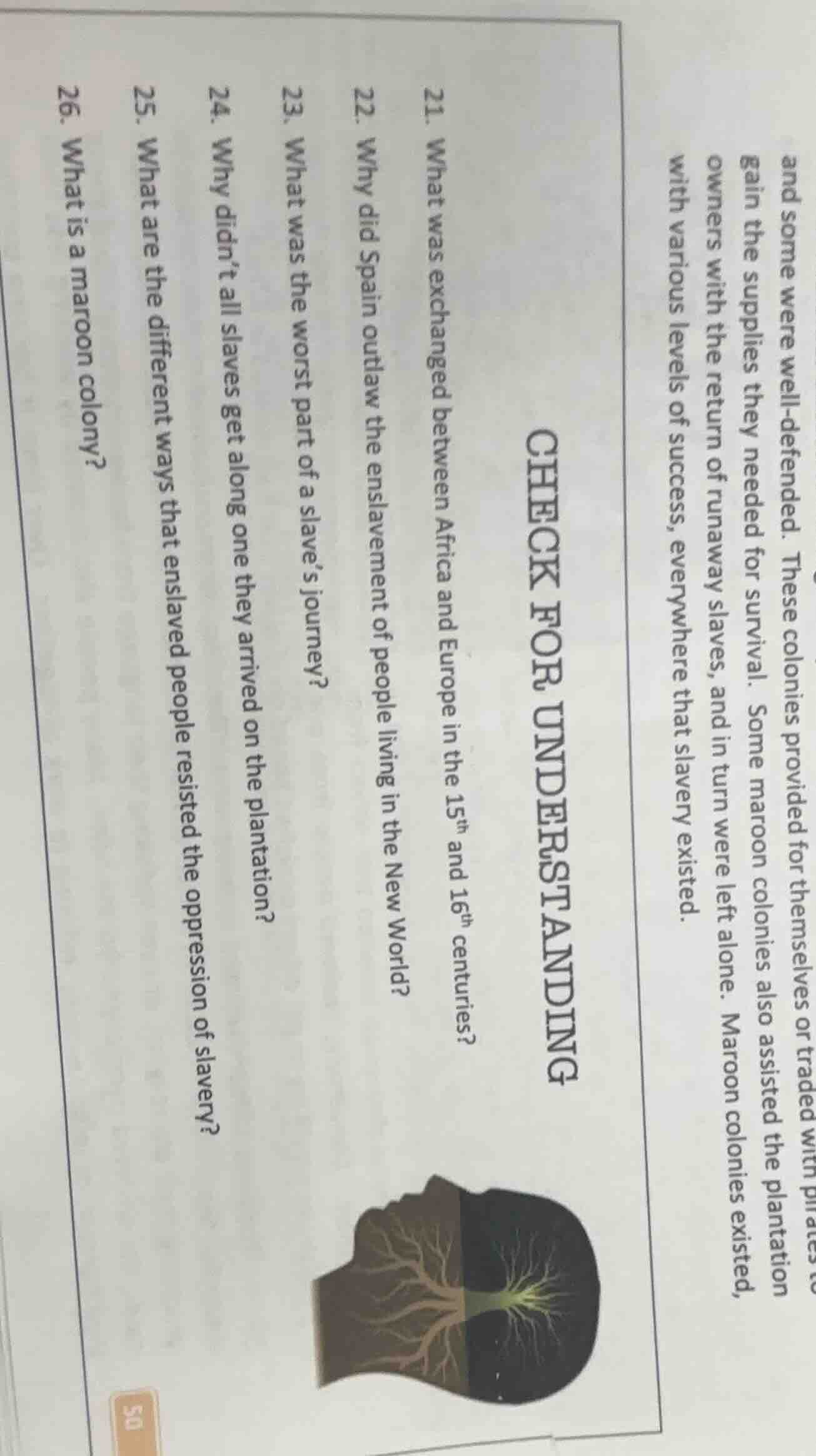
check for understanding 21. what was exchanged between africa and europe in the 15th and 16th centuries? 22. why did spain outlaw the enslavement of people living in the new world? 23. what was the worst part of a slave’s journey? 24. why didn’t all slaves get along one they arrived on the plantation? 25. what are the different ways that enslaved people resisted the oppression of slavery? 26. what is a maroon colony?
Brief Explanations
- In the 15th and 16th centuries, Europe exchanged manufactured goods (like guns, textiles, and metal tools) with Africa, while Africa supplied enslaved people, gold, and raw materials to Europe as part of the early transatlantic trade system.
- Spain did not outlaw enslavement of people in the New World; in fact, Spain was one of the earliest and most active European powers to establish and expand chattel slavery in its American colonies to support its plantation economies and extractive systems.
- The worst part of an enslaved person's journey (the Middle Passage) was the overcrowded, unsanitary conditions aboard slave ships, where people faced starvation, disease, physical abuse, and extremely high mortality rates.
- Enslaved people often came from different African ethnic groups, spoke different languages, and had distinct cultural backgrounds, which created barriers to immediate unity upon arrival. Additionally, slave owners intentionally separated groups to prevent organized resistance.
- Enslaved people resisted through passive acts (like work slowdowns, breaking tools, or feigning illness) and active acts (like running away, organizing uprisings, or sabotaging plantation operations).
- A maroon colony was a community established by escaped enslaved people, typically in remote, defensible areas. These colonies were self-sustaining, often traded with outside groups, and provided refuge for other runaway enslaved people.

Snap & solve any problem in the app
Get step-by-step solutions on Sovi AI
Photo-based solutions with guided steps
Explore more problems and detailed explanations
- Europe sent manufactured goods (guns, textiles, metal tools) to Africa; Africa sent enslaved people, gold, and raw materials to Europe.
- Spain did not outlaw enslavement in the New World; it expanded and relied on chattel slavery for colonial economies.
- The Middle Passage: overcrowded, deadly ship conditions with abuse, disease, and high death rates.
- They came from diverse African groups with different languages/cultures, and slave owners divided them to prevent unity.
- Passive resistance (work slowdowns, tool-breaking) and active resistance (runaways, uprisings, sabotage).
- A self-sustaining, defensible community of escaped enslaved people, often in remote areas, that provided refuge and sometimes traded with outside groups.