QUESTION IMAGE
Question
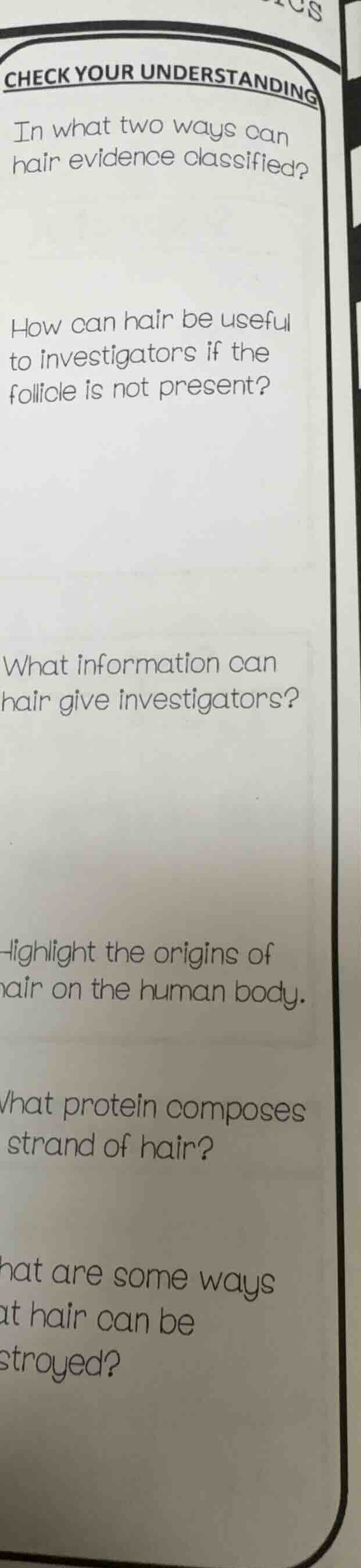
check your understanding
in what two ways can hair evidence classified?
how can hair be useful to investigators if the follicle is not present?
what information can hair give investigators?
highlight the origins of hair on the human body.
what protein composes strand of hair?
what are some ways that hair can be destroyed?
1. In what two ways can hair evidence be classified?
Hair evidence can be classified as either human hair or animal hair. Another way is by its stage of growth (anagen, catagen, telogen) or by its morphological characteristics (e.g., color, texture, structure like cuticle, cortex, medulla patterns). The two primary classification ways often focus on origin (human/animal) and growth stage or morphological traits.
Even without the follicle (which contains DNA), hair still has value. Its morphological features (cuticle scale pattern, cortex pigment distribution, medulla type) can link it to a species (e.g., human vs. animal) or narrow down to a group (e.g., hair texture, color matching a suspect). Chemical analysis of the hair shaft (e.g., drug residues, heavy metals) can reveal past exposures or drug use, aiding in investigations.
Hair provides multiple insights:
- Biological origin: Human vs. animal, or hair type (e.g., head, pubic, facial).
- Physical traits: Color, texture, length (suggesting grooming habits or ethnicity clues).
- Forensic clues: Presence of drugs/toxins (via chemical analysis), trauma (e.g., cut marks from scissors), or linkage (morphology matching a crime scene to a suspect). If the follicle is present, DNA can identify an individual; without it, morphological/chemical data still helps.
- Environmental info: Exposure to chemicals (e.g., pesticides, pollutants) or dietary clues (via stable isotope analysis).

Snap & solve any problem in the app
Get step-by-step solutions on Sovi AI
Photo-based solutions with guided steps
Explore more problems and detailed explanations
Hair evidence can be classified in two ways: 1. By origin (human hair or animal hair); 2. By growth stage (anagen, catagen, telogen) or morphological characteristics (e.g., cuticle, cortex, medulla patterns, color, texture).