QUESTION IMAGE
Question
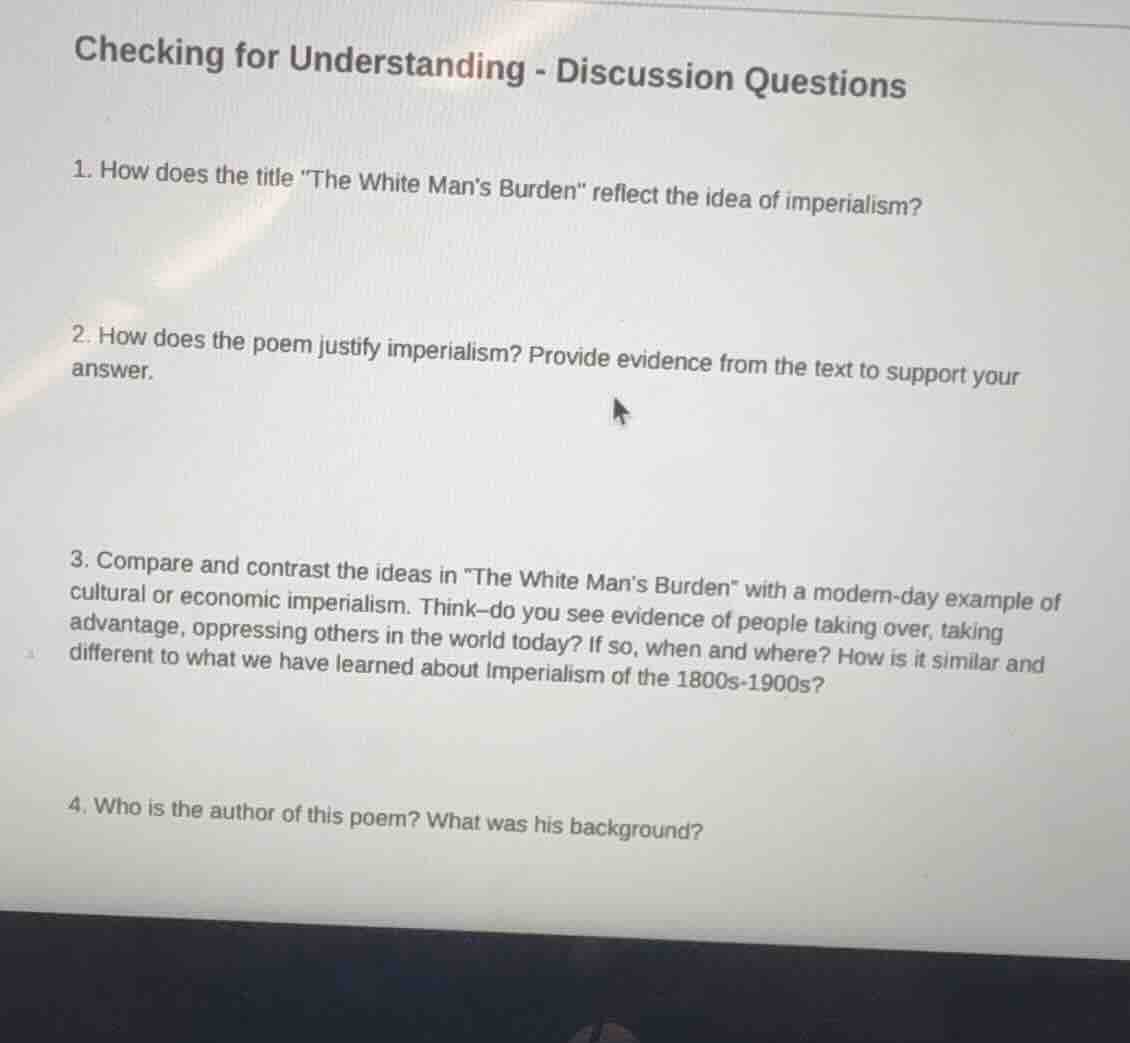
checking for understanding - discussion questions
- how does the title \the white mans burden\ reflect the idea of imperialism?
- how does the poem justify imperialism? provide evidence from the text to support your answer.
- compare and contrast the ideas in \the white mans burden\ with a modern - day example of cultural or economic imperialism. think - do you see evidence of people taking over, taking advantage, oppressing others in the world today? if so, when and where? how is it similar and different to what we have learned about imperialism of the 1800s - 1900s?
- who is the author of this poem? what was his background?
Brief Explanations
- The title frames imperial control as a "burden"—a supposed moral duty of white nations to govern and "civilize" non-white, colonized peoples, which is a core ideological pillar of 19th-20th century imperialism that justified territorial and cultural domination.
- The poem justifies imperialism by framing colonized people as "sullen peoples, half-devil and half-child," portraying them as needing the guidance of white colonizers. It positions imperial rule as a selfless, difficult duty ("To seek another’s profit, / And work another’s gain") rather than an exploitative project, framing the colonizer as sacrificing for the colonized's "betterment."
- For example, modern economic imperialism via multinational corporations (MNCs) in Global South nations is similar: it involves powerful entities extracting resources or exploiting cheap labor, asserting dominance over weaker economies. It differs from 1800s-1900s formal imperialism because it rarely uses direct political control (no colonial governments) and often operates through trade policies, debt, and corporate influence instead of military occupation. Evidence can be seen in MNCs in Southeast Asian garment industries, where workers are paid low wages for goods sold at high profits in Western nations—this is exploitation like colonial resource extraction, but without formal territorial rule.
- The author is Rudyard Kipling, a British writer born in India. He grew up in colonial India, had deep ties to the British Empire, and his works often reflected and promoted the imperial ideology of the "civilizing mission" that justified British colonial rule.

Snap & solve any problem in the app
Get step-by-step solutions on Sovi AI
Photo-based solutions with guided steps
Explore more problems and detailed explanations
- It frames imperialism as a supposed moral, self-sacrificing duty of white nations to "civilize" non-white peoples, a key imperial ideology.
- It portrays colonized peoples as uncivilized ("half-devil and half-child") and frames imperial rule as a selfless, necessary duty to guide them, with lines like "To seek another’s profit, / And work another’s gain" casting exploitation as benevolence.
- Similarity: Modern economic imperialism (e.g., Western MNCs exploiting low-wage labor in the Global South) involves powerful groups extracting benefits from weaker ones, like 19th-century colonial resource theft. Difference: 1800s-1900s imperialism used formal political/colonial rule, while modern forms rely on trade policies, debt, and corporate power without direct territorial control. An example is garment MNCs in Bangladesh, where workers earn poverty wages for goods sold for high profits in Western countries.
- Rudyard Kipling. He was a British author born in colonial India, raised with strong ties to the British Empire, and his work promoted the imperial "civilizing mission" ideology.