QUESTION IMAGE
Question
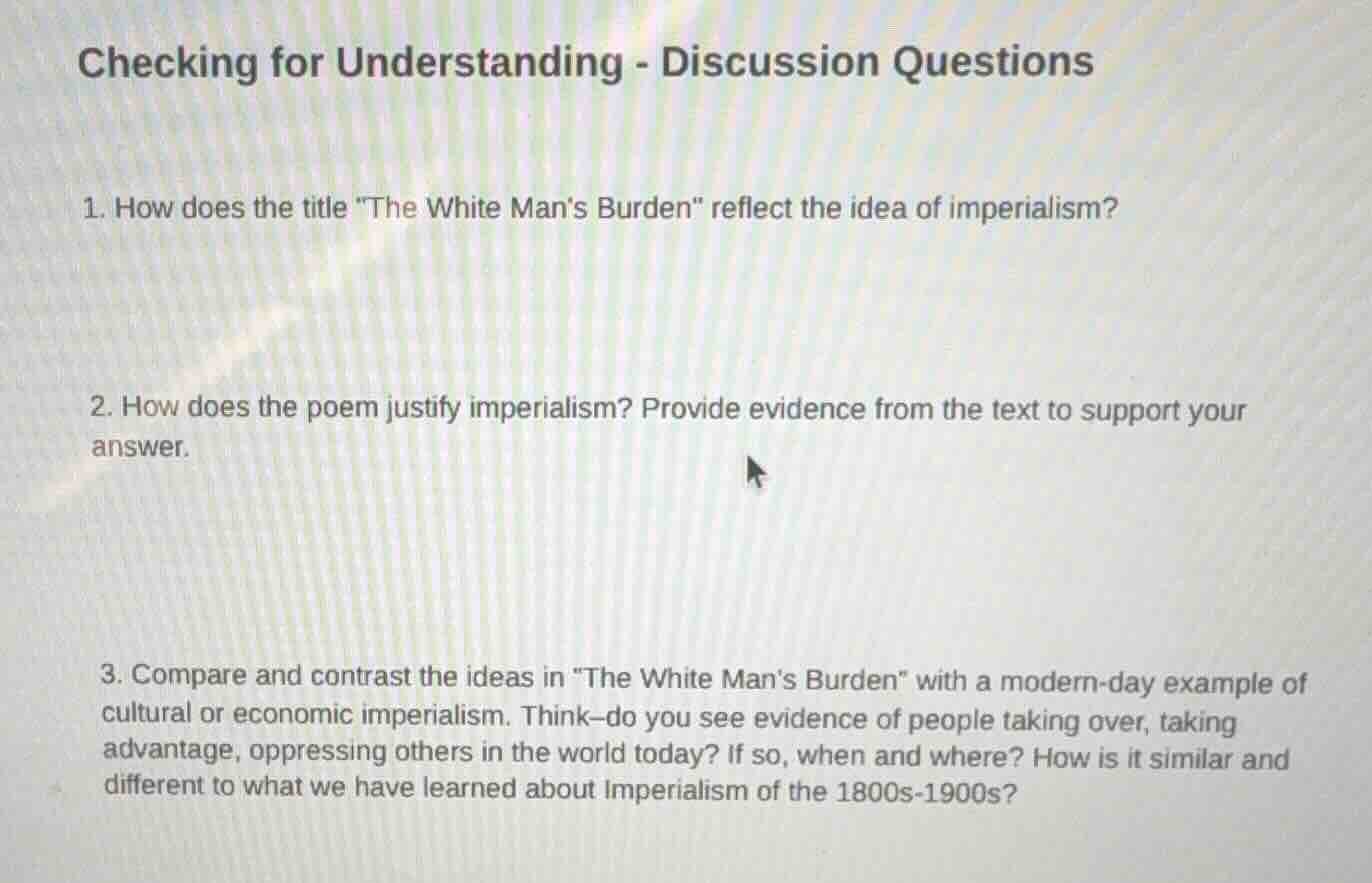
checking for understanding - discussion questions
- how does the title \the white mans burden\ reflect the idea of imperialism?
- how does the poem justify imperialism? provide evidence from the text to support your answer.
- compare and contrast the ideas in \the white mans burden\ with a modern - day example of cultural or economic imperialism. think - do you see evidence of people taking over, taking advantage, oppressing others in the world today? if so, when and where? how is it similar and different to what we have learned about imperialism of the 1800s - 1900s?
Brief Explanations
- The title frames imperial control as a "burden"—a supposed moral duty of white nations to govern and "civilize" non-white, colonized peoples. This mirrors the core imperial ideology of framing domination as a benevolent, necessary mission rather than exploitation.
- The poem justifies imperialism by framing colonized people as "sullen peoples, half-devil and half-child," framing imperial rule as a mission to lift these groups out of their supposed backwardness. Lines like "To seek another’s profit, / And work another’s gain" also frame imperial economic extraction as a selfless act, casting the colonizer as a sacrificing benefactor rather than an exploiter.
- A modern example is economic imperialism via multinational corporations in developing nations. Similar to the 1800s-1900s imperialism, it involves powerful entities extracting resources/wealth from less powerful regions. Differences include that modern economic imperialism often operates through corporate structures and trade policies rather than direct political rule, and it may be framed as "economic development" rather than a "civilizing burden." Evidence can be seen in low-wage manufacturing in Southeast Asia, where corporations exploit cheap labor and weak regulations to maximize profits, mirroring the resource extraction of 19th-century imperialism but without formal colonial governance.

Snap & solve any problem in the app
Get step-by-step solutions on Sovi AI
Photo-based solutions with guided steps
Explore more problems and detailed explanations
- The title reflects imperialism by framing the domination of non-white peoples as a supposed moral, self-sacrificing duty of white nations, which was a core ideological justification for imperial expansion and control.
- The poem justifies imperialism by portraying colonized peoples as uncivilized ("half-devil and half-child") and framing imperial rule as a benevolent mission to "civilize" them, while casting imperial economic exploitation as selfless service (e.g., lines about working "another’s gain").
- Modern example: Economic imperialism via Western multinational corporations in low-income countries. Similarity: Both involve powerful groups extracting wealth/advantage from less powerful regions, framed as beneficial to the dominated group. Difference: 1800s-1900s imperialism used direct political colonial rule, while modern economic imperialism operates through corporate and trade systems without formal territorial control. Evidence can be found in garment manufacturing in Bangladesh, where Western brands pay extremely low wages to access cheap labor, mirroring 19th-century resource extraction but without formal colonial governance.