QUESTION IMAGE
Question
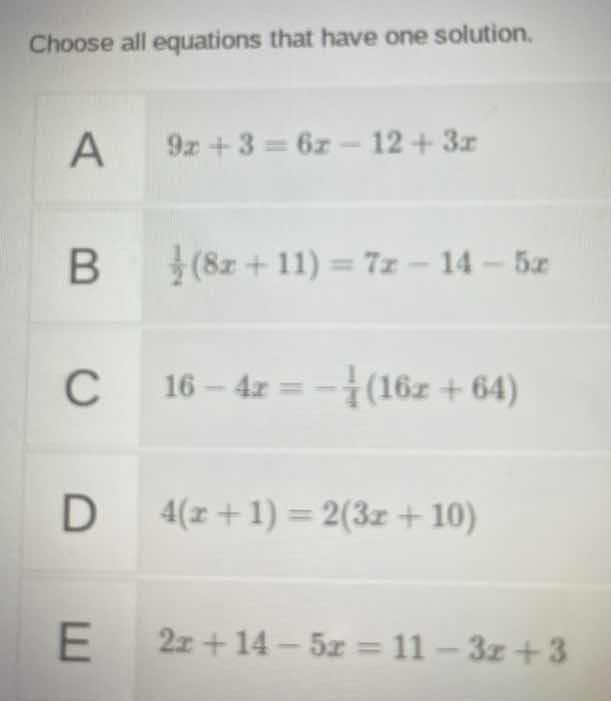
choose all equations that have one solution.
a $9x + 3 = 6x - 12 + 3x$
b $\frac{1}{2}(8x + 11) = 7x - 14 - 5x$
c $16 - 4x = -\frac{1}{4}(16x + 64)$
d $4(x + 1) = 2(3x + 10)$
e $2x + 14 - 5x = 11 - 3x + 3$
Step1: Analyze Equation A
Simplify the right - hand side: \(6x - 12+3x=9x - 12\). The equation becomes \(9x + 3=9x - 12\). Subtract \(9x\) from both sides: \(3=- 12\), which is false. So Equation A has no solution.
Step2: Analyze Equation B
First, simplify both sides. The left - hand side: \(\frac{1}{2}(8x + 11)=4x+\frac{11}{2}\). The right - hand side: \(7x-14 - 5x = 2x-14\). Now the equation is \(4x+\frac{11}{2}=2x - 14\). Subtract \(2x\) from both sides: \(2x+\frac{11}{2}=-14\). Subtract \(\frac{11}{2}\) from both sides: \(2x=-14-\frac{11}{2}=-\frac{28 + 11}{2}=-\frac{39}{2}\). Divide both sides by 2: \(x =-\frac{39}{4}\). So Equation B has one solution.
Step3: Analyze Equation C
Simplify the right - hand side: \(-\frac{1}{4}(16x + 64)=-4x-16\). The equation becomes \(16-4x=-4x - 16\). Add \(4x\) to both sides: \(16=-16\), which is false. So Equation C has no solution.
Step4: Analyze Equation D
Expand both sides. Left - hand side: \(4(x + 1)=4x + 4\). Right - hand side: \(2(3x + 10)=6x+20\). The equation is \(4x + 4=6x+20\). Subtract \(4x\) from both sides: \(4 = 2x+20\). Subtract 20 from both sides: \(2x=-16\). Divide by 2: \(x=-8\). So Equation D has one solution.
Step5: Analyze Equation E
Simplify both sides. Left - hand side: \(2x + 14-5x=-3x + 14\). Right - hand side: \(11-3x + 3=-3x + 14\). The equation becomes \(-3x + 14=-3x + 14\). Subtract \(-3x\) from both sides: \(14 = 14\), which is always true. So Equation E has infinitely many solutions.

Snap & solve any problem in the app
Get step-by-step solutions on Sovi AI
Photo-based solutions with guided steps
Explore more problems and detailed explanations
B. \(\frac{1}{2}(8x + 11)=7x - 14 - 5x\), D. \(4(x + 1)=2(3x + 10)\)