QUESTION IMAGE
Question
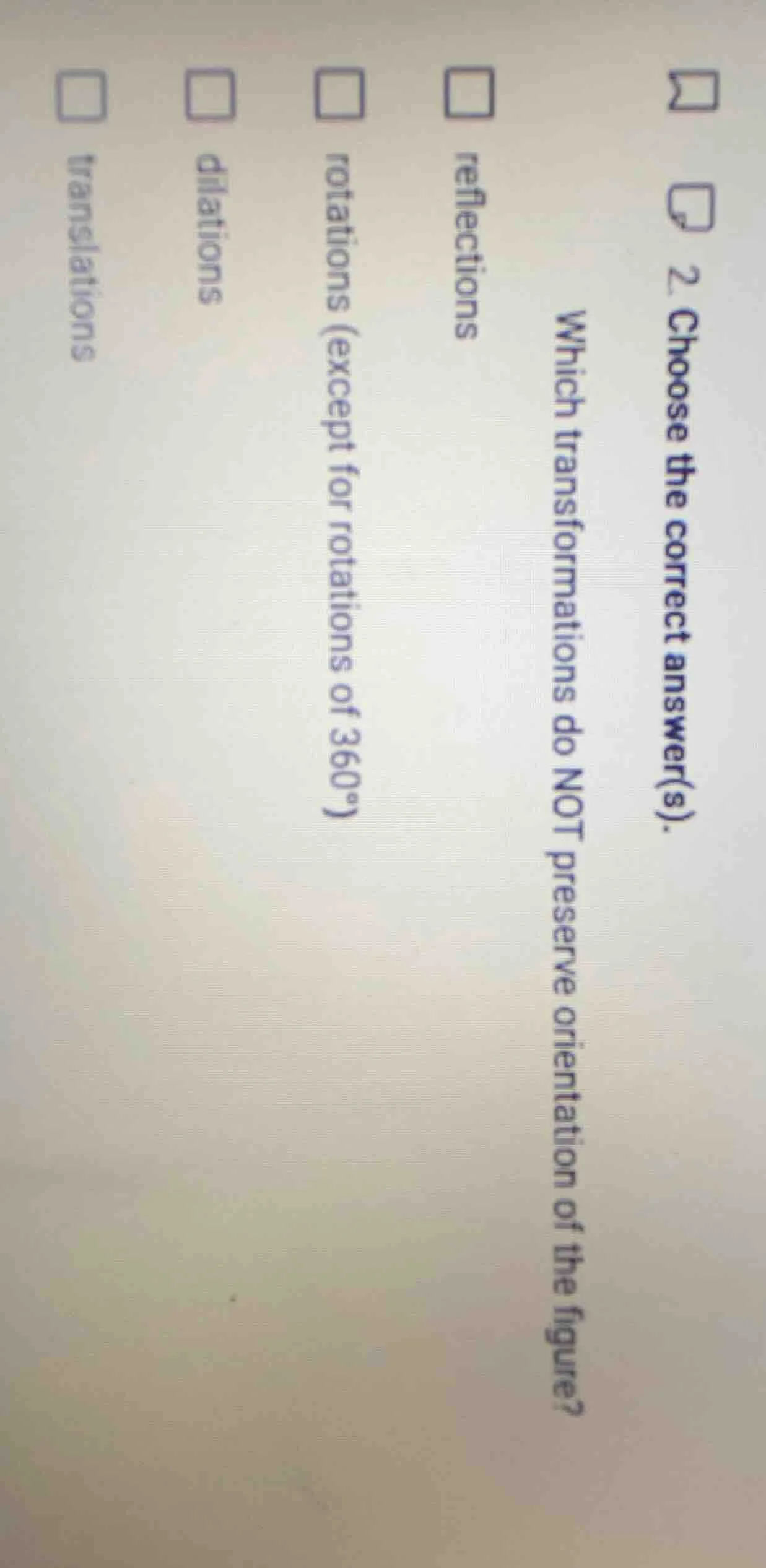
2 choose the correct answer(s). which transformations do not preserve orientation of the figure? reflections rotations (except for rotations of 360°) dilations translations
Brief Explanations
- Recall the concept of orientation preservation in transformations:
- Reflections: A reflection (like flipping a figure over a line) reverses the orientation. For example, if you have a triangle with vertices labeled in clockwise order, after a reflection, the order becomes counter - clockwise (or vice - versa).
- Rotations (except 360°): Rotations by angles other than 360° are rigid transformations that preserve orientation. A 360° rotation brings the figure back to its original position, and non - 360° rotations just rotate the figure around a point without reversing the order of the vertices' orientation.
- Dilations: Dilations are non - rigid transformations that change the size of the figure but do not change the orientation. The relative order of the vertices (clockwise or counter - clockwise) remains the same.
- Translations: Translations are rigid transformations that slide the figure without changing its orientation. The order of the vertices' orientation is preserved.
- Based on the above analysis, reflections are the transformations that do not preserve the orientation of the figure. Also, note that the question might have a mis - option or maybe a mis - understanding, but from the given options, reflections are the ones that reverse orientation. Wait, also, actually, in some cases, people might consider that rotations (except 360°) - no, rotations preserve orientation. Wait, maybe the options are:
- Reflections: Reverse orientation.
- Rotations (except 360°): Preserve orientation.
- Dilations: Preserve orientation (only change size).
- Translations: Preserve orientation (only change position).
Wait, maybe there is a mistake in the options, but according to the standard knowledge of geometric transformations:
- Reflections: Do not preserve orientation (they are orientation - reversing).
- Also, if we consider the options again, maybe the intended answer is reflections. But let's re - check:
- A reflection is a transformation that flips the figure over a line. This flipping changes the orientation of the figure. For example, if you write the word "MOM" on a piece of paper and reflect it over a vertical line, the image will be a mirror - image, and the orientation (the order of the letters' direction) is reversed.
- Rotations (except 360°) are like turning the figure around a point. For example, rotating a triangle 90° around a point will keep the clockwise or counter - clockwise order of its vertices intact (just in a different position).
- Dilations: If you dilate a triangle with a scale factor, the angles remain the same, and the clockwise or counter - clockwise order of the vertices also remains the same.
- Translations: Sliding the figure does not change the orientation of the figure. The order of the vertices' orientation is preserved.
So the transformation that does not preserve orientation is reflections.

Snap & solve any problem in the app
Get step-by-step solutions on Sovi AI
Photo-based solutions with guided steps
Explore more problems and detailed explanations
A. reflections