QUESTION IMAGE
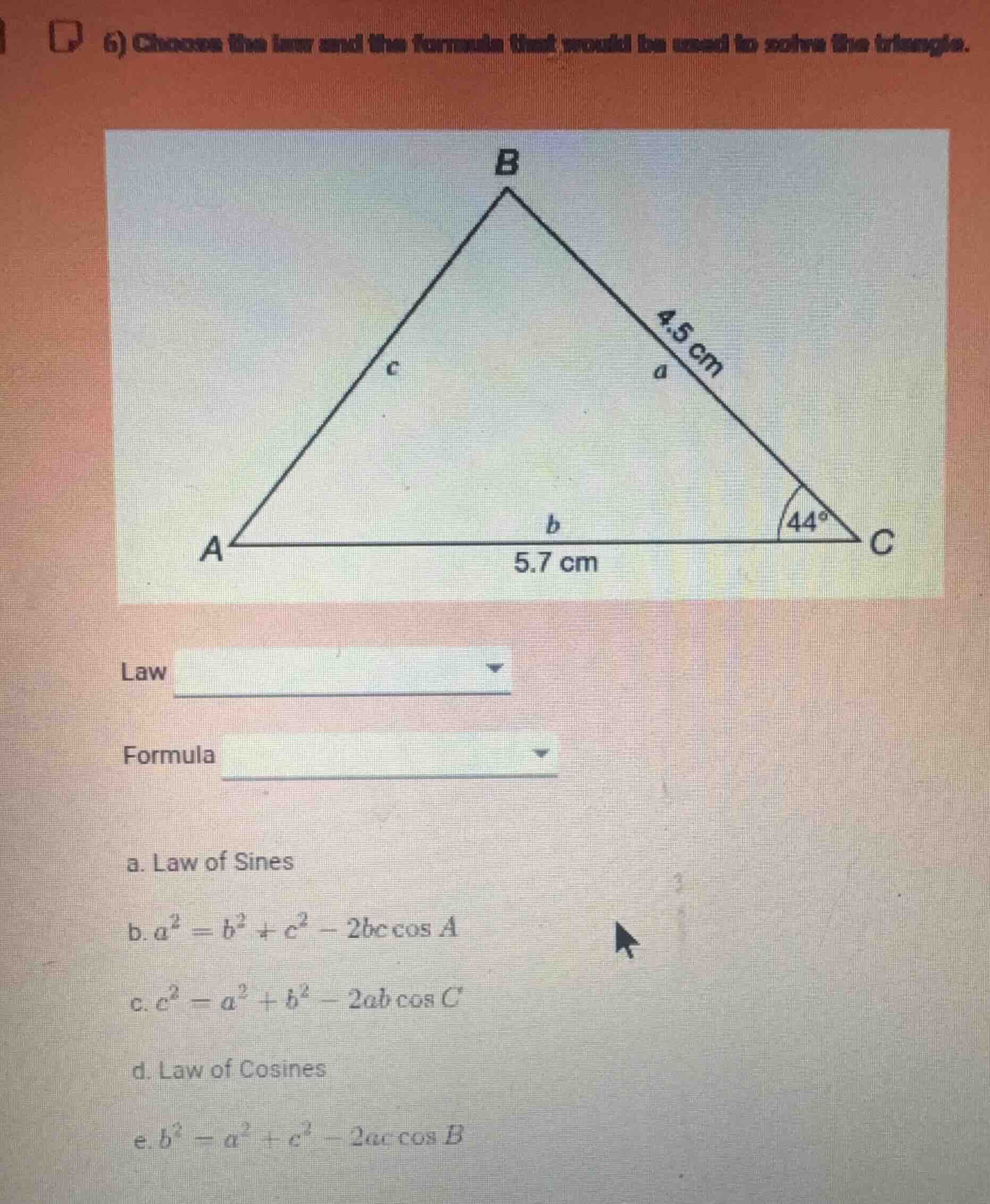
Question
- choose the law and the formula that would be used to solve the triangle.
law
formula
a. law of sines
b. $a^2 = b^2 + c^2 - 2bccos a$
c. $c^2 = a^2 + b^2 - 2abcos c$
d. law of cosines
e. $b^2 = a^2 + c^2 - 2accos b$
Step1: Analyze the triangle's given information
We have triangle \(ABC\) with side \(a = 4.5\) cm, side \(b = 5.7\) cm, and angle \(C = 44^\circ\). We need to solve the triangle, which likely involves finding unknown sides or angles. The Law of Cosines relates the lengths of the sides of a triangle to the cosine of one of its angles. The formula for the Law of Cosines is \(c^{2}=a^{2}+b^{2}-2ab\cos C\) (or other variations depending on the angle), and the Law of Sines is \(\frac{a}{\sin A}=\frac{b}{\sin B}=\frac{c}{\sin C}\). Here, we have two sides and the included angle? Wait, no, angle \(C\) is between sides \(a\) and \(b\)? Wait, in standard notation, side \(a\) is opposite angle \(A\), side \(b\) opposite angle \(B\), side \(c\) opposite angle \(C\). Wait, in the diagram, side \(BC\) is \(a = 4.5\) cm, side \(AC\) is \(b = 5.7\) cm, angle at \(C\) is \(44^\circ\). So we have two sides \(a = 4.5\), \(b = 5.7\), and the included angle? No, angle \(C\) is between sides \(a\) (BC) and \(b\) (AC), so the side opposite angle \(B\) is \(b\)? Wait, maybe I mixed up. Wait, the Law of Cosines formula when we know two sides and the included angle: if we know sides \(a\) and \(c\) and angle \(B\) between them, then \(b^{2}=a^{2}+c^{2}-2ac\cos B\). But in our case, we have sides \(a = 4.5\) (BC), \(b = 5.7\) (AC), and angle \(C = 44^\circ\) (at \(C\), between \(a\) and \(b\)? Wait, no, side \(AB\) is \(c\), side \(BC\) is \(a\), side \(AC\) is \(b\). So angle at \(C\) is between sides \(a\) (BC) and \(b\) (AC), so the side opposite angle \(B\) is \(b\)? Wait, maybe the correct formula here is the Law of Cosines. The Law of Cosines is used when we have two sides and the included angle, or three sides. Here, we have two sides (\(a = 4.5\), \(b = 5.7\)) and the angle between them? Wait, no, angle at \(C\) is between \(a\) (BC) and \(b\) (AC), so the side opposite angle \(B\) is \(b\)? Wait, maybe the formula \(b^{2}=a^{2}+c^{2}-2ac\cos B\) is not. Wait, let's check the options. The Law of Cosines is option d, and the formula options: option e is \(b^{2}=a^{2}+c^{2}-2ac\cos B\)? Wait, no, in the diagram, side \(AC\) is \(b = 5.7\) cm, side \(BC\) is \(a = 4.5\) cm, angle at \(C\) is \(44^\circ\). Wait, maybe I made a mistake. Wait, the Law of Cosines formula for angle \(C\): \(c^{2}=a^{2}+b^{2}-2ab\cos C\). But in the options, option c is \(c^{2}=a^{2}+b^{2}-2ab\cos C\), and option e is \(b^{2}=a^{2}+c^{2}-2ac\cos B\). Wait, maybe the side we want to find is \(b\)? No, side \(AC\) is \(b = 5.7\) cm? Wait, no, the diagram shows \(AC\) as \(b = 5.7\) cm, \(BC\) as \(a = 4.5\) cm, angle at \(C\) is \(44^\circ\). So we have two sides \(a = 4.5\), \(b = 5.7\), and angle \(C = 44^\circ\). Wait, no, maybe the side we need to find is \(c\) (AB) or angle \(A\) or \(B\). Wait, the Law of Cosines is used here because we have two sides and the included angle? Wait, angle \(C\) is between sides \(a\) (BC) and \(b\) (AC), so the side opposite angle \(C\) is \(c\) (AB). So to find \(c\), we can use \(c^{2}=a^{2}+b^{2}-2ab\cos C\), which is option c. But also, the Law is Law of Cosines (option d). Wait, let's check the options again. The Law options are a (Law of Sines) and d (Law of Cosines). The formula options are b, c, e. So first, determine the law: since we have two sides and the included angle (angle \(C\) between \(a\) and \(b\)), we use Law of Cosines (d). Then the formula: for angle \(C\), the formula is \(c^{2}=a^{2}+b^{2}-2ab\cos C\) (option c), but wait, in the diagram, side \(AC\) is \(b = 5.7\) cm, side \(BC\) is \(a = 4.5\) cm, angle at \(C\)…

Snap & solve any problem in the app
Get step-by-step solutions on Sovi AI
Photo-based solutions with guided steps
Explore more problems and detailed explanations
Law: d. Law of Cosines
Formula: c. \(c^{2}=a^{2}+b^{2}-2ab\cos C\)