QUESTION IMAGE
Question
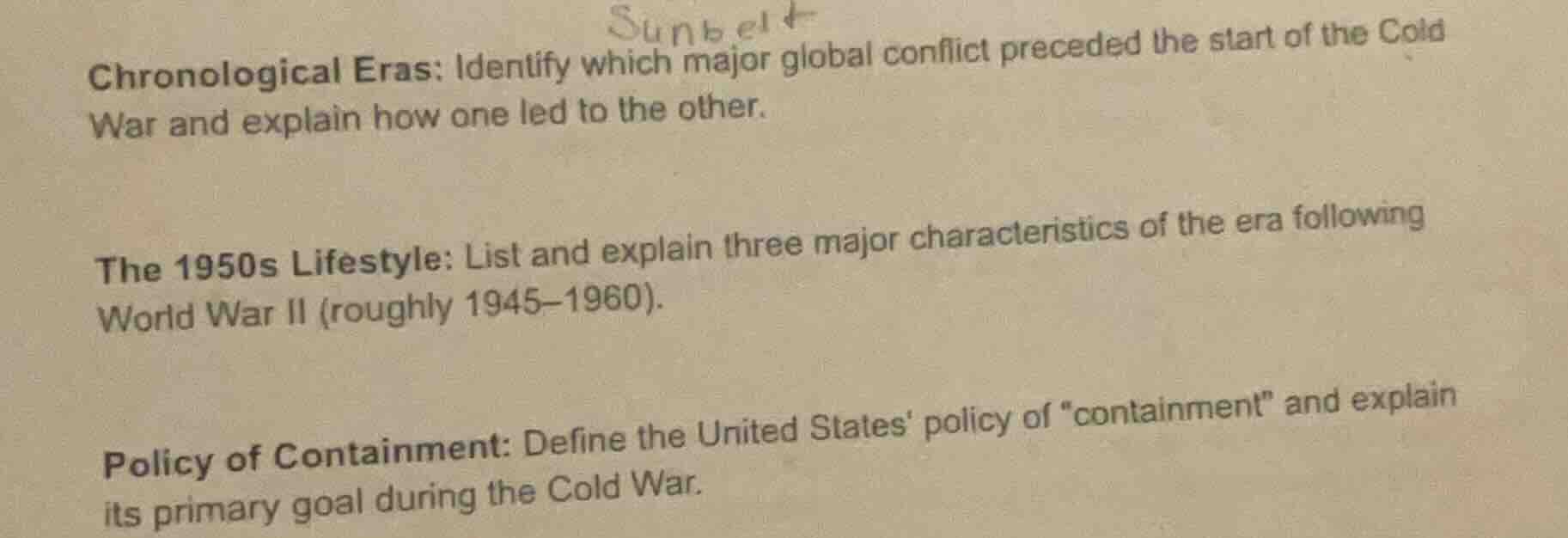
chronological eras: identify which major global conflict preceded the start of the cold war and explain how one led to the other.
the 1950s lifestyle: list and explain three major characteristics of the era following world war ii (roughly 1945–1960).
policy of containment: define the united states policy of \containment\ and explain its primary goal during the cold war.
1. Chronological Eras
World War II ended in 1945, and its aftermath directly set the stage for the Cold War. The Allied victory split Europe into spheres of influence, with the U.S.-led Western bloc and Soviet-led Eastern bloc competing for power. Post-war tensions over Germany's division, Soviet expansion in Eastern Europe, and ideological clashes between capitalism and communism escalated into the prolonged Cold War rivalry.
2. The 1950s Lifestyle
- Suburbanization: Post-WWII economic boom, GI Bill benefits, and affordable housing led millions to move from cities to planned suburban communities, promoting a nuclear family-centric, consumer-focused lifestyle.
- Rise of Consumer Culture: Increased disposable income, mass production, and advertising fueled demand for household appliances, automobiles, and other consumer goods, driving economic growth.
- Conformity and Traditional Gender Roles: Society emphasized strict social norms, with women expected to focus on homemaking and child-rearing, while men served as primary breadwinners, reflecting a push for stability after wartime upheaval.
3. Policy of Containment
Containment was a U.S. foreign policy strategy. It aimed to prevent the spread of Soviet communism globally, rather than directly attacking existing communist regimes. The primary goal was to limit Soviet influence through economic aid, military alliances, and diplomatic pressure, maintaining a balance of power and protecting U.S. capitalist interests and allies.

Snap & solve any problem in the app
Get step-by-step solutions on Sovi AI
Photo-based solutions with guided steps
Explore more problems and detailed explanations
- Chronological Eras: The major global conflict preceding the Cold War is World War II. WWII's end created a power vacuum in Europe; the U.S. and USSR emerged as superpowers with opposing ideologies. Soviet control over Eastern Europe, the division of Germany, and mutual distrust led to the sustained geopolitical rivalry of the Cold War.
- The 1950s Lifestyle:
- Suburbanization: Mass migration to planned suburbs, enabled by economic prosperity and housing policies, centered on nuclear family life.
- Consumer Culture: Surge in demand for mass-produced goods, driven by rising disposable income and advertising.
- Social Conformity: Strict gender roles and social norms prioritizing stability after wartime disruption.
- Policy of Containment: Containment was a U.S. Cold War policy defined as the strategic effort to stop the spread of Soviet communism. Its primary goal was to limit Soviet expansion across the globe to protect U.S. interests, capitalist allies, and maintain global power balance.