QUESTION IMAGE
Question
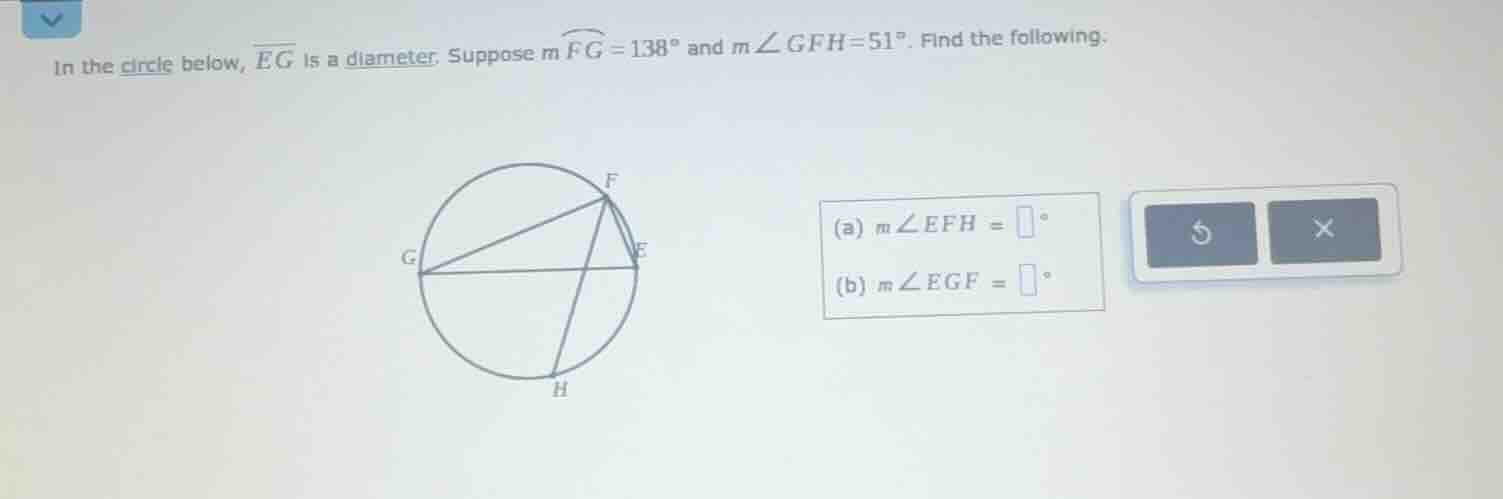
in the circle below, \\(\overline{eg}\\) is a diameter. suppose \\(m\overarc{fg} = 138^\circ\\) and \\(m\angle gfh = 51^\circ\\). find the following. (a) \\(m\angle efh = \square^\circ\\) (b) \\(m\angle egf = \square^\circ\\)
Part (a)
Step1: Find measure of arc FE
Since \( EG \) is a diameter, the measure of arc \( E G \) is \( 180^\circ \). Given \( m\overarc{FG} = 138^\circ \), then \( m\overarc{FE}=180^\circ - 138^\circ=42^\circ \).
Step2: Use inscribed angle theorem for \( \angle EHF \)
Wait, actually \( \angle EFH \): Wait, no, let's re - examine. Wait, \( \angle GFH = 51^\circ \), and we can find \( \angle EFH \) by first finding \( \angle EFG \). Wait, \( \angle EFG \) is an inscribed angle subtended by arc \( FE \). The measure of an inscribed angle is half the measure of its subtended arc. So \( m\angle EFG=\frac{1}{2}m\overarc{FE} \). Since \( m\overarc{FE} = 42^\circ \), \( m\angle EFG = 21^\circ \). Wait, no, maybe another approach. Wait, \( \angle GFH = 51^\circ \), and we want \( \angle EFH \). Wait, actually, \( \angle EFH=\angle GFH-\angle GFE \)? No, that's not right. Wait, let's start over.
Since \( EG \) is a diameter, \( \angle EFG = 90^\circ \)? No, \( \angle EFG \): Wait, no, \( \triangle EFG \): Wait, \( \angle EFG \) is an inscribed angle over arc \( EG \)? No, \( EG \) is a diameter, so arc \( EG \) is \( 180^\circ \). Wait, maybe I made a mistake. Let's use the fact that \( \angle GFH = 51^\circ \), and we can find \( \angle EFH \) as follows:
First, find the measure of arc \( EH \). Wait, no, let's look at \( \angle EFH \). Wait, the sum of \( \angle EFH \) and \( \angle GFH \) is related to the arcs. Wait, actually, \( \angle EFG \) is an inscribed angle over arc \( EG \) (which is \( 180^\circ \)), so \( \angle EFG = 90^\circ \). Wait, no, \( \angle EFG \) is not over arc \( EG \). Arc \( EG \) is the diameter, so any angle subtended by \( EG \) on the circle is a right angle. So \( \angle EFG = 90^\circ \)? No, \( \angle EFG \): The angle at \( F \) between \( EF \) and \( FG \). Wait, \( EG \) is a diameter, so \( \angle EFG = 90^\circ \) (angle inscribed in a semicircle). Then, since \( \angle GFH = 51^\circ \), then \( \angle EFH=\angle EFG-\angle GFH \). Since \( \angle EFG = 90^\circ \), \( \angle EFH = 90^\circ - 51^\circ=39^\circ \)? Wait, no, that can't be. Wait, maybe my initial assumption about \( \angle EFG \) is wrong.
Wait, let's use the arc measures. The measure of arc \( FG = 138^\circ \), arc \( FE=180 - 138 = 42^\circ \). The inscribed angle over arc \( FE \) is \( \angle FGE \), but we need \( \angle EFH \). Wait, \( \angle GFH = 51^\circ \), and \( \angle EFH \): Let's find the measure of arc \( EH \). Wait, no, let's use the fact that \( \angle EFH \) is an inscribed angle. Wait, maybe the correct approach is:
We know that \( m\overarc{FG}=138^\circ \), so \( m\overarc{FE} = 180 - 138=42^\circ \). The inscribed angle \( \angle FGE \) (which is \( \angle EGF \)) is half of arc \( FE \), so \( m\angle EGF=\frac{1}{2}m\overarc{FE} = 21^\circ \). Then, for \( \angle EFH \):
Since \( \angle GFH = 51^\circ \), and we can find \( \angle EFH \) as follows: In \( \triangle FGH \) or something? Wait, no, let's look at the angles at \( F \). The angle \( \angle EFH \): Let's consider that \( \angle EFG \) is an inscribed angle over arc \( EG \) (180°), so \( \angle EFG = 90^\circ \). Then \( \angle EFH=\angle EFG-\angle GFH \). Since \( \angle EFG = 90^\circ \) and \( \angle GFH = 51^\circ \), then \( \angle EFH=90 - 51 = 39^\circ \). Wait, but let's check with the arc. The measure of \( \angle EFH \) is half the measure of arc \( EH \). Wait, maybe I messed up. Let's do part (b) first.
Part (b)
Step1: Find measure of arc \( FE \)
Since \( EG \) is a diameter, \( m\overarc{EG}=180^\circ \). Given \( m\overarc{FG} = 138^\circ \), then \( m\overarc{FE}=m\overarc{EG}-m\overarc{FG}=180^\circ - 138^\circ = 42^\circ \).
Step2: Use inscribed angle theorem for \( \angle EGF \)
The measure of an inscribed angle is half the measure of its subtended arc. \( \angle EGF \) is an inscribed angle subtended by arc \( FE \). So \( m\angle EGF=\frac{1}{2}m\overarc{FE} \). Substituting \( m\overarc{FE} = 42^\circ \), we get \( m\angle EGF=\frac{1}{2}\times42^\circ = 21^\circ \).
Now, going back to part (a):
Step1: Recall that \( \angle EFG = 90^\circ \) (angle inscribed in a semicircle, since \( EG \) is a diameter)
Step2: Calculate \( \angle EFH \)
We know that \( \angle EFG=\angle EFH+\angle GFH \). We know \( \angle EFG = 90^\circ \) and \( \angle GFH = 51^\circ \). So \( \angle EFH=\angle EFG-\angle GFH=90^\circ - 51^\circ = 39^\circ \).

Snap & solve any problem in the app
Get step-by-step solutions on Sovi AI
Photo-based solutions with guided steps
Explore more problems and detailed explanations
(a) \( \boldsymbol{39} \)
(b) \( \boldsymbol{21} \)