QUESTION IMAGE
Question
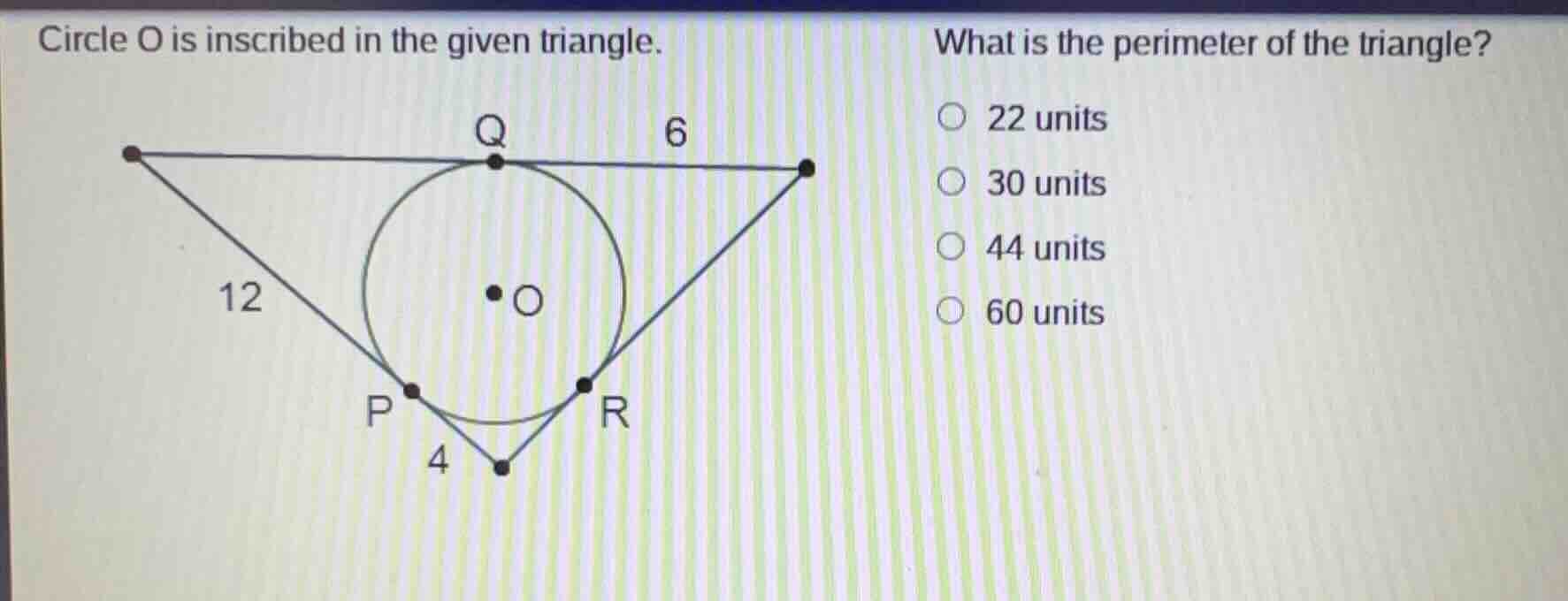
circle o is inscribed in the given triangle. what is the perimeter of the triangle? 22 units 30 units 44 units 60 units
Step1: Recall tangent segment theorem
Tangent segments from a single external point to a circle are congruent. Let the triangle be \( \triangle ABC \) with circle \( O \) inscribed, touching the sides at \( Q \), \( P \), \( R \). Let the vertices be \( A \) (opposite \( Q \)), \( B \) (opposite \( P \)), \( C \) (opposite \( R \)). The tangent from \( C \) to the circle has length 6 (segment \( CQ \)) and the tangent from \( B \) to the circle has length 4 (segment \( BP \)). The tangent from \( A \) to the circle has length 12 (segment \( AP \)).
Step2: Find lengths of all sides
- Side \( AC \): The two tangent segments from \( A \) and \( C \) to the circle. The tangent from \( A \) is 12, and from \( C \) is 6. Wait, no, actually, for a triangle with an incircle, if we denote the tangent lengths from each vertex as \( x \), \( y \), \( z \), then the sides are \( x + y \), \( y + z \), \( z + x \). Wait, let's label correctly. Let the vertex with tangent length 4 be \( B \), so \( BP = BR = 4 \). The vertex with tangent length 6 be \( C \), so \( CQ = CR = 6 \). The vertex with tangent length 12 be \( A \), so \( AQ = AP = 12 \).
So side \( AB \): \( AQ + BQ \)? Wait, no, \( AQ = 12 \), \( BQ \) is not given, but \( BP = 4 \), \( AP = 12 \), so \( AB = AP + BP = 12 + 4 = 16 \)? Wait, no, maybe I messed up the labels. Wait, the triangle has three sides: let's say the side with length 12 is one tangent segment from vertex \( A \) to point \( P \), the side with length 4 is from vertex \( B \) to point \( P \), and the side with length 6 is from vertex \( C \) to point \( Q \). Then, by the tangent segment theorem:
- From \( A \): \( AP = AQ = 12 \)
- From \( B \): \( BP = BR = 4 \)
- From \( C \): \( CQ = CR = 6 \)
Now, the sides of the triangle:
- Side \( AB \): \( AP + BP = 12 + 4 = 16 \)
- Side \( BC \): \( BR + CR = 4 + 6 = 10 \)
- Side \( AC \): \( AQ + CQ = 12 + 6 = 18 \)? Wait, no, that can't be, because then perimeter would be 16 + 10 + 18 = 44? Wait, let's check again. Wait, maybe the side with length 12 is \( AQ \), the side with length 6 is \( CQ \), and the side with length 4 is \( BP \). Then:
Wait, the three sides of the triangle are:
- \( AB \): \( AP + BP = 12 + 4 = 16 \)
- \( BC \): \( BR + CR = 4 + 6 = 10 \)
- \( AC \): \( AQ + CQ = 12 + 6 = 18 \)
Wait, but 16 + 10 + 18 = 44. Let's verify:
Wait, maybe the correct way is:
Let the triangle have vertices \( X \), \( Y \), \( Z \). The incircle touches \( XY \) at \( Q \), \( YZ \) at \( R \), \( ZX \) at \( P \). Then:
- \( XQ = XP = 12 \)
- \( YR = YQ \)? No, \( YR = YP \)? Wait, no, tangent segments from a single point to the circle are equal. So from \( X \): \( XQ = XP = 12 \)
From \( Y \): \( YR = YQ \)? Wait, \( Y \) is the vertex with the tangent segment of length 4: \( YP = YR = 4 \)
From \( Z \): \( ZR = ZQ = 6 \)
Then, the sides:
- \( XY \): \( XQ + YQ = 12 + YQ \)? Wait, no, \( XQ \) is from \( X \) to \( Q \) on \( XY \), and \( YQ \) is from \( Y \) to \( Q \) on \( XY \). But \( Y \) has tangent segments \( YP \) and \( YR \), both 4. \( X \) has tangent segments \( XQ \) and \( XP \), both 12. \( Z \) has tangent segments \( ZR \) and \( ZQ \), both 6.
So side \( XY \): \( XQ + YQ \). But \( YQ \) is equal to \( YR \)? No, \( YQ \) is from \( Y \) to \( Q \) on \( XY \), and \( YR \) is from \( Y \) to \( R \) on \( YZ \). So \( YQ = YR = 4 \)? Wait, no, \( Y \) is connected to \( P \) and \( R \), so \( YP = YR = 4 \). \( X \) is connected to \( P \) and \( Q \), so \( XP = XQ = 12 \). \( Z \) is connected to \( Q \) and \( R \),…

Snap & solve any problem in the app
Get step-by-step solutions on Sovi AI
Photo-based solutions with guided steps
Explore more problems and detailed explanations
44 units