QUESTION IMAGE
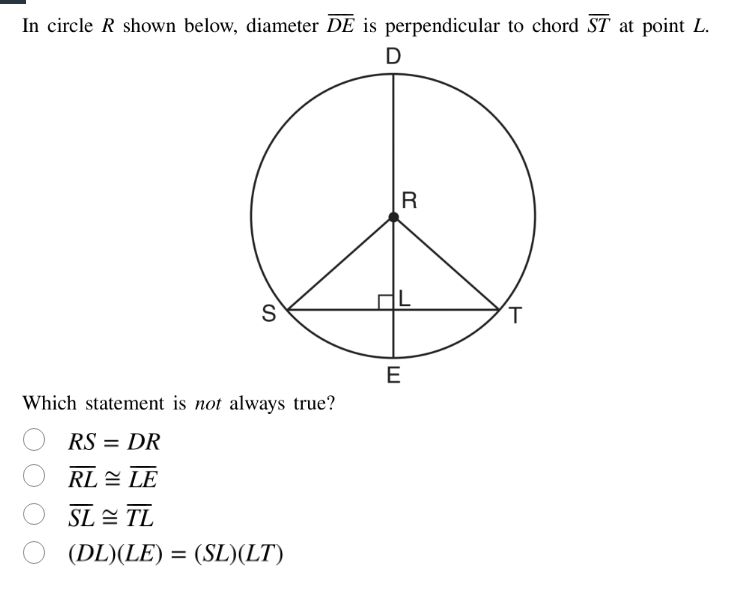
Question
in circle r shown below, diameter \\(\overline{de}\\) is perpendicular to chord \\(\overline{st}\\) at point l.
which statement is not always true?
\\( rs = dr \\)
\\( \overline{rl} \cong \overline{le} \\)
\\( \overline{sl} \cong \overline{tl} \\)
\\( (dl)(le) = (sl)(lt) \\)
Step1: Analyze $RS=DR$
$RS$ and $DR$ are both radii of circle $R$, so $RS=DR$ is always true.
Step2: Analyze $\overline{RL} \cong \overline{LE}$
$L$ is the foot of the perpendicular from $R$ to chord $\overline{ST}$, but $L$ only coincides with the midpoint of $\overline{DE}$ if $\overline{ST}$ is also a diameter. For any other chord $\overline{ST}$, $RL
eq LE$, so this is not always true.
Step3: Analyze $\overline{SL} \cong \overline{TL}$
A diameter perpendicular to a chord bisects the chord, so $\overline{SL} \cong \overline{TL}$ is always true.
Step4: Analyze $(DL)(LE)=(SL)(LT)$
By the intersecting chords theorem: if two chords intersect at $L$, then $(DL)(LE)=(SL)(LT)$, so this is always true.

Snap & solve any problem in the app
Get step-by-step solutions on Sovi AI
Photo-based solutions with guided steps
Explore more problems and detailed explanations
$\overline{RL} \cong \overline{LE}$