QUESTION IMAGE
Question
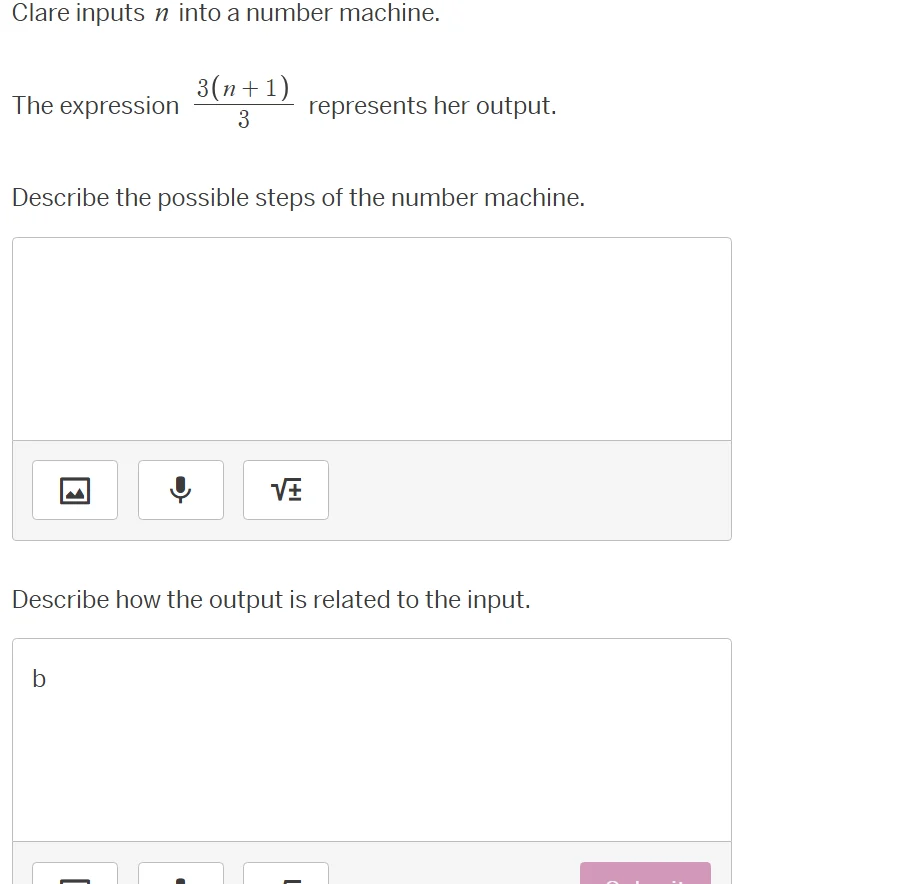
clare inputs n into a number machine.
the expression \\(\frac{3(n + 1)}{3}\\) represents her output.
describe the possible steps of the number machine.
describe how the output is related to the input.
b
Part 1: Describe the possible steps of the number machine
Step 1: Analyze the innermost operation
First, we look at the expression $\frac{3(n + 1)}{3}$. The innermost operation in the numerator is adding 1 to the input $n$. So the first step is to take the input $n$ and add 1 to it, which gives $n + 1$.
Step 2: Multiply by 3
Next, we multiply the result from Step 1 by 3. So we take $n + 1$ and multiply it by 3, which gives $3(n + 1)$.
Step 3: Divide by 3
Finally, we divide the result from Step 2 by 3. So we take $3(n + 1)$ and divide it by 3, which gives $\frac{3(n + 1)}{3}$.
Part 2: Describe how the output is related to the input
Let's simplify the expression $\frac{3(n + 1)}{3}$. The 3 in the numerator and the 3 in the denominator cancel each other out (since $\frac{3}{3}=1$). So when we simplify $\frac{3(n + 1)}{3}$, we get $n + 1$. This means that the output of the number machine is equal to the input $n$ plus 1.

Snap & solve any problem in the app
Get step-by-step solutions on Sovi AI
Photo-based solutions with guided steps
Explore more problems and detailed explanations
s:
- Steps of the number machine: First, add 1 to the input \( n \) to get \( n + 1 \). Then, multiply \( n + 1 \) by 3 to get \( 3(n + 1) \). Finally, divide \( 3(n + 1) \) by 3.
- Relationship between output and input: The output is equal to the input \( n \) plus 1 (because \(\frac{3(n + 1)}{3}=n + 1\)).