QUESTION IMAGE
Question
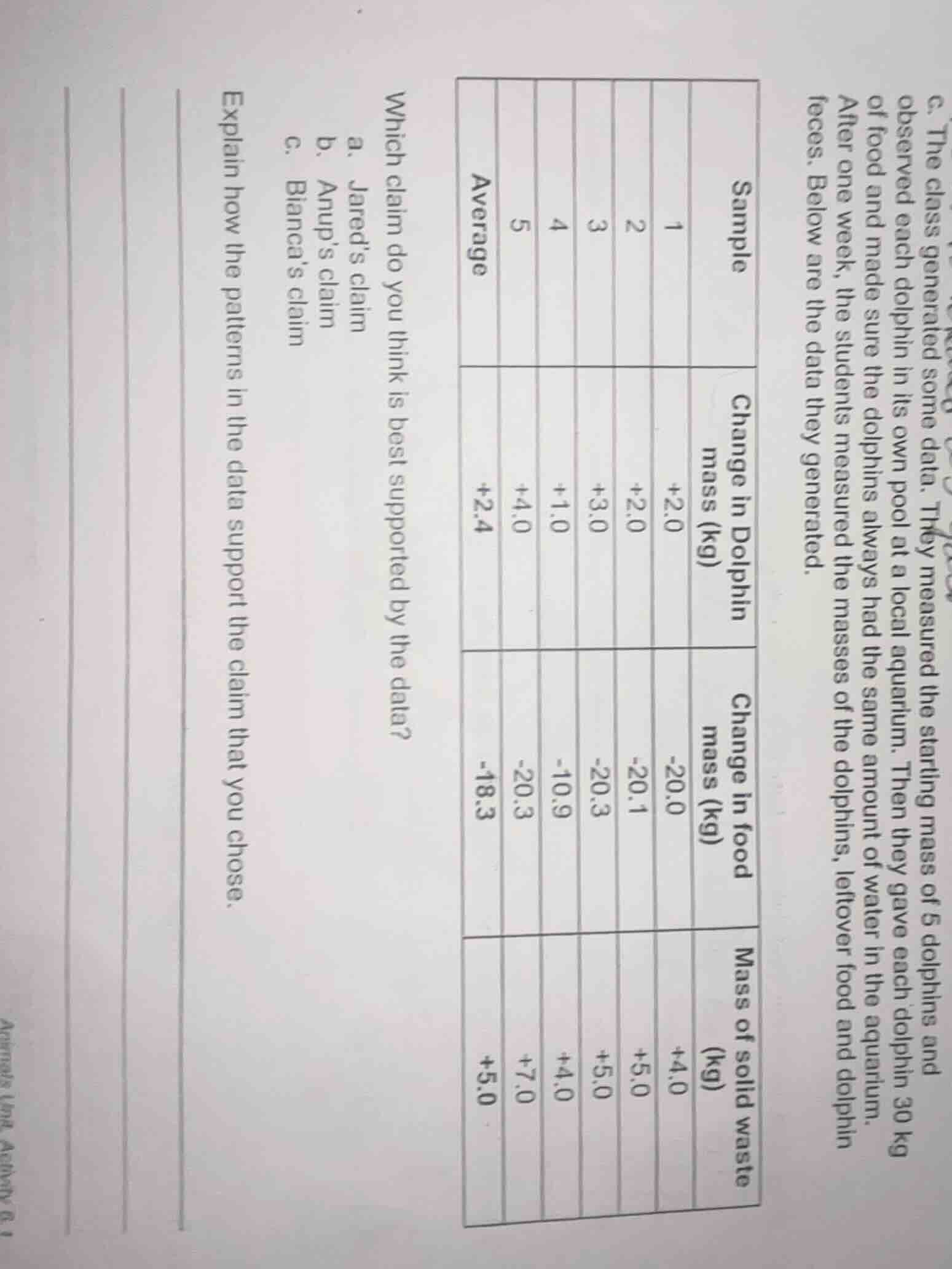
c. the class generated some data. they measured the starting mass of 5 dolphins and observed each dolphin in its own pool at a local aquarium. then they gave each dolphin 30 kg of food and made sure the dolphins always had the same amount of water in the aquarium. after one week, the students measured the masses of the dolphins, leftover food and dolphin feces. below are the data they generated.
| sample | change in dolphin mass (kg) | change in food mass (kg) | mass of solid waste (kg) |
|---|---|---|---|
| 2 | +2.0 | -20.1 | +5.0 |
| 3 | +3.0 | -20.3 | +5.0 |
| 4 | +1.0 | -10.9 | +4.0 |
| 5 | +4.0 | -20.3 | +7.0 |
| average | +2.4 | -18.3 | +5.0 |
which claim do you think is best supported by the data?
a. jared’s claim
b. anup’s claim
c. bianca’s claim
explain how the patterns in the data support the claim that you chose.
First, calculate the total mass output (dolphin mass gain + solid waste) for each sample and compare it to the mass of food consumed:
- Sample 1: $2.0 + 4.0 = 6.0$ kg; $30 - 20.0 = 10.0$ kg (food eaten). $6.0
eq 10.0$
- Sample 2: $2.0 + 5.0 = 7.0$ kg; $30 - 20.1 = 9.9$ kg. $7.0
eq 9.9$
- Sample 3: $3.0 + 5.0 = 8.0$ kg; $30 - 20.3 = 9.7$ kg. $8.0
eq 9.7$
- Sample 4: $1.0 + 4.0 = 5.0$ kg; $30 - 10.9 = 19.1$ kg. $5.0
eq 19.1$
- Sample 5: $4.0 + 7.0 = 11.0$ kg; $30 - 20.3 = 9.7$ kg. $11.0
eq 9.7$
- Average: $2.4 + 5.0 = 7.4$ kg; $30 - 18.3 = 11.7$ kg. $7.4
eq 11.7$
The data shows the mass of food eaten is not equal to the sum of dolphin mass gain and solid waste. This matches Anup's claim (implied to state that not all food mass is accounted for in those two outputs, as some mass is lost to other processes like respiration, urine, or energy use).

Snap & solve any problem in the app
Get step-by-step solutions on Sovi AI
Photo-based solutions with guided steps
Explore more problems and detailed explanations
b. Anup's claim