QUESTION IMAGE
Question
classe :
nom :
matière :
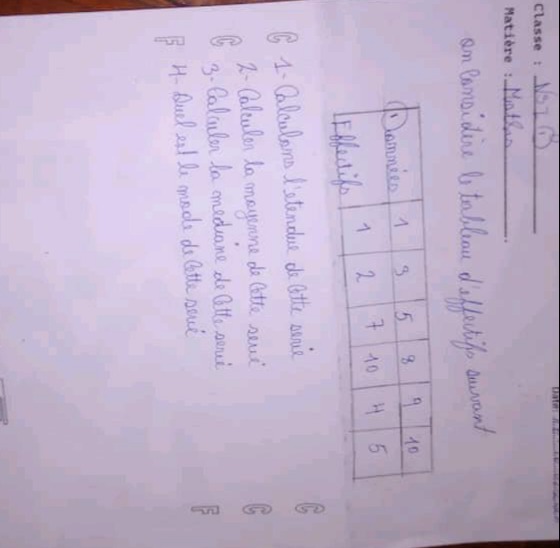
on considère le tableau deffectifs suivant
(1) nombre | effectifs
1 | 1
3 | 2
5 | 7
8 | 10
9 | 4
10 | 5
c 1- calculer létendue de cette série.
c 2- calculer la moyenne de cette série.
c 3- calculer la médiane de cette série.
f 4- quel est le mode de cette série ?
To solve the problems related to the given table (let's assume the table has two columns: "Nombre" (Number) and "Effectif" (Frequency) with values: Nombre: 1, 3, 5, 8, 9, 10; Effectif: 1, 2, 7, 10, 4, 5), we'll address each sub - question:
Sub - question A: Calculate the range of this series
Step 1: Recall the formula for the range
The range of a data series is calculated as the difference between the maximum value and the minimum value in the series. The formula is \( \text{Range}=\text{Maximum value}-\text{Minimum value} \).
Step 2: Identify the maximum and minimum values
From the "Nombre" column, the values are 1, 3, 5, 8, 9, 10. The minimum value (\( \text{Min} \)) is 1 and the maximum value (\( \text{Max} \)) is 10.
Step 3: Calculate the range
Using the formula, we have \( \text{Range}=10 - 1=9 \).
Sub - question B: Calculate the mean of this series
Step 1: Recall the formula for the mean (\( \bar{x} \))
The mean of a grouped (or ungrouped with frequencies) data series is given by \( \bar{x}=\frac{\sum_{i = 1}^{n}(x_{i}\times f_{i})}{\sum_{i = 1}^{n}f_{i}} \), where \( x_{i} \) are the values of the variable and \( f_{i} \) are their corresponding frequencies.
Step 2: Calculate \( \sum_{i = 1}^{n}(x_{i}\times f_{i}) \)
- For \( x_1 = 1 \) and \( f_1 = 1 \): \( x_1\times f_1=1\times1 = 1 \)
- For \( x_2 = 3 \) and \( f_2 = 2 \): \( x_2\times f_2=3\times2 = 6 \)
- For \( x_3 = 5 \) and \( f_3 = 7 \): \( x_3\times f_3=5\times7 = 35 \)
- For \( x_4 = 8 \) and \( f_4 = 10 \): \( x_4\times f_4=8\times10 = 80 \)
- For \( x_5 = 9 \) and \( f_5 = 4 \): \( x_5\times f_5=9\times4 = 36 \)
- For \( x_6 = 10 \) and \( f_6 = 5 \): \( x_6\times f_6=10\times5 = 50 \)
Now, sum these products: \( \sum(x_{i}\times f_{i})=1 + 6+35 + 80+36 + 50=208 \)
Step 3: Calculate the sum of frequencies (\( \sum f_{i} \))
\( \sum f_{i}=1 + 2+7 + 10+4 + 5=29 \)
Step 4: Calculate the mean
Using the formula for the mean, \( \bar{x}=\frac{208}{29}\approx7.17 \) (rounded to two decimal places)
Sub - question C: Calculate the median of this series
Step 1: Calculate the cumulative frequency
First, we create a cumulative frequency table:
| Nombre (\( x_i \)) | Effectif (\( f_i \)) | Cumulative Frequency (\( CF \)) |
|---|---|---|
| 3 | 2 | \( 1 + 2=3 \) |
| 5 | 7 | \( 3+7 = 10 \) |
| 8 | 10 | \( 10 + 10=20 \) |
| 9 | 4 | \( 20+4 = 24 \) |
| 10 | 5 | \( 24 + 5=29 \) |
Step 2: Find the position of the median
The total number of observations \( N=\sum f_{i}=29 \). The position of the median is \( \frac{N + 1}{2}=\frac{29+1}{2}=15^{th} \) observation.
Step 3: Identify the median class
We look at the cumulative frequency column. We need to find the class (here, the "Nombre" value) where the cumulative frequency is greater than or equal to 15.
- The cumulative frequency for \( x = 5 \) is 10 (less than 15)
- The cumulative frequency for \( x = 8 \) is 20 (greater than 15)
So, the median is the value of \( x \) corresponding to the cumulative frequency that first exceeds \( \frac{N + 1}{2} \), which is 8.
Sub - question D: Determine the mode of this series
The mode of a data series is the value that has the highest frequency.
Looking at the "Effectif" (frequency) column:
- The frequency of 1 is 1
- The frequency of 3 is 2
- The frequency of 5 is 7
- The frequency of 8 is 10
- The frequency of 9 is 4
- The frequency of 10 is 5
The highest frequency is 10, which corresponds to the "Nombre" value of 8. So, the mode is 8.

Snap & solve any problem in the app
Get step-by-step solutions on Sovi AI
Photo-based solutions with guided steps
Explore more problems and detailed explanations
s:
- Range: \( \boldsymbol{9} \)
- Mean: \( \boldsymbol{\approx7.17} \) (or \( \boldsymbol{\frac{208}{29}} \))
- Median: \( \boldsymbol{8} \)
- Mode: \( \boldsymbol{8} \)