QUESTION IMAGE
Question
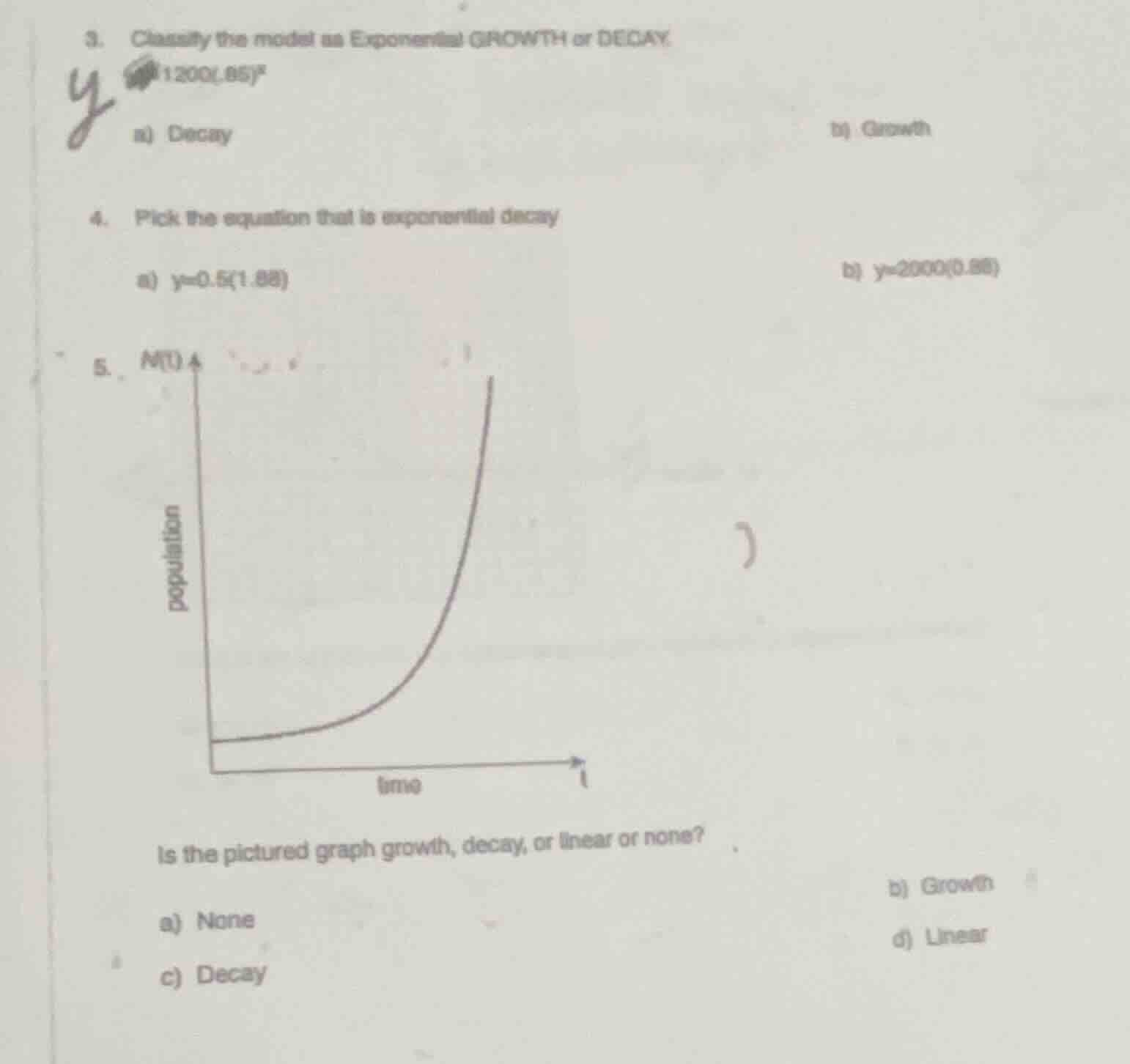
- classify the model as exponential growth or decay. \\( y = 1200(0.85)^x \\) \\( \text{a) decay} \\) \\( \text{b) growth} \\) \\( 4. \text{pick the equation that is exponential decay} \\) \\( \text{a) } y = 0.5(1.88) \\) \\( \text{b) } y = 2000(0.88) \\) \\( 5. \text{is the pictured graph growth, decay, or linear or none?} \\) \\( \text{a) none} \\) \\( \text{b) growth} \\) \\( \text{c) decay} \\) \\( \text{d) linear} \\)
Question 3
The general form of an exponential function is \( y = a(b)^x \). If \( 0 < b < 1 \), it's exponential decay; if \( b > 1 \), it's exponential growth. For \( y = 1200(0.85)^x \), \( b = 0.85 \) which is between 0 and 1, so it's decay.
For an exponential decay function \( y = a(b)^x \), \( 0 < b < 1 \). In option a, \( y = 0.5(1.88)^x \) has \( b = 1.88 > 1 \) (growth). In option b, \( y = 2000(0.88)^x \) has \( b = 0.88 \) (between 0 and 1), so it's decay.
The graph shows population over time. It's a curve that increases rapidly as time increases, which is characteristic of exponential growth (not linear, as linear is a straight line; decay would decrease over time).

Snap & solve any problem in the app
Get step-by-step solutions on Sovi AI
Photo-based solutions with guided steps
Explore more problems and detailed explanations
a) Decay