QUESTION IMAGE
Question
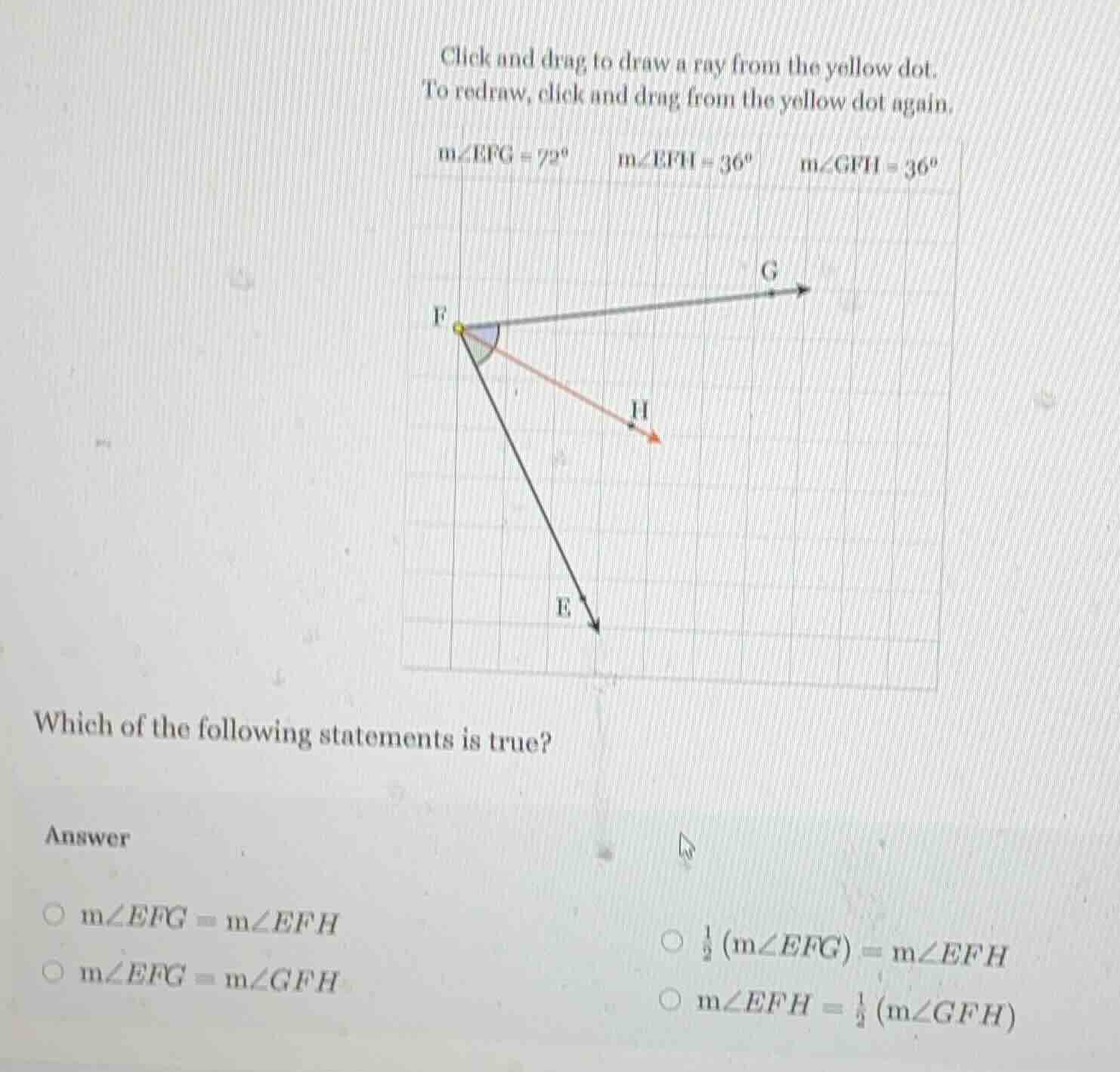
click and drag to draw a ray from the yellow dot. to redraw, click and drag from the yellow dot again. \\(\text{m}\angle efg = 72^\circ\\) \\(\text{m}\angle efh = 36^\circ\\) \\(\text{m}\angle gfh = 36^\circ\\) \\(\text{which of the following statements is true?}\\) \\(\text{answer}\\) \\(\circ\\) \\(\text{m}\angle efg = \text{m}\angle efh\\) \\(\circ\\) \\(\text{m}\angle efg = \text{m}\angle gfh\\) \\(\circ\\) \\(\frac{1}{2}(\text{m}\angle efg) = \text{m}\angle efh\\) \\(\circ\\) \\(\text{m}\angle efh = \frac{1}{2}(\text{m}\angle gfh)\\)
We are given \( m\angle EFG = 72^\circ \) and \( m\angle EFH = 36^\circ \). Let's check each option:
- For the first option: \( m\angle EFG = 72^\circ \) and \( m\angle EFH = 36^\circ \), so \( m\angle EFG
eq m\angle EFH \).
- For the second option: Calculate \( \frac{1}{2}(m\angle EFG) \). Substitute \( m\angle EFG = 72^\circ \), we get \( \frac{1}{2}\times72^\circ = 36^\circ \), which is equal to \( m\angle EFH = 36^\circ \). So this statement is true.
- For the third option: \( m\angle EFG = 72^\circ \) and \( m\angle GFH = 36^\circ \), so \( m\angle EFG
eq m\angle GFH \).
- For the fourth option: \( \frac{1}{2}(m\angle GFH)=\frac{1}{2}\times36^\circ = 18^\circ \), which is not equal to \( m\angle EFH = 36^\circ \).

Snap & solve any problem in the app
Get step-by-step solutions on Sovi AI
Photo-based solutions with guided steps
Explore more problems and detailed explanations
\(\frac{1}{2}(m\angle EFG)=m\angle EFH\) (the option with this statement)