QUESTION IMAGE
Question
close reading
classifying governments
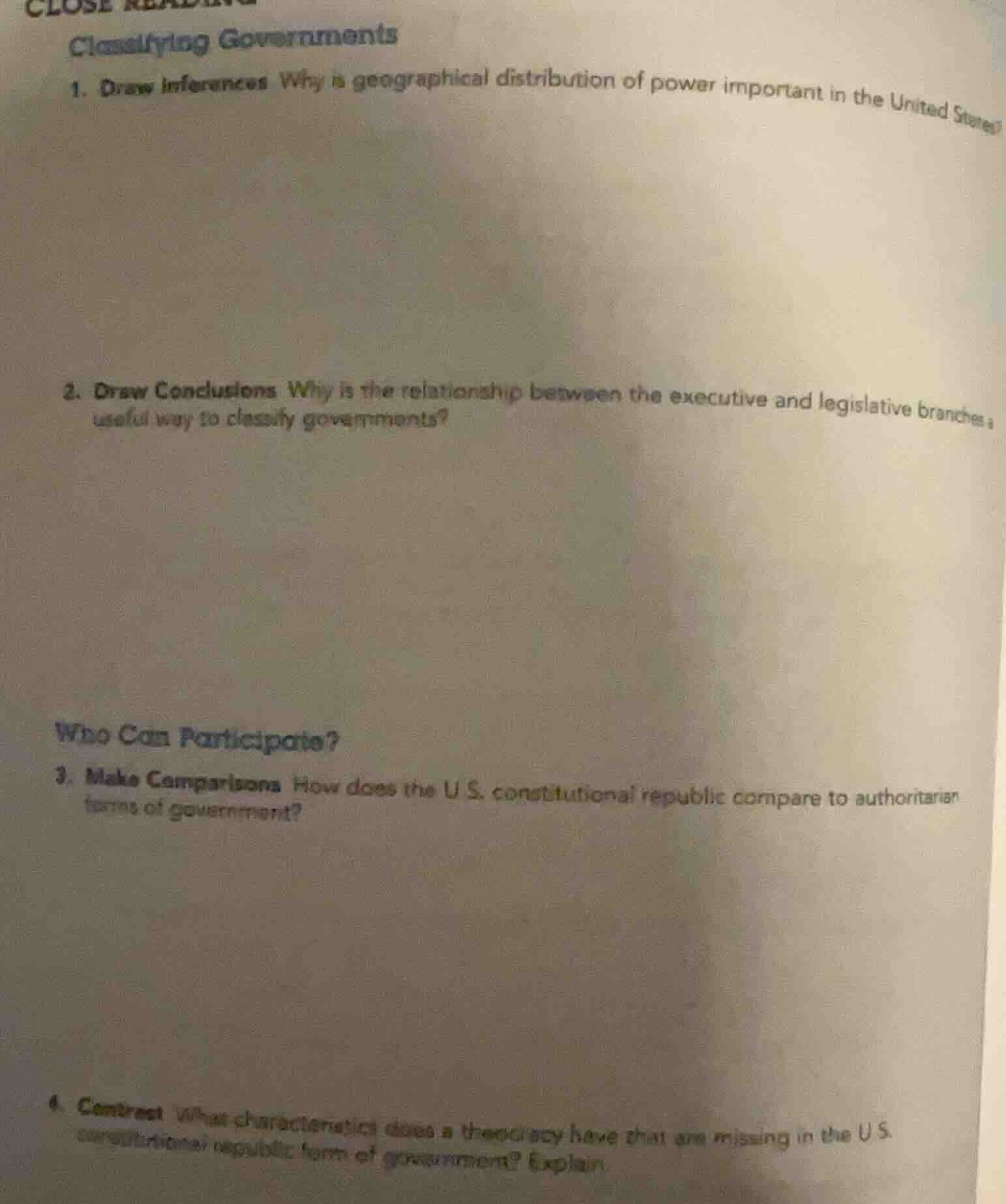
- draw inferences why is geographical distribution of power important in the united states?
- draw conclusions why is the relationship between the executive and legislative branches a useful way to classify governments?
who can participate?
- make comparisons how does the u.s. constitutional republic compare to authoritarian forms of government?
- contrast what characteristics does a theocracy have that are missing in the u.s. constitutional republic form of government? explain
Brief Explanations
- For the U.S., the geographical power distribution (federal system) balances national and state authority, protects local autonomy, prevents central overconcentration, and adapts to regional diversity.
- The executive-legislative relationship defines core government structure: it distinguishes systems like presidential (separate branches, checks and balances) vs parliamentary (fusion of powers), clarifies decision-making dynamics and accountability.
- A U.S. constitutional republic has elected representatives, a supreme constitution protecting individual rights, separation of powers, and free elections; authoritarian systems have unelected, unaccountable leadership, no meaningful checks on power, restricted political participation, and no guaranteed civil liberties.
- A theocracy centers rule on religious doctrine and religious authorities, with law tied to religious texts; the U.S. constitutional republic is secular, separates church and state, and bases governance on a secular constitution, not religious dogma.

Snap & solve any problem in the app
Get step-by-step solutions on Sovi AI
Photo-based solutions with guided steps
Explore more problems and detailed explanations
- It balances national/state power, protects local autonomy, prevents central overreach, and accommodates regional differences in the U.S.
- It defines core governance structure, distinguishing systems (presidential/parliamentary) and clarifying accountability/decision-making.
- U.S. constitutional republic: elected reps, supreme secular constitution, separation of powers, free elections, protected civil liberties. Authoritarian systems: unelected leadership, no checks on power, restricted participation, no guaranteed rights.
- Theocracies are ruled by religious doctrine/authorities, with law based on religious texts; the U.S. is secular, with church-state separation and governance tied to a secular constitution, not religious rules.