QUESTION IMAGE
Question
close reading
the presidents many roles
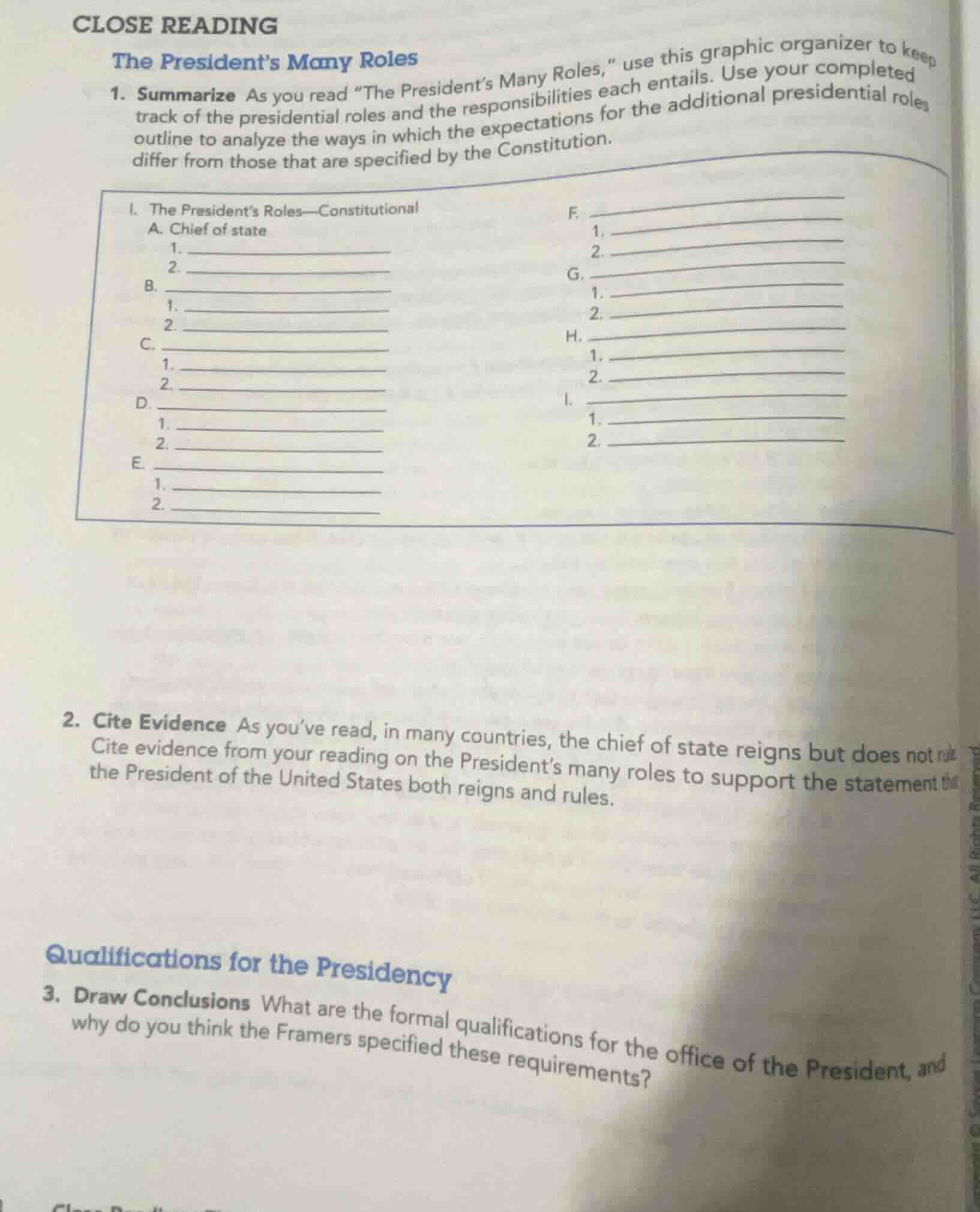
- summarize as you read \the presidents many roles,\ use this graphic organizer to keep track of the presidential roles and the responsibilities each entails. use your completed outline to analyze the ways in which the expectations for the additional presidential roles differ from those that are specified by the constitution.
i. the presidents roles—constitutional
a. chief of state
1.
2.
b.
1.
2.
c.
1.
2.
d.
1.
2.
e.
1.
2.
f.
1.
2.
g.
1.
2.
h.
1.
2.
i.
1.
2.
- cite evidence as youve read, in many countries, the chief of state reigns but does not rule. cite evidence from your reading on the presidents many roles to support the statement that the president of the united states both reigns and rules.
qualifications for the presidency
- draw conclusions what are the formal qualifications for the office of the president, and why do you think the framers specified these requirements?
Brief Explanations
- For the presidential roles graphic organizer: Constitutional roles are defined in the U.S. Constitution, while additional roles are evolved political expectations.
- For the "reigns and rules" claim: The U.S. President acts as ceremonial head (reigns) and has executive, legislative, and military power (rules).
- For presidential qualifications: Formal requirements set by the Framer ensure stability and competence.

Snap & solve any problem in the app
Get step-by-step solutions on Sovi AI
Photo-based solutions with guided steps
Explore more problems and detailed explanations
- Constitutional Presidential Roles & Responsibilities
A. Chief of state
- Serve as ceremonial U.S. head
- Represent nation at events
B. Chief Executive
- Enforce federal laws
- Appoint federal officials
C. Chief Legislator
- Propose congressional legislation
- Veto congressional bills
D. Commander in Chief
- Lead U.S. armed forces
- Direct military operations
E. Chief Diplomat
- Shape U.S. foreign policy
- Negotiate foreign treaties
Additional (Non-Constitutional) Roles & Responsibilities
F. Chief of Party
- Lead their political party
- Campaign for party candidates
G. Chief Citizen
- Represent public interests
- Model civic responsibility
H. Economic Planner
- Guide national economic policy
- Propose federal budget priorities
I. Crisis Manager
- Respond to national emergencies
- Coordinate disaster relief efforts
Key difference: Constitutional roles are legally mandated; additional roles are political/cultural expectations with no direct constitutional basis.
- Evidence for "reigns and rules":
- As Chief of State (reigns), the President performs ceremonial duties like greeting foreign leaders, laying wreaths at national memorials, and hosting state dinners—similar to a monarch's symbolic role.
- As Chief Executive, Commander in Chief, and Chief Legislator (rules), the President has the legal power to enforce laws, command the military, propose and veto legislation, and appoint key government officials—exercising active governing authority no ceremonial monarch possesses.
- Formal Qualifications for U.S. President:
- Be a natural-born U.S. citizen
- Be at least 35 years old
- Have resided in the U.S. for at least 14 years
Framer's Rationale:
- Natural-born citizenship: Ensures loyalty to the U.S. and avoids foreign influence over the executive branch.
- Age requirement: Ensures the candidate has sufficient life and professional experience to handle the office's demands.
- Residency rule: Ensures the candidate has a deep understanding of U.S. society, politics, and values.