QUESTION IMAGE
Question
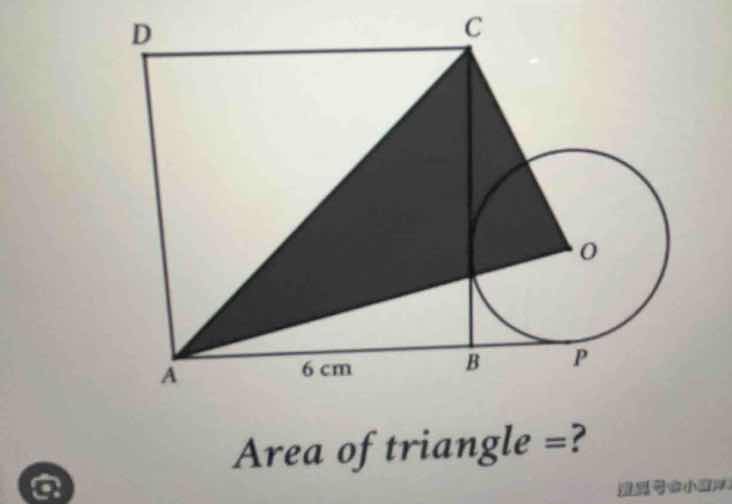
a 6 cm b p area of triangle =?
Step1: Identify the shape and formula
The figure shows a square (since \(AB = 6\) cm and \(ABCD\) looks like a square) and a triangle \( \triangle ACD \) or \( \triangle AC O\)? Wait, actually, for triangle \( \triangle AOC \)? No, wait, the key is that in a square \(ABCD\) with side \(6\) cm, the area of \( \triangle ACD \) or \( \triangle ACB \)? Wait, no, the shaded triangle: notice that the base and height of the triangle can be related to the square. The area of a triangle is \( \frac{1}{2} \times base \times height \). For \( \triangle ACD \), but wait, actually, the triangle \( \triangle AOC \) – no, wait, the square has side \(6\) cm, so \(AB = BC = 6\) cm. The triangle \( \triangle ACO \) – no, wait, the area of \( \triangle ACD \) is \( \frac{1}{2} \times 6 \times 6 = 18 \)? Wait, no, wait, the shaded triangle: actually, the triangle \( \triangle AOC \) – no, wait, the key is that the area of the triangle is half the area of the square. Wait, the square \(ABCD\) has side \(6\) cm, so area of square is \(6 \times 6 = 36\) cm². The triangle \( \triangle ACD \) (or \( \triangle ACB \)?) Wait, no, the shaded triangle: let's see, \(AC\) is the diagonal? No, wait, the triangle \( \triangle AOC \) – no, wait, the base and height: if we take \(AB\) as base (6 cm) and \(BC\) as height (6 cm), but no, the triangle is \( \triangle ACO \)? Wait, no, the correct approach: in a square, the area of a triangle with base equal to the side and height equal to the side is \( \frac{1}{2} \times side \times side \). Wait, the square has side \(6\) cm, so the area of the triangle (shaded) is \( \frac{1}{2} \times 6 \times 6 = 18 \) cm². Wait, let's confirm: the triangle \( \triangle ACD \) has base \(CD = 6\) cm and height \(AD = 6\) cm, so area is \( \frac{1}{2} \times 6 \times 6 = 18 \) cm². Alternatively, the triangle \( \triangle ACB \) would have base \(AB = 6\) and height \(BC = 6\), area \( \frac{1}{2} \times 6 \times 6 = 18 \) cm². So regardless, the area is \(18\) cm².
Step1: Recall the formula for the area of a triangle
The formula for the area of a triangle is \( A = \frac{1}{2} \times base \times height \).
Step2: Determine the base and height
In the square \(ABCD\), \(AB = 6\) cm and \(BC = 6\) cm (since it's a square). The triangle in question (shaded) has a base and height equal to the side of the square. So base \( = 6\) cm, height \( = 6\) cm.
Step3: Calculate the area
Substitute into the formula: \( A = \frac{1}{2} \times 6 \times 6 \)
\( A = \frac{1}{2} \times 36 \)
\( A = 18 \) cm².

Snap & solve any problem in the app
Get step-by-step solutions on Sovi AI
Photo-based solutions with guided steps
Explore more problems and detailed explanations
The area of the triangle is \(18\) square centimeters.