QUESTION IMAGE
Question
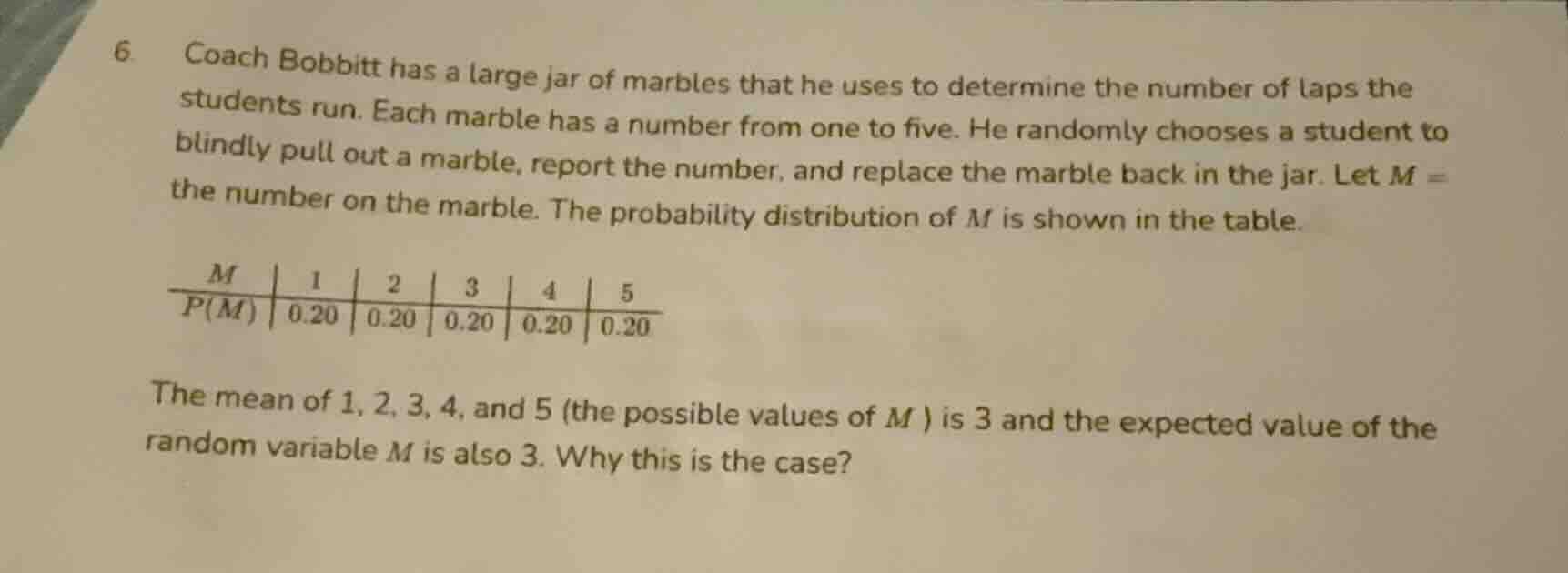
6 coach bobbitt has a large jar of marbles that he uses to determine the number of laps the students run. each marble has a number from one to five. he randomly chooses a student to blindly pull out a marble, report the number, and replace the marble back in the jar. let m = the number on the marble. the probability distribution of m is shown in the table. \\(\
\\) the mean of 1, 2, 3, 4, and 5 (the possible values of m ) is 3 and the expected value of the random variable m is also 3. why this is the case?
- The probability distribution of \(M\) is uniform: each value 1 through 5 has an identical probability of 0.20.
- For a uniform discrete distribution, the expected value formula \(E(M) = \sum [M \times P(M)]\) simplifies to the arithmetic mean of the possible values, since each term is weighted equally.
- The arithmetic mean of 1, 2, 3, 4, 5 is \(\frac{1+2+3+4+5}{5} = 3\), which matches the calculated expected value \(E(M) = (1\times0.20)+(2\times0.20)+(3\times0.20)+(4\times0.20)+(5\times0.20) = 3\).

Snap & solve any problem in the app
Get step-by-step solutions on Sovi AI
Photo-based solutions with guided steps
Explore more problems and detailed explanations
This occurs because the random variable \(M\) follows a uniform probability distribution, where each outcome has an equal probability, so its expected value equals the arithmetic mean of its possible values.