QUESTION IMAGE
Question
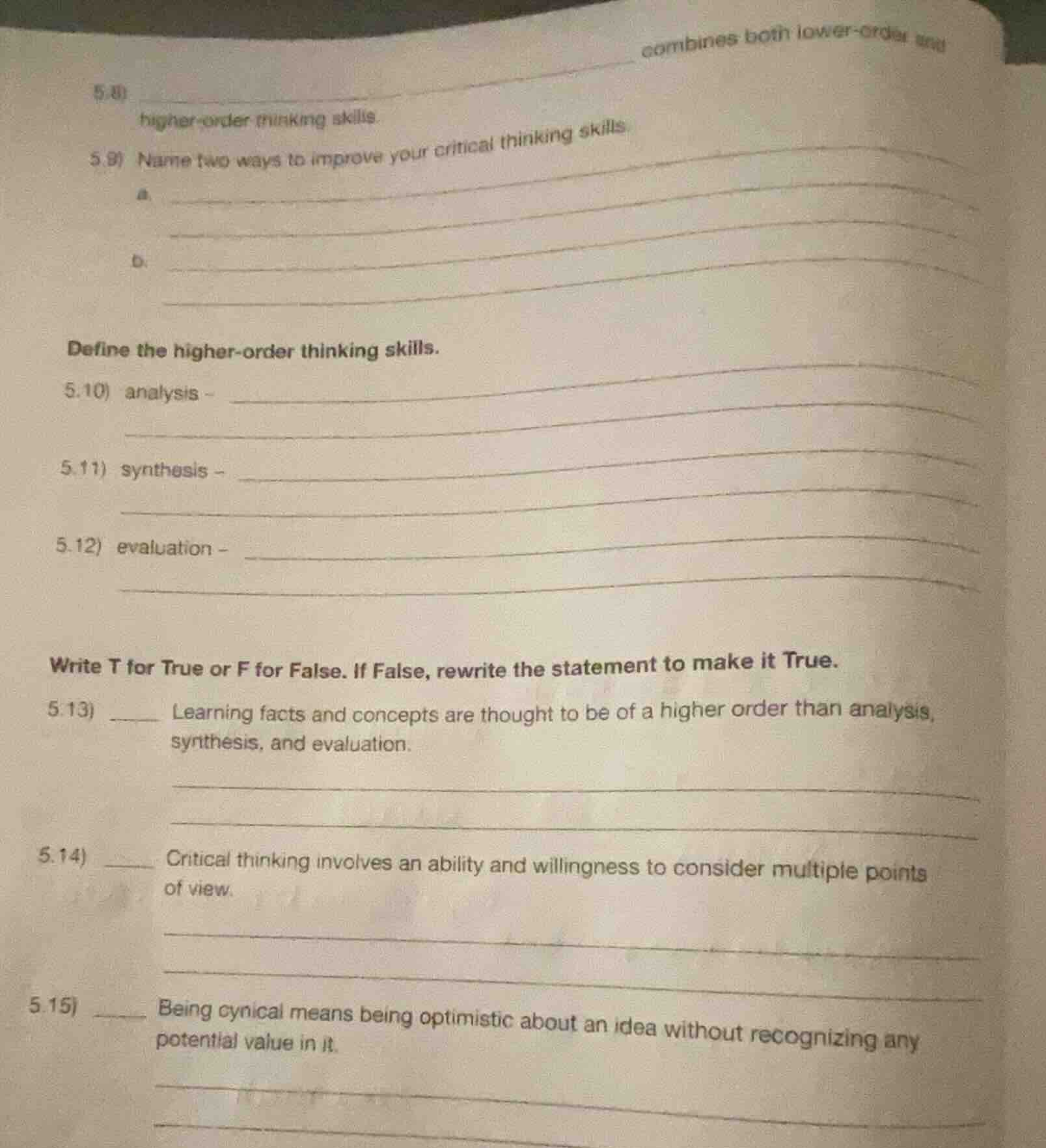
5.8)
combines both lower-order and
higher-order thinking skills.
5.9) name two ways to improve your critical thinking skills
a.
b.
define the higher-order thinking skills.
5.10) analysis -
5.11) synthesis -
5.12) evaluation -
write t for true or f for false. if false, rewrite the statement to make it true.
5.13) ___ learning facts and concepts are thought to be of a higher order than analysis,
synthesis, and evaluation.
5.14) ___ critical thinking involves an ability and willingness to consider multiple points
of view.
5.15) ___ being cynical means being optimistic about an idea without recognizing any
potential value in it.
5.9)
To improve critical thinking skills, common ways include practicing active learning (engaging with material, asking questions) and analyzing different perspectives (considering multiple viewpoints to evaluate ideas). Another way could be solving complex problems that require reasoning. Here are two typical ways:
a. Practice analyzing arguments (e.g., in articles, discussions) to identify logic, evidence, and assumptions.
b. Engage in reflective thinking (reviewing your own thought processes, decisions, and learning to identify biases or gaps).
Analysis in higher - order thinking is the process of breaking down a complex concept, problem, or information into its constituent parts (such as components, elements, or steps) to understand the relationships between those parts and how they contribute to the whole. For example, in a scientific experiment, analyzing the procedure by looking at each step, the variables involved, and how they interact.
Synthesis in higher - order thinking involves combining different parts, ideas, or pieces of information (from various sources or components of a problem) to create a new whole, such as a new idea, solution, or interpretation. For instance, in writing a research paper, synthesizing findings from multiple studies to form a new argument or conclusion.

Snap & solve any problem in the app
Get step-by-step solutions on Sovi AI
Photo-based solutions with guided steps
Explore more problems and detailed explanations
a. Practice analyzing arguments (e.g., identify logic, evidence, assumptions in texts/discussions)
b. Engage in reflective thinking (review your thought processes/decisions for biases/gaps)