QUESTION IMAGE
Question
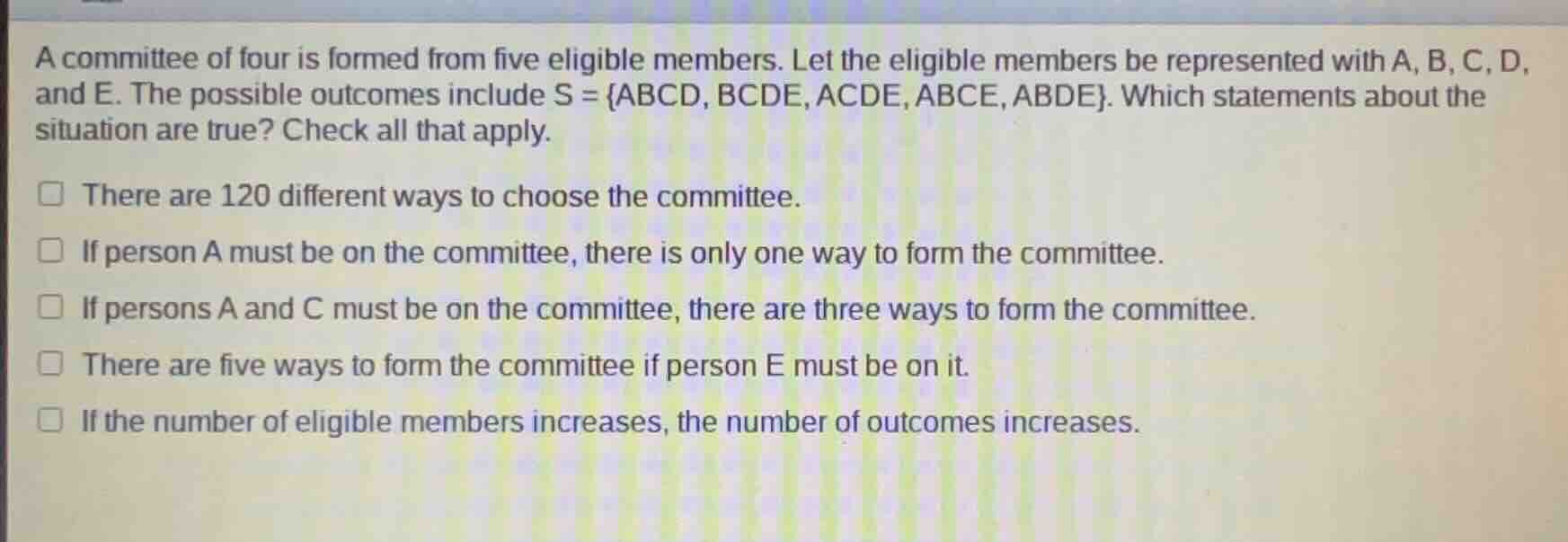
a committee of four is formed from five eligible members. let the eligible members be represented with a, b, c, d, and e. the possible outcomes include s = {abcd, bcde, acde, abce, abde}. which statements about the situation are true? check all that apply. there are 120 different ways to choose the committee. if person a must be on the committee, there is only one way to form the committee. if persons a and c must be on the committee, there are three ways to form the committee. there are five ways to form the committee if person e must be on it. if the number of eligible members increases, the number of outcomes increases.
Step1: Analyze the total number of ways to choose the committee
The problem is about combinations (since the order of selection doesn't matter for a committee). The formula for combinations is \( C(n, k)=\frac{n!}{k!(n - k)!} \), where \( n = 5 \) (eligible members) and \( k = 4 \) (committee size).
\[
C(5,4)=\frac{5!}{4!(5 - 4)!}=\frac{5!}{4!1!}=\frac{5\times4!}{4!×1}= 5
\]
So the first statement "There are 120 different ways to choose the committee" is false because the actual number is 5, not 120.
Step2: Analyze the case when person A must be on the committee
If A must be on the committee, we need to choose 3 more members from the remaining 4 (B, C, D, E). Using the combination formula with \( n = 4 \) and \( k = 3 \):
\[
C(4,3)=\frac{4!}{3!(4 - 3)!}=\frac{4!}{3!1!}=\frac{4\times3!}{3!×1}=4
\]
So the statement "If person A must be on the committee, there is only one way to form the committee" is false.
Step3: Analyze the case when persons A and C must be on the committee
If A and C must be on the committee, we need to choose 2 more members from the remaining 3 (B, D, E). Using the combination formula with \( n = 3 \) and \( k = 2 \):
\[
C(3,2)=\frac{3!}{2!(3 - 2)!}=\frac{3!}{2!1!}=\frac{3\times2!}{2!×1}=3
\]
So the statement "If persons A and C must be on the committee, there are three ways to form the committee" is true.
Step4: Analyze the case when person E must be on the committee
If E must be on the committee, we need to choose 3 more members from the remaining 4 (A, B, C, D). Using the combination formula with \( n = 4 \) and \( k = 3 \):
\[
C(4,3)=\frac{4!}{3!(4 - 3)!}=4
\]
Wait, but looking at the sample space \( S=\{ABCD, BCDE, ACDE, ABCE, ABDE\} \), when E is in the committee, the subsets are BCDE, ACDE, ABCE, ABDE. Wait, no, wait: if E must be in the committee, we choose 3 from the other 4. But the sample space given has 5 elements, each with 4 members, and when E is in the committee, let's list them: BCDE (E is in), ACDE (E is in), ABCE (E is in), ABDE (E is in), and what about ACD E? Wait, no, the sample space is all 4 - member subsets of 5 elements. The number of 4 - member subsets containing E is equal to the number of 3 - member subsets of the remaining 4 elements (A, B, C, D). \( C(4,3) = 4 \)? But the sample space has 5 elements, and let's check which ones contain E: BCDE, ACDE, ABCE, ABDE. Wait, that's 4? But the fifth option in the problem says "There are five ways to form the committee if person E must be on it." Wait, maybe I made a mistake. Wait, the total number of 4 - member subsets of 5 elements is \( C(5,4)=5 \). Each subset either contains E or not. The number of subsets not containing E is \( C(4,4) = 1 \) (the subset ABCD). So the number of subsets containing E is \( 5-1 = 4 \)? But the sample space given is \( S=\{ABCD, BCDE, ACDE, ABCE, ABDE\} \), which are all 5 subsets. So the subsets containing E are BCDE, ACDE, ABCE, ABDE. Wait, that's 4. But the statement says 5. Wait, no, maybe I messed up. Wait, if E must be on the committee, the number of ways is the number of 4 - member committees with E. Since we need 4 members and E is one, we need 3 more from A, B, C, D. The number of ways to choose 3 from 4 is \( C(4,3)=4 \). But the sample space has 5 elements, and the one without E is ABCD, so the ones with E are 4. But the statement says 5. Wait, maybe the problem's sample space is all possible outcomes, and when E is in, let's check the sample space: BCDE (E), ACDE (E), ABCE (E), ABDE (E), and ABCD (no E). So there are 4, not 5. So the statement "There are five ways to form the com…

Snap & solve any problem in the app
Get step-by-step solutions on Sovi AI
Photo-based solutions with guided steps
Explore more problems and detailed explanations
- If persons A and C must be on the committee, there are three ways to form the committee. (True)
- If the number of eligible members increases, the number of outcomes increases. (True)
(The other statements are false: The total number of ways is 5, not 120; when A is on the committee, there are 4 ways, not 1; when E is on the committee, there are 4 ways, not 5)