QUESTION IMAGE
Question
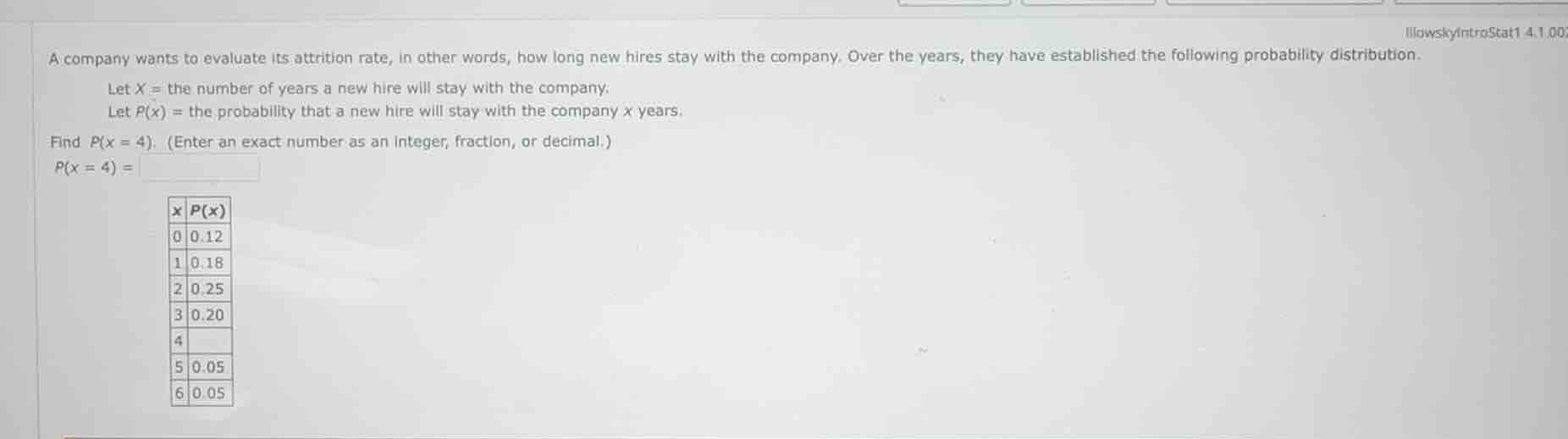
a company wants to evaluate its attrition rate, in other words, how long new hires stay with the company. over the years, they have established the following probability distribution. let ( x ) = the number of years a new hire will stay with the company. let ( p(x) ) = the probability that a new hire will stay with the company ( x ) years. find ( p(x = 4) ). (enter an exact number as an integer, fraction, or decimal.) ( p(x = 4) = ) the chart is: ( x ) and ( p(x) ) are in two columns. the rows are: ( x = 0 ), ( p(x) = 0.12 ); ( x = 1 ), ( p(x) = 0.18 ); ( x = 2 ), ( p(x) = 0.25 ); ( x = 3 ), ( p(x) = 0.20 ); ( x = 4 ), ( p(x) ) is blank; ( x = 5 ), ( p(x) = 0.05 ); ( x = 6 ), ( p(x) = 0.05 ).
Step1: Recall the property of a probability distribution
The sum of all probabilities in a probability distribution must equal 1. So we first sum up the given probabilities and then subtract that sum from 1 to find \( P(x = 4) \).
Step2: Calculate the sum of the given probabilities
The given probabilities are \( P(0)=0.12 \), \( P(1)=0.18 \), \( P(2)=0.25 \), \( P(3)=0.20 \), \( P(5)=0.05 \), \( P(6)=0.05 \).
The sum \( S = 0.12 + 0.18 + 0.25 + 0.20 + 0.05 + 0.05 \)
\( S = 0.12+0.18 = 0.3 \); \( 0.3+0.25 = 0.55 \); \( 0.55+0.20 = 0.75 \); \( 0.75+0.05 = 0.8 \); \( 0.8+0.05 = 0.85 \)
Step3: Find \( P(x = 4) \)
Since the total probability is 1, we have \( P(x = 4)=1 - S \)
Substituting \( S = 0.85 \), we get \( P(x = 4)=1 - 0.85 = 0.15 \)

Snap & solve any problem in the app
Get step-by-step solutions on Sovi AI
Photo-based solutions with guided steps
Explore more problems and detailed explanations
\( 0.15 \)