QUESTION IMAGE
Question
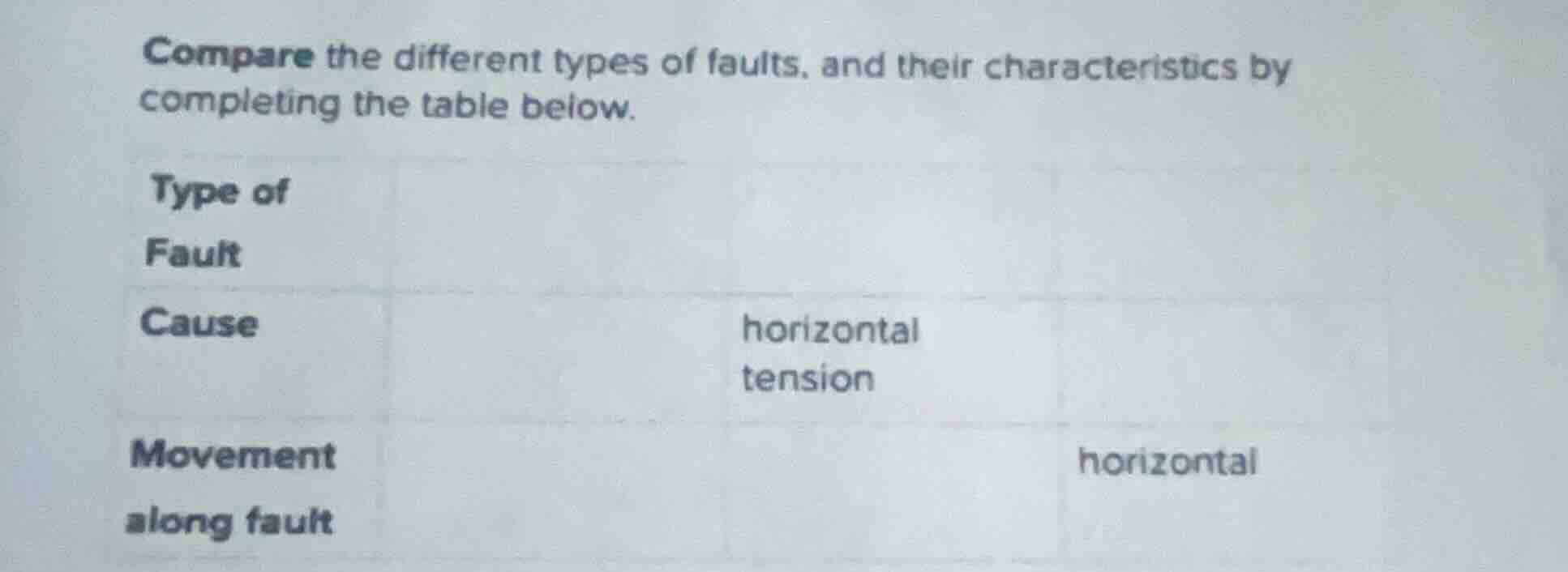
compare the different types of faults, and their characteristics by completing the table below. type of fault cause horizontal tension movement along fault horizontal
To solve this, we recall the types of geological faults (Normal, Reverse, Strike - Slip) and their characteristics:
1. Normal Fault
- Cause: Vertical tension (when the crust is being pulled apart vertically).
- Movement along fault: Vertical (the hanging wall moves down relative to the footwall).
2. Reverse Fault (Thrust Fault)
- Cause: Compression (when the crust is being pushed together).
- Movement along fault: Vertical (the hanging wall moves up relative to the footwall).
3. Strike - Slip Fault
- Cause: Horizontal shear (horizontal forces that cause the rocks to slide past each other horizontally).
- Movement along fault: Horizontal (the rocks on either side of the fault move horizontally past each other, like in the San Andreas Fault).
Now, let's fill the table (assuming the table has three columns for Normal, Reverse, and Strike - Slip faults):
| Type of Fault | Normal Fault | Reverse Fault | Strike - Slip Fault |
|---|---|---|---|
| Movement along fault | Vertical | Vertical | Horizontal |
If we assume the given "horizontal tension" and "horizontal" movement are for Strike - Slip Fault (a common error in the given table, as Strike - Slip is caused by horizontal shear, but if we go with the given terms):
- For the "Cause" column, if we consider the intended fault for "horizontal tension" (maybe a misnomer, but if we proceed), and "horizontal" movement:
- The fault type is Strike - Slip Fault (even though the cause is more accurately horizontal shear, but matching the given "horizontal tension" and "horizontal" movement).
- For the other fault types:
- Normal Fault: Cause - Vertical tension, Movement - Vertical.
- Reverse Fault: Cause - Compression, Movement - Vertical.
If we correct the cause for Strike - Slip Fault:
| Type of Fault | Normal Fault | Reverse Fault | Strike - Slip Fault |
|---|---|---|---|
| Movement along fault | Vertical | Vertical | Horizontal |
If we strictly follow the given "horizontal tension" (incorrect term, but as per the problem's given data):
The fault with "horizontal tension" (intended to be horizontal shear) as cause and "horizontal" movement is Strike - Slip Fault.
For the other rows (assuming the table has three fault types):
- Normal Fault:
- Cause: Vertical tension (when the Earth's crust is stretched vertically).
- Movement along fault: Vertical (hanging wall moves down relative to footwall).
- Reverse Fault:
- Cause: Compression (when the Earth's crust is pushed together).
- Movement along fault: Vertical (hanging wall moves up relative to footwall).
- Strike - Slip Fault:
- Cause: Horizontal shear (horizontal forces that make rocks slide past each other horizontally, mislabeled as "horizontal tension" in the problem).
- Movement along fault: Horizontal (rocks on either side of the fault move horizontally).
If we need to fill the table with the three main fault types:
| Type of Fault | Normal Fault | Reverse Fault | Strike - Slip Fault |
|---|---|---|---|
| Movement along fault | Vertical | Vertical | Horizontal |
So, if we are to identify the fault type with "horizontal tension" (erroneous) cause and "horizontal" movement, it is the Strike - Slip Fault.
We analyze the three main geological fault types (Normal, Reverse, Strike - Slip) based on their causes (forces acting on the crust) and movement along the fault. Normal faults form due to vertical tension with vertical movement, reverse faults due to compression with vertical movement, and strike - slip faults (matching the given "horizontal" movement) due to horizontal shear (mislabeled as "horizontal tension" in the problem).

Snap & solve any problem in the app
Get step-by-step solutions on Sovi AI
Photo-based solutions with guided steps
Explore more problems and detailed explanations
The fault type with "horizontal tension" (erroneous, should be horizontal shear) as cause and "horizontal" movement is the Strike - Slip Fault.
For the complete table (correcting the cause for Strike - Slip):
| Type of Fault | Normal Fault | Reverse Fault | Strike - Slip Fault |
|---|---|---|---|
| Movement along fault | Vertical | Vertical | Horizontal |
If we follow the problem's incorrect "horizontal tension" for cause:
| Type of Fault | Normal Fault | Reverse Fault | Strike - Slip Fault |
|---|---|---|---|
| Movement along fault | Vertical | Vertical | Horizontal |