QUESTION IMAGE
Question
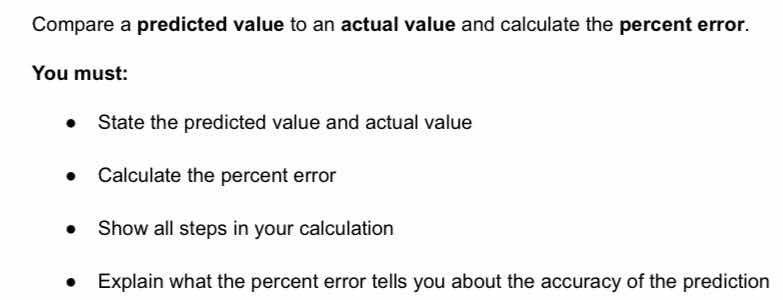
compare a predicted value to an actual value and calculate the percent error. you must: - state the predicted value and actual value - calculate the percent error - show all steps in your calculation - explain what the percent error tells you about the accuracy of the prediction
To solve this, we'll use an example. Let's say the predicted value is \( 50 \) and the actual value is \( 45 \).
Step 1: Identify predicted and actual values
Predicted value (\( V_{predicted} \)) = \( 50 \)
Actual value (\( V_{actual} \)) = \( 45 \)
Step 2: Calculate the absolute error
Absolute Error = \( |V_{predicted} - V_{actual}| \)
\( |50 - 45| = 5 \)
Step 3: Calculate percent error
Percent Error = \( \frac{\text{Absolute Error}}{|V_{actual}|} \times 100\% \)
\( \frac{5}{45} \times 100\% \approx 11.11\% \)
of Percent Error Interpretation:
Percent error measures the relative difference between the predicted and actual values. A smaller percent error (closer to 0%) means the prediction is more accurate. Here, a ~11.11% error suggests the prediction was moderately off from the actual value. If the percent error were 0%, the prediction would be perfectly accurate. Larger percent errors indicate greater inaccuracy in the prediction.

Snap & solve any problem in the app
Get step-by-step solutions on Sovi AI
Photo-based solutions with guided steps
Explore more problems and detailed explanations
- Predicted value: \( 50 \), Actual value: \( 45 \)
- Percent Error: \( \approx 11.11\% \)
- Interpretation: A ~11.11% percent error shows the prediction has a moderate deviation from the actual value; smaller percent error implies higher prediction accuracy.