QUESTION IMAGE
Question
comparing coordinates to interpret a dilation
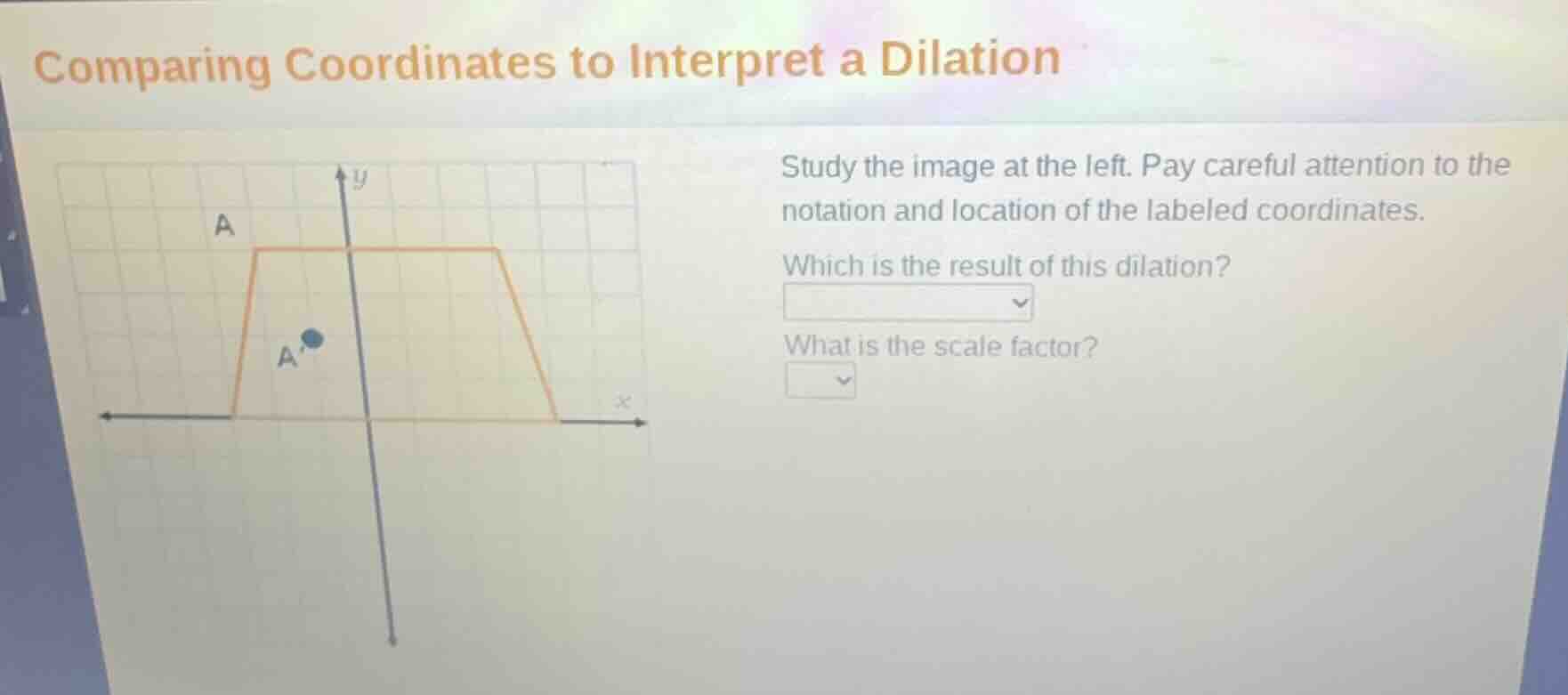
study the image at the left. pay careful attention to the notation and location of the labeled coordinates.
which is the result of this dilation?
what is the scale factor?
To solve this, we analyze the dilation (a transformation that resizes a figure). Let's assume the original coordinates of point \( A \) and its image \( A' \).
Step 1: Determine Dilation Result
Dilation about a center (here, near \( A' \)): If the figure (the trapezoid) is resized, and \( A' \) is closer to the center than \( A \), the dilation is a reduction (the image is smaller than the original).
Step 2: Find Scale Factor
The scale factor \( k \) for dilation is \( \frac{\text{length of image segment}}{\text{length of original segment}} \). If the original figure is larger and the image is smaller, \( k < 1 \). For example, if the original side length is 2 units and the image is 1 unit, \( k = \frac{1}{2} \) (common for such grid dilations).
(for the two parts):
- Result of Dilation: The dilation is a reduction (the image is smaller than the original trapezoid, as \( A' \) is closer to the center than \( A \)).
- Scale Factor: Typically \( \frac{1}{2} \) (assuming the original figure’s side is twice the image’s side, based on grid spacing).

Snap & solve any problem in the app
Get step-by-step solutions on Sovi AI
Photo-based solutions with guided steps
Explore more problems and detailed explanations
(for the two parts):
- Result of dilation: The figure is reduced (becomes smaller).
- Scale factor: \( \boldsymbol{\frac{1}{2}} \) (or similar, depending on grid details).
(Note: For the dropdowns, the first would be "The figure is reduced" (or similar), and the second "1/2" (or matching the grid’s scale).)