QUESTION IMAGE
Question
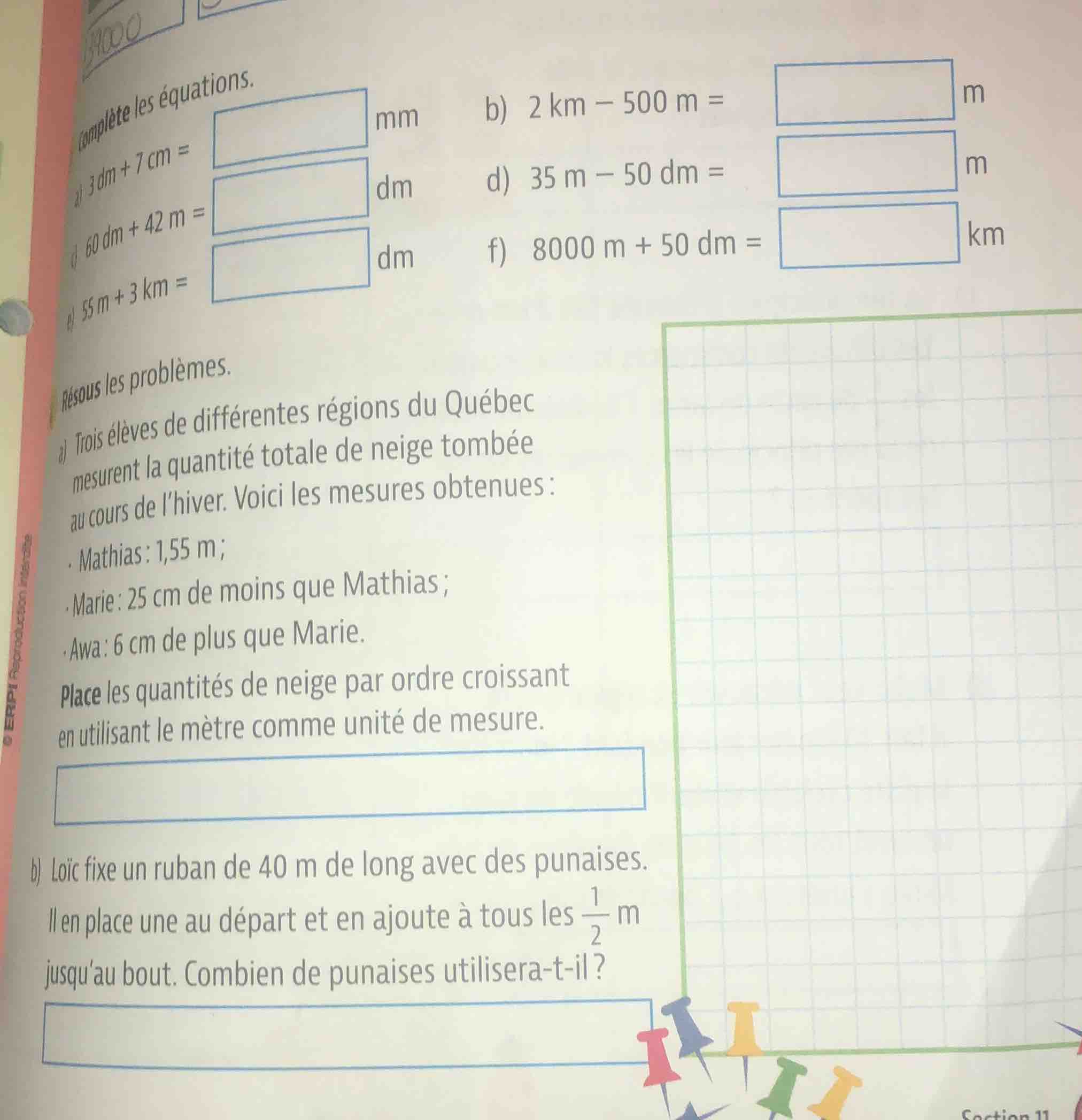
complète les équations.
a) 3 dm + 7 cm = \boxed{} mm
b) 2 km − 500 m = \boxed{} m
c) 60 dm + 42 m = \boxed{} dm
d) 35 m − 50 dm = \boxed{} m
e) 55 m + 3 km = \boxed{} dm
f) 8000 m + 50 dm = \boxed{} km
résous les problèmes.
a) trois élèves de différentes régions du québec mesurent la quantité totale de neige tombée au cours de l’hiver. voici les mesures obtenues :
- mathias : 1,55 m ;
- marie : 25 cm de moins que mathias ;
- awa : 6 cm de plus que marie.
place les quantités de neige par ordre croissant en utilisant le mètre comme unité de mesure.
\boxed{}
b) loïc fixe un ruban de 40 m de long avec des punaises. il en place une au départ et en ajoute à tous les $\frac{1}{2}$ m jusqu’au bout. combien de punaises utilisera-t-il ?
\boxed{}
Partie 1: Compléter les équations
a) \( 3 \, \text{dm} + 7 \, \text{cm} = \dots \, \text{mm} \)
Step 1: Convertir en mm
- \( 1 \, \text{dm} = 100 \, \text{mm} \), donc \( 3 \, \text{dm} = 3 \times 100 = 300 \, \text{mm} \).
- \( 1 \, \text{cm} = 10 \, \text{mm} \), donc \( 7 \, \text{cm} = 7 \times 10 = 70 \, \text{mm} \).
Step 2: Additionner
\( 300 + 70 = 370 \, \text{mm} \).
b) \( 2 \, \text{km} - 500 \, \text{m} = \dots \, \text{m} \)
Step 1: Convertir \( 2 \, \text{km} \) en m
\( 1 \, \text{km} = 1000 \, \text{m} \), donc \( 2 \, \text{km} = 2 \times 1000 = 2000 \, \text{m} \).
Step 2: Soustraire
\( 2000 - 500 = 1500 \, \text{m} \).
c) \( 60 \, \text{dm} + 42 \, \text{m} = \dots \, \text{dm} \)
Step 1: Convertir \( 42 \, \text{m} \) en dm
\( 1 \, \text{m} = 10 \, \text{dm} \), donc \( 42 \, \text{m} = 42 \times 10 = 420 \, \text{dm} \).
Step 2: Additionner
\( 60 + 420 = 480 \, \text{dm} \).
d) \( 35 \, \text{m} - 50 \, \text{dm} = \dots \, \text{m} \)
Step 1: Convertir \( 50 \, \text{dm} \) en m
\( 1 \, \text{dm} = 0.1 \, \text{m} \), donc \( 50 \, \text{dm} = 50 \times 0.1 = 5 \, \text{m} \).
Step 2: Soustraire
\( 35 - 5 = 30 \, \text{m} \).
e) \( 55 \, \text{m} + 3 \, \text{km} = \dots \, \text{dm} \)
Step 1: Convertir en dm
- \( 1 \, \text{m} = 10 \, \text{dm} \), donc \( 55 \, \text{m} = 55 \times 10 = 550 \, \text{dm} \).
- \( 1 \, \text{km} = 10000 \, \text{dm} \) (car \( 1 \, \text{km} = 1000 \, \text{m} = 1000 \times 10 \, \text{dm} \)), donc \( 3 \, \text{km} = 3 \times 10000 = 30000 \, \text{dm} \).
Step 2: Additionner
\( 550 + 30000 = 30550 \, \text{dm} \).
f) \( 8000 \, \text{m} + 50 \, \text{dm} = \dots \, \text{km} \)
Step 1: Convertir en km
- \( 8000 \, \text{m} = 8 \, \text{km} \) (car \( 1000 \, \text{m} = 1 \, \text{km} \)).
- \( 50 \, \text{dm} = 5 \, \text{m} = 0.005 \, \text{km} \) (car \( 1 \, \text{dm} = 0.1 \, \text{m} \), \( 50 \, \text{dm} = 5 \, \text{m} \); \( 1 \, \text{m} = 0.001 \, \text{km} \), donc \( 5 \, \text{m} = 0.005 \, \text{km} \)).
Step 2: Additionner
\( 8 + 0.005 = 8.005 \, \text{km} \).
Partie 2: Résoudre les problèmes
a) Ordre croissant des quantités de neige
- Mathias: \( 1.55 \, \text{m} \).
- Marie: \( 25 \, \text{cm} = 0.25 \, \text{m} \) de moins que Mathias, donc \( 1.55 - 0.25 = 1.30 \, \text{m} \).
- Awa: \( 6 \, \text{cm} = 0.06 \, \text{m} \) de plus que Marie, donc \( 1.30 + 0.06 = 1.36 \, \text{m} \).
Ordre croissant: \( \boldsymbol{Marie \, (1.30 \, \text{m}) < Awa \, (1.36 \, \text{m}) < Mathias \, (1.55 \, \text{m})} \).
b) Nombre de punaises
- Longueur du ruban: \( 40 \, \text{m} \).
- Espace entre punaises: \( \frac{1}{2} \, \text{m} \).
- Nombre d’intervalles: \( \frac{40}{\frac{1}{2}} = 40 \times 2 = 80 \).
- Ajouter la punaise au départ: \( 80 + 1 = 81 \).
Réponses
Equations:
a) \( \boldsymbol{370} \, \text{mm} \)
b) \( \boldsymbol{1500} \, \text{m} \)
c) \( \boldsymbol{480} \, \text{dm} \)
d) \( \boldsymbol{30} \, \text{m} \)
e) \( \boldsymbol{30550} \, \text{dm} \)
f) \( \boldsymbol{8.005} \, \text{km} \)
Problèmes:
a) \( \boldsymbol{Marie \, (1.30 \, \text{m}), \, Awa \, (1.36 \, \text{m}), \, Mathias \, (1.55 \, \text{m})} \)
b) \( \boldsymbol{81} \) punaises

Snap & solve any problem in the app
Get step-by-step solutions on Sovi AI
Photo-based solutions with guided steps
Explore more problems and detailed explanations
Partie 1: Compléter les équations
a) \( 3 \, \text{dm} + 7 \, \text{cm} = \dots \, \text{mm} \)
Step 1: Convertir en mm
- \( 1 \, \text{dm} = 100 \, \text{mm} \), donc \( 3 \, \text{dm} = 3 \times 100 = 300 \, \text{mm} \).
- \( 1 \, \text{cm} = 10 \, \text{mm} \), donc \( 7 \, \text{cm} = 7 \times 10 = 70 \, \text{mm} \).
Step 2: Additionner
\( 300 + 70 = 370 \, \text{mm} \).
b) \( 2 \, \text{km} - 500 \, \text{m} = \dots \, \text{m} \)
Step 1: Convertir \( 2 \, \text{km} \) en m
\( 1 \, \text{km} = 1000 \, \text{m} \), donc \( 2 \, \text{km} = 2 \times 1000 = 2000 \, \text{m} \).
Step 2: Soustraire
\( 2000 - 500 = 1500 \, \text{m} \).
c) \( 60 \, \text{dm} + 42 \, \text{m} = \dots \, \text{dm} \)
Step 1: Convertir \( 42 \, \text{m} \) en dm
\( 1 \, \text{m} = 10 \, \text{dm} \), donc \( 42 \, \text{m} = 42 \times 10 = 420 \, \text{dm} \).
Step 2: Additionner
\( 60 + 420 = 480 \, \text{dm} \).
d) \( 35 \, \text{m} - 50 \, \text{dm} = \dots \, \text{m} \)
Step 1: Convertir \( 50 \, \text{dm} \) en m
\( 1 \, \text{dm} = 0.1 \, \text{m} \), donc \( 50 \, \text{dm} = 50 \times 0.1 = 5 \, \text{m} \).
Step 2: Soustraire
\( 35 - 5 = 30 \, \text{m} \).
e) \( 55 \, \text{m} + 3 \, \text{km} = \dots \, \text{dm} \)
Step 1: Convertir en dm
- \( 1 \, \text{m} = 10 \, \text{dm} \), donc \( 55 \, \text{m} = 55 \times 10 = 550 \, \text{dm} \).
- \( 1 \, \text{km} = 10000 \, \text{dm} \) (car \( 1 \, \text{km} = 1000 \, \text{m} = 1000 \times 10 \, \text{dm} \)), donc \( 3 \, \text{km} = 3 \times 10000 = 30000 \, \text{dm} \).
Step 2: Additionner
\( 550 + 30000 = 30550 \, \text{dm} \).
f) \( 8000 \, \text{m} + 50 \, \text{dm} = \dots \, \text{km} \)
Step 1: Convertir en km
- \( 8000 \, \text{m} = 8 \, \text{km} \) (car \( 1000 \, \text{m} = 1 \, \text{km} \)).
- \( 50 \, \text{dm} = 5 \, \text{m} = 0.005 \, \text{km} \) (car \( 1 \, \text{dm} = 0.1 \, \text{m} \), \( 50 \, \text{dm} = 5 \, \text{m} \); \( 1 \, \text{m} = 0.001 \, \text{km} \), donc \( 5 \, \text{m} = 0.005 \, \text{km} \)).
Step 2: Additionner
\( 8 + 0.005 = 8.005 \, \text{km} \).
Partie 2: Résoudre les problèmes
a) Ordre croissant des quantités de neige
- Mathias: \( 1.55 \, \text{m} \).
- Marie: \( 25 \, \text{cm} = 0.25 \, \text{m} \) de moins que Mathias, donc \( 1.55 - 0.25 = 1.30 \, \text{m} \).
- Awa: \( 6 \, \text{cm} = 0.06 \, \text{m} \) de plus que Marie, donc \( 1.30 + 0.06 = 1.36 \, \text{m} \).
Ordre croissant: \( \boldsymbol{Marie \, (1.30 \, \text{m}) < Awa \, (1.36 \, \text{m}) < Mathias \, (1.55 \, \text{m})} \).
b) Nombre de punaises
- Longueur du ruban: \( 40 \, \text{m} \).
- Espace entre punaises: \( \frac{1}{2} \, \text{m} \).
- Nombre d’intervalles: \( \frac{40}{\frac{1}{2}} = 40 \times 2 = 80 \).
- Ajouter la punaise au départ: \( 80 + 1 = 81 \).
Réponses
Equations:
a) \( \boldsymbol{370} \, \text{mm} \)
b) \( \boldsymbol{1500} \, \text{m} \)
c) \( \boldsymbol{480} \, \text{dm} \)
d) \( \boldsymbol{30} \, \text{m} \)
e) \( \boldsymbol{30550} \, \text{dm} \)
f) \( \boldsymbol{8.005} \, \text{km} \)
Problèmes:
a) \( \boldsymbol{Marie \, (1.30 \, \text{m}), \, Awa \, (1.36 \, \text{m}), \, Mathias \, (1.55 \, \text{m})} \)
b) \( \boldsymbol{81} \) punaises