QUESTION IMAGE
Question
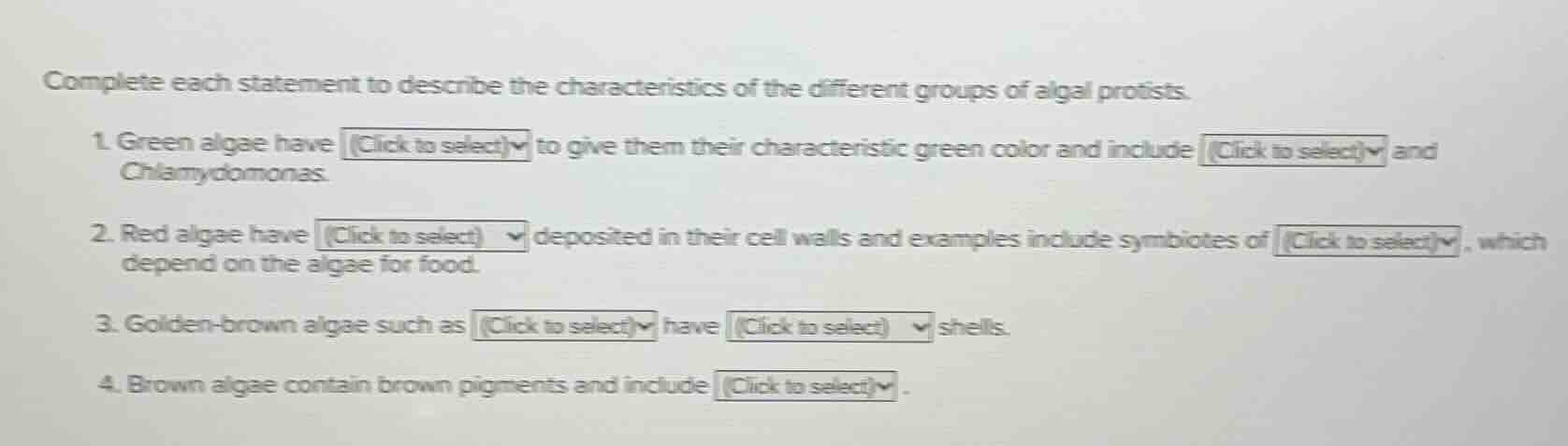
complete each statement to describe the characteristics of the different groups of algal protists.
- green algae have to give them their characteristic green color and include and chlamydomonas.
- red algae have deposited in their cell walls and examples include symbiotes of , which depend on the algae for food.
- golden-brown algae such as have shells.
- brown algae contain brown pigments and include .
Brief Explanations
- Green algae get their green color from chlorophyll a and b, common examples besides Chlamydomonas are Spirogyra.
- Red algae have calcium carbonate in their cell walls, and they form symbiotic relationships with corals that rely on them for nutrients.
- Diatoms are a type of golden-brown algae, and they have silica-based shells.
- Kelp is a well-known example of large, multicellular brown algae that contains brown accessory pigments.

Snap & solve any problem in the app
Get step-by-step solutions on Sovi AI
Photo-based solutions with guided steps
Explore more problems and detailed explanations
- Green algae have chlorophyll a and b to give them their characteristic green color and include Spirogyra and Chlamydomonas.
- Red algae have calcium carbonate deposited in their cell walls and examples include symbiotes of corals, which depend on the algae for food.
- Golden-brown algae such as diatoms have silica shells.
- Brown algae contain brown pigments and include kelp.