QUESTION IMAGE
Question
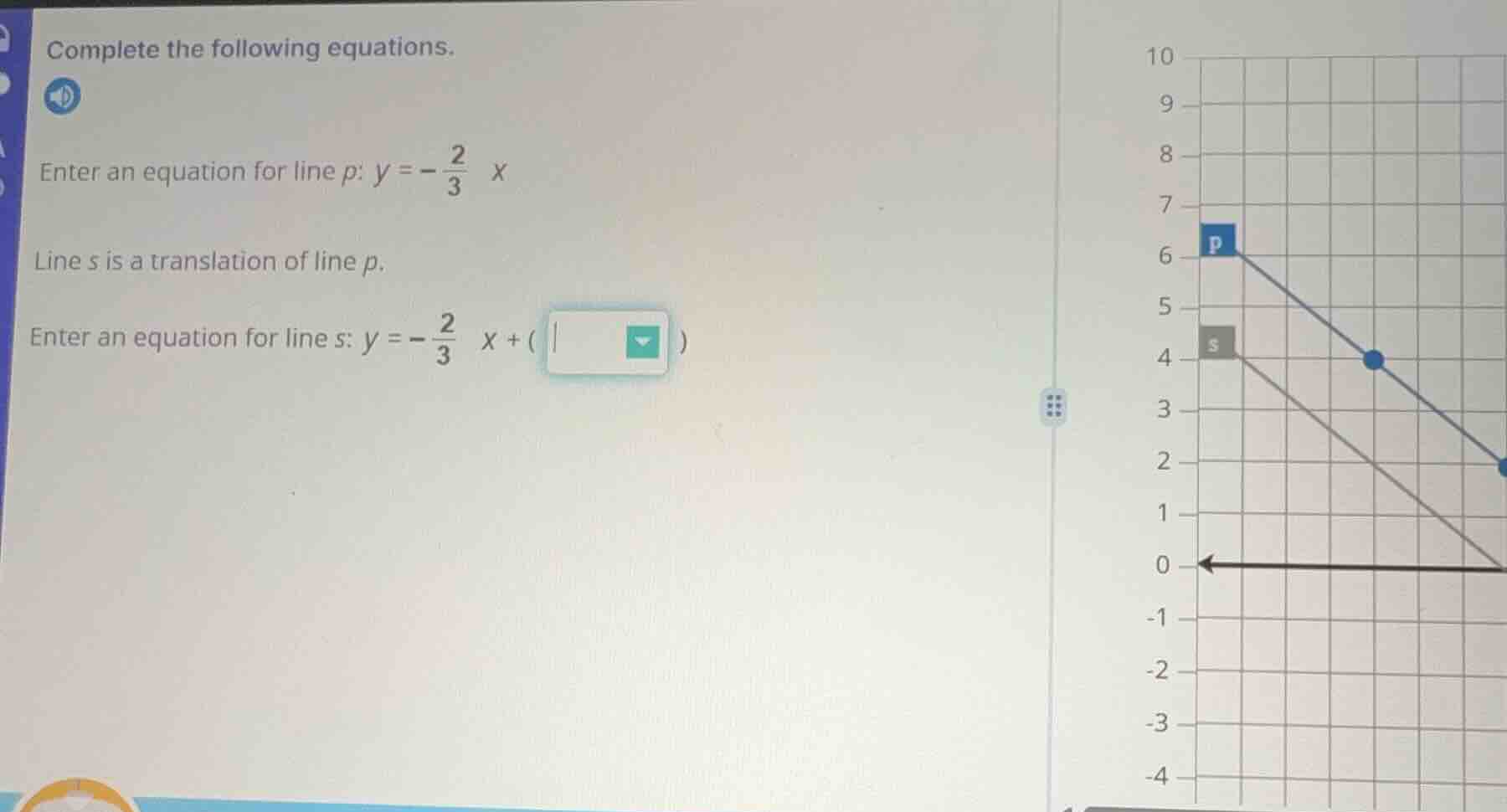
complete the following equations. enter an equation for line p: ( y = -\frac{2}{3}x ) line s is a translation of line p. enter an equation for line s: ( y = -\frac{2}{3}x + (quad) )
Step1: Analyze the translation of the line
A translation of a line (a rigid transformation) does not change the slope, only the y - intercept. We can find the y - intercept of line \( s \) by looking at a point on line \( s \). From the graph, when \( x = 0 \), let's find the \( y \)-value of line \( s \). The gray square (point on line \( s \)) at \( x = 0 \) has \( y = 4 \)? Wait, no, wait. Wait, line \( p \) has a point at \( (0,6) \) (the blue square), and line \( s \) has a point at \( (0,4) \)? Wait, no, looking at the graph, line \( s \) passes through \( (0,4) \)? Wait, no, the equation of line \( p \) is \( y=-\frac{2}{3}x \), so when \( x = 0 \), \( y = 0 \)? Wait, no, the blue square for line \( p \) is at \( (0,6) \)? Wait, maybe I misread. Wait, the equation of line \( p \) is given as \( y = -\frac{2}{3}x \), but the graph shows line \( p \) passing through \( (0,6) \)? Wait, no, maybe the initial equation of line \( p \) is actually \( y=-\frac{2}{3}x + 6 \)? Wait, no, the problem says "Enter an equation for line \( p \): \( y = -\frac{2}{3}x \)". But the graph shows line \( p \) with a point at \( (0,6) \). Wait, maybe there's a mistake, but line \( s \) is a translation. Let's take a point on line \( s \). Let's take \( x = 0 \), what's \( y \)? From the graph, line \( s \) (the gray line) at \( x = 0 \) has \( y = 4 \)? Wait, no, the equation for line \( s \) is \( y=-\frac{2}{3}x + b \), and we need to find \( b \). Let's take a point on line \( s \). Let's say when \( x = 0 \), \( y = 4 \)? Wait, no, looking at the graph, line \( s \) passes through \( (0,4) \)? Wait, no, the blue dot on line \( p \) is at some point, and line \( s \) has a point at \( (0,4) \). Wait, maybe the vertical translation: line \( p \) is shifted down by 2 units? Wait, line \( p \) has a y - intercept of 6 (from the graph, the blue square at \( x = 0 \), \( y = 6 \)), and line \( s \) has a y - intercept of 4? No, wait, the problem says line \( p \) is \( y = -\frac{2}{3}x \), but the graph shows line \( p \) with \( y \)-intercept 6. Maybe the problem has a typo, but according to the graph, line \( s \) is a translation (same slope) of line \( p \). Let's find the y - intercept of line \( s \). Let's take a point on line \( s \). Let's take \( x = 0 \), the y - coordinate of line \( s \) is 4? Wait, no, the gray square (point on line \( s \)) is at \( (0,4) \)? Wait, the equation of line \( s \) is \( y = -\frac{2}{3}x + b \), and we can find \( b \) by plugging in a point on line \( s \). Let's take \( x = 0 \), then \( y = b \). From the graph, line \( s \) at \( x = 0 \) has \( y = 4 \)? Wait, no, the blue square for line \( p \) is at \( (0,6) \), and line \( s \) is at \( (0,4) \), so the vertical shift is down by 2? Wait, but the problem says line \( p \) is \( y = -\frac{2}{3}x \), but the graph shows line \( p \) with \( y \)-intercept 6. Maybe the initial equation of line \( p \) is \( y = -\frac{2}{3}x + 6 \), and line \( s \) is \( y = -\frac{2}{3}x + 4 \)? But the problem says line \( p \) is \( y = -\frac{2}{3}x \). Wait, maybe I made a mistake. Wait, let's check the slope. The slope of line \( p \) and line \( s \) is the same (\( -\frac{2}{3} \)) because it's a translation. Now, let's find the y - intercept of line \( s \). Let's take a point on line \( s \). Let's take \( x = 0 \), what's \( y \)? From the graph, line \( s \) (the gray line) at \( x = 0 \) has \( y = 4 \)? Wait, no, the gray square is at \( (0,4) \)? Wait, the equation of line \( s \) is \( y = -\frac{2}{3}x + b \), and when \( x = 0 \), \( y = b \).…

Snap & solve any problem in the app
Get step-by-step solutions on Sovi AI
Photo-based solutions with guided steps
Explore more problems and detailed explanations
4