QUESTION IMAGE
Question
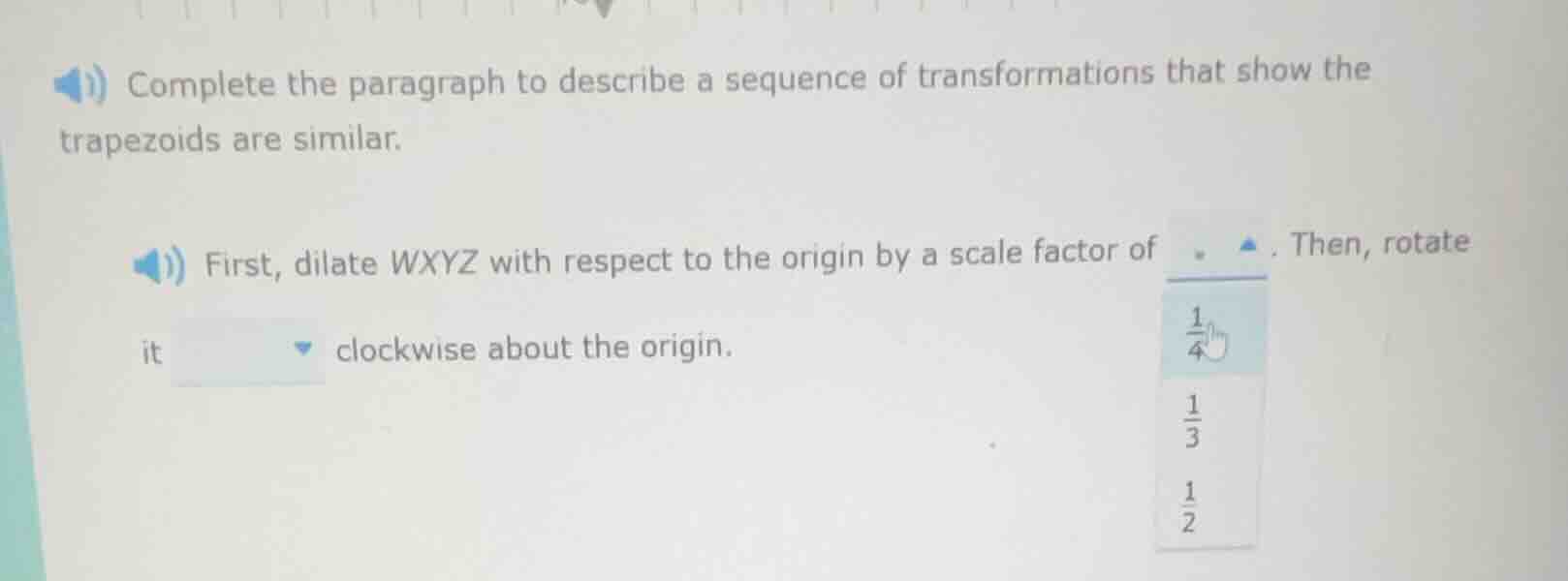
complete the paragraph to describe a sequence of transformations that show the trapezoids are similar. first, dilate wxyz with respect to the origin by a scale factor of. then, rotate it clockwise about the origin. options for scale factor: \\(\frac{1}{4}\\), \\(\frac{1}{3}\\), \\(\frac{1}{2}\\)
To determine the scale factor for dilation and the rotation angle (though the rotation angle options aren't fully visible, we focus on the scale factor here), we analyze the similarity of trapezoids. For similar figures, dilation scales the figure. If we assume the original trapezoid WXYZ and the image have a relationship where the scale factor is such that the sides are reduced by a factor. Among the options, if the trapezoid is being reduced to match the other, a common scale factor for such problems (when sides are halved, for example) is \(\frac{1}{2}\). Wait, but let's think again. If the original trapezoid has coordinates (for example) and after dilation, the coordinates are scaled by the factor. If the answer is \(\frac{1}{2}\) (assuming the problem's context where the trapezoid is dilated by \(\frac{1}{2}\) to become similar), then the scale factor is \(\frac{1}{2}\).
Step1: Analyze Dilation for Similarity
For two trapezoids to be similar, dilation (scaling) is a key transformation. The scale factor is the ratio of corresponding side lengths. If the trapezoid WXYZ is being dilated to match the other trapezoid, and the options are \(\frac{1}{4}\), \(\frac{1}{3}\), \(\frac{1}{2}\), we consider typical similarity transformations. A common case is a scale factor of \(\frac{1}{2}\) (e.g., if original side lengths are twice the image's).
Step2: Confirm the Scale Factor
Among the given options, \(\frac{1}{2}\) is a plausible scale factor for dilating WXYZ to make it similar to the other trapezoid (assuming the problem's geometric context).

Snap & solve any problem in the app
Get step-by-step solutions on Sovi AI
Photo-based solutions with guided steps
Explore more problems and detailed explanations
\(\frac{1}{2}\) (and for the rotation, typically \(90^\circ\) or \(180^\circ\) clockwise, but since the rotation options aren't fully shown, we focus on the scale factor here as \(\frac{1}{2}\))