QUESTION IMAGE
Question
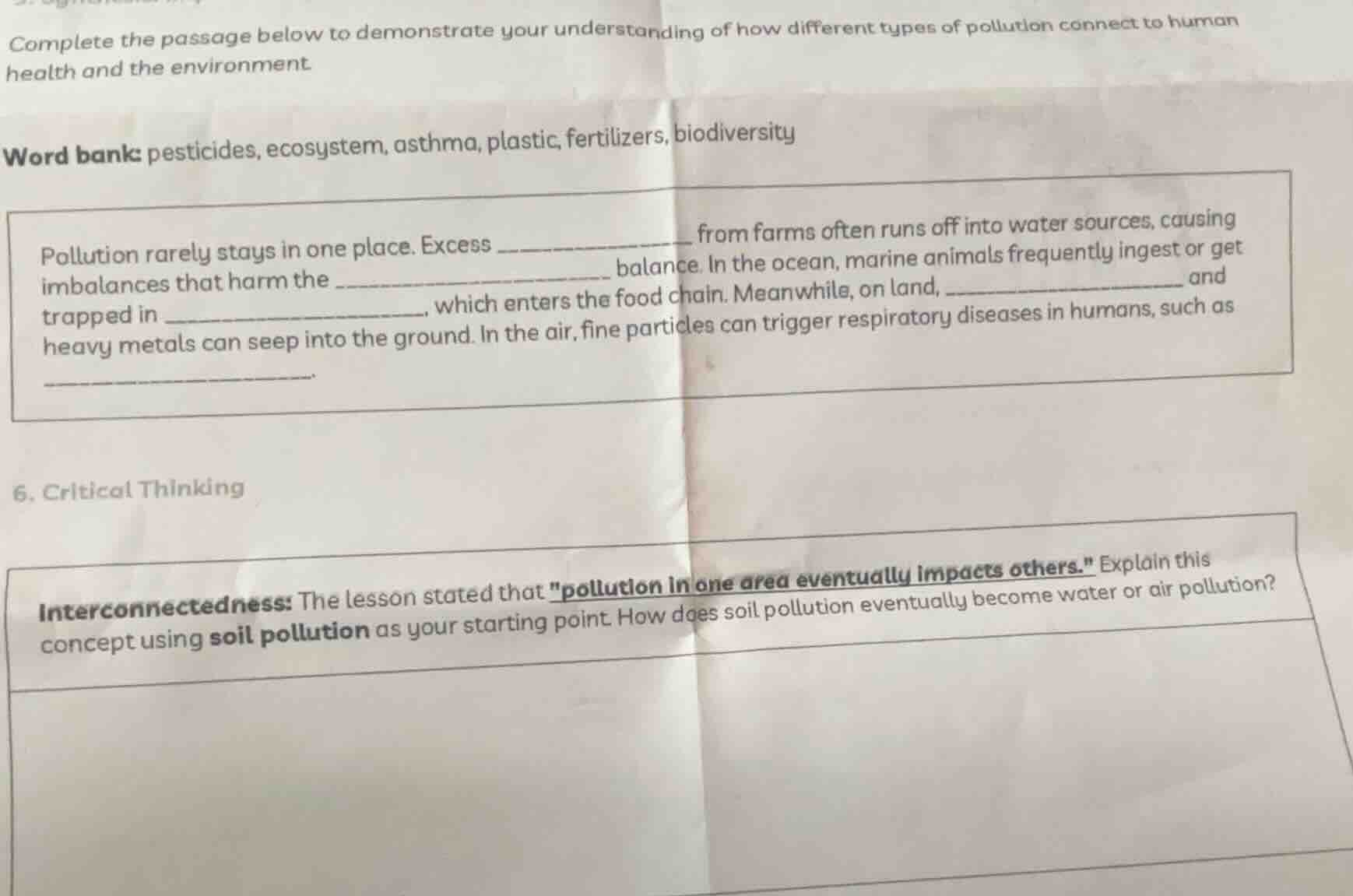
complete the passage below to demonstrate your understanding of how different types of pollution connect to human health and the environment
word bank: pesticides, ecosystem, asthma, plastic, fertilizers, biodiversity
pollution rarely stays in one place. excess __________ from farms often runs off into water sources, causing imbalances that harm the ________________ balance. in the ocean, marine animals frequently ingest or get trapped in ________________, which enters the food chain. meanwhile, on land, ___________ and heavy metals can seep into the ground. in the air, fine particles can trigger respiratory diseases in humans, such as _____________.
- critical thinking
interconnectedness: the lesson stated that \pollution in one area eventually impacts others.\ explain this concept using soil pollution as your starting point. how does soil pollution eventually become water or air pollution?
Completing the Passage:
- For the first blank, "fertilizers" are commonly used in farms and excess can run off, so we choose "fertilizers".
- The second blank refers to the balance in the environment, so "ecosystem" (which includes biodiversity and other components) fits as it's about the environmental balance.
- In the ocean, marine animals interact with "plastic" as a pollutant they ingest or get trapped in.
- On land, "pesticides" are a pollutant that can seep into the ground along with heavy metals.
- For respiratory diseases, "asthma" is a common one triggered by fine particles in the air.
Soil pollution (e.g., from pesticides, fertilizers, or heavy metals) can lead to water pollution through runoff. When it rains, pollutants in the soil are carried by water into rivers, lakes, or oceans. For air pollution, pollutants in the soil can be released into the air through processes like evaporation (for volatile chemicals) or wind erosion (carrying contaminated soil particles). For example, pesticides in soil can evaporate into the air, and dust storms can pick up polluted soil and spread it as air pollution. Also, when soil is polluted, it affects plants, which can then be part of the food chain, but the key for water/air is the movement of pollutants from soil to these other spheres.

Snap & solve any problem in the app
Get step-by-step solutions on Sovi AI
Photo-based solutions with guided steps
Explore more problems and detailed explanations
Pollution rarely stays in one place. Excess \underline{fertilizers} from farms often runs off into water sources, causing imbalances that harm the \underline{ecosystem} balance. In the ocean, marine animals frequently ingest or get trapped in \underline{plastic}, which enters the food chain. Meanwhile, on land, \underline{pesticides} and heavy metals can seep into the ground. In the air, fine particles can trigger respiratory diseases in humans, such as \underline{asthma}.