QUESTION IMAGE
Question
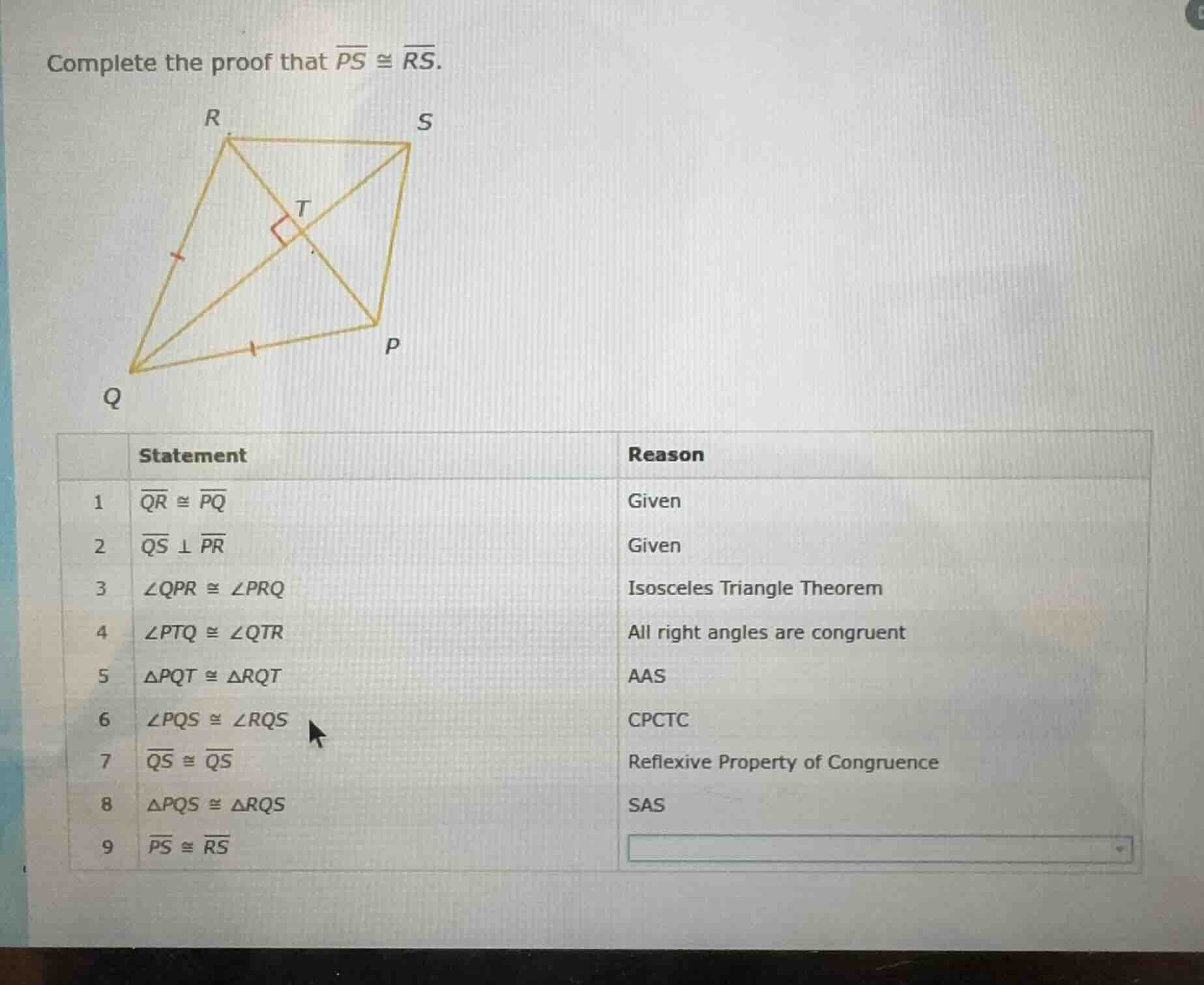
complete the proof that \\(\overline{ps} \cong \overline{rs}\\).
| statement | reason | |
|---|---|---|
| 2 | \\(\overline{qs} \perp \overline{pr}\\) | given |
| 3 | \\(\angle qpr \cong \angle prq\\) | isosceles triangle theorem |
| 4 | \\(\angle ptq \cong \angle qtr\\) | all right angles are congruent |
| 5 | \\(\triangle pqt \cong \triangle rqt\\) | aas |
| 6 | \\(\angle pqs \cong \angle rqs\\) | cpctc |
| 7 | \\(\overline{qs} \cong \overline{qs}\\) | reflexive property of congruence |
| 8 | \\(\triangle pqs \cong \triangle rqs\\) | sas |
| 9 | \\(\overline{ps} \cong \overline{rs}\\) |
Step1: Recall CPCTC
CPCTC (Corresponding Parts of Congruent Triangles are Congruent) states that if two triangles are congruent, their corresponding parts (sides and angles) are congruent.
Step2: Apply CPCTC to $\triangle PQS$ and $\triangle RQS$
We know from step 8 that $\triangle PQS \cong \triangle RQS$ (by SAS). So, the corresponding sides $\overline{PS}$ and $\overline{RS}$ must be congruent by CPCTC.

Snap & solve any problem in the app
Get step-by-step solutions on Sovi AI
Photo-based solutions with guided steps
Explore more problems and detailed explanations
CPCTC (Corresponding Parts of Congruent Triangles are Congruent)