QUESTION IMAGE
Question
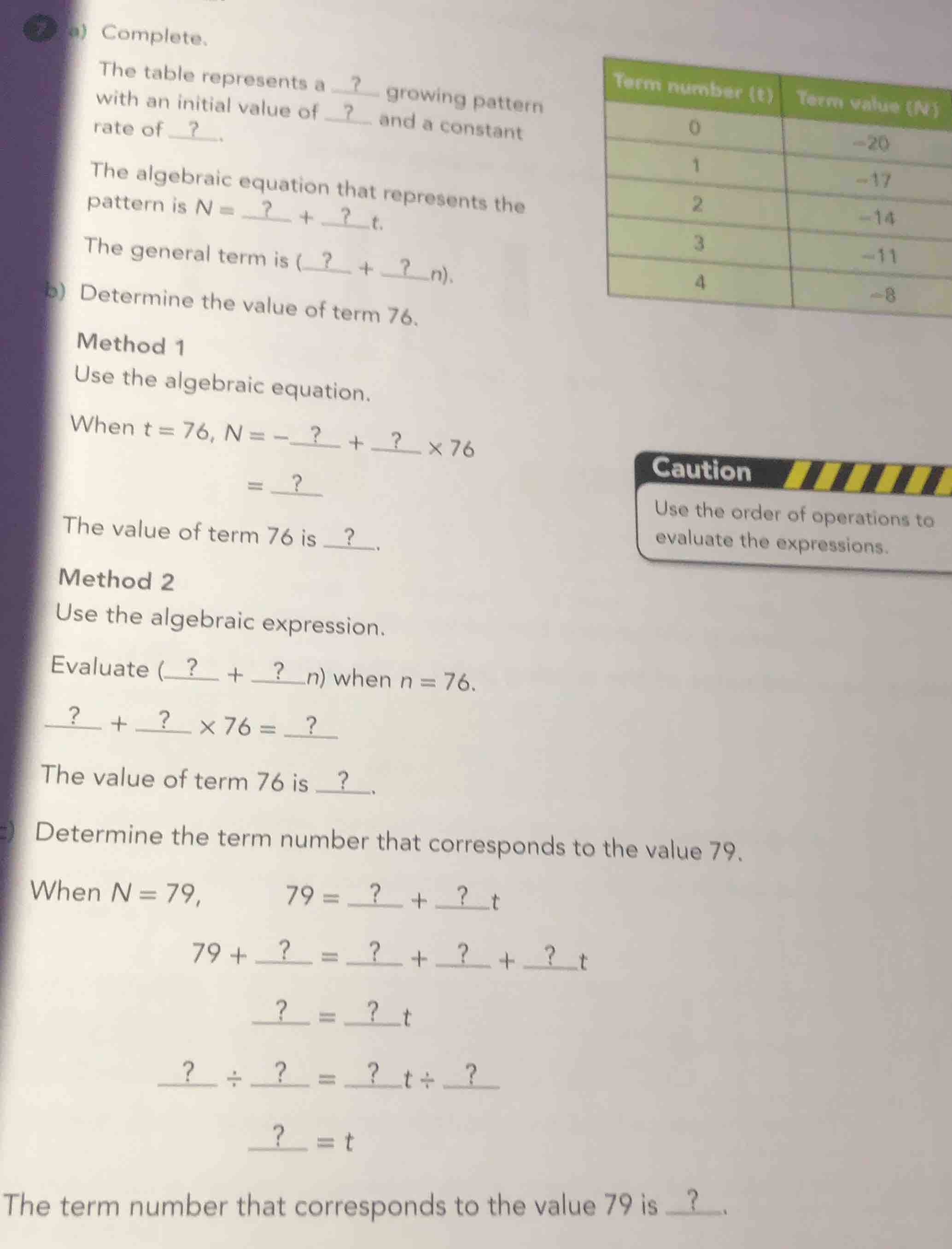
7 a) complete. the table represents a _?__ growing pattern with an initial value of _?__ and a constant rate of _?__. the algebraic equation that represents the pattern is ( n = _?_ + _?_ t ). the general term is ( (_?_ + _?_ n) ). b) determine the value of term 76. method 1 use the algebraic equation. when ( t = 76 ), ( n = -_?_ + _?_ \times 76 = _?_ ) the value of term 76 is _?__. method 2 use the algebraic expression. evaluate ( (_?_ + _?_ n) ) when ( n = 76 ). ( _?_ + _?_ \times 76 = _?_ ) the value of term 76 is _?__. c) determine the term number that corresponds to the value 79. when ( n = 79 ), ( 79 = _?_ + _?_ t ) ( 79 + _?_ = _?_ + _?_ + _?_ t ) ( _?_ = _?_ t ) ( _?_ div _?_ = _?_ t div _?_ ) ( _?_ = t ) the term number that corresponds to the value 79 is _?__. term number (t) | term value (n) 0 | -20 1 | -17 2 | -14 3 | -11 4 | -8 caution use the order of operations to evaluate the expressions.
Step1: Identify pattern type/initial value
Initial value (when $t=0$) is $-20$. The pattern is linear (constant difference between terms: $-17 - (-20) = 3$, $-14 - (-17) = 3$, etc.).
Step2: Find constant rate/equation
Constant rate = $3$. Linear equation form: $N = \text{initial value} + \text{rate} \times t$, so $N = -20 + 3t$. General term uses $n$: $-20 + 3n$.
Step3: Calculate term 76 (Method1)
Substitute $t=76$ into $N=-20+3t$.
$N = -20 + 3 \times 76 = -20 + 228 = 208$
Step4: Calculate term 76 (Method2)
Substitute $n=76$ into $-20+3n$.
$-20 + 3 \times 76 = -20 + 228 = 208$
Step5: Find term number for $N=79$
Set $79 = -20 + 3t$. Add 20 to both sides:
$79 + 20 = -20 + 20 + 3t$
$99 = 3t$
Divide both sides by 3:
$\frac{99}{3} = \frac{3t}{3}$
$33 = t$

Snap & solve any problem in the app
Get step-by-step solutions on Sovi AI
Photo-based solutions with guided steps
Explore more problems and detailed explanations
Part a)
The table represents a linear growing pattern with an initial value of $\boldsymbol{-20}$ and a constant rate of $\boldsymbol{3}$.
The algebraic equation that represents the pattern is $N = \boldsymbol{-20} + \boldsymbol{3}t$.
The general term is $(\boldsymbol{-20} + \boldsymbol{3}n)$.
Part b)
Method 1
When $t = 76$, $N = -\boldsymbol{20} + \boldsymbol{3} \times 76 = \boldsymbol{208}$
The value of term 76 is $\boldsymbol{208}$.
Method 2
Evaluate $(\boldsymbol{-20} + \boldsymbol{3}n)$ when $n = 76$.
$\boldsymbol{-20} + \boldsymbol{3} \times 76 = \boldsymbol{208}$
The value of term 76 is $\boldsymbol{208}$.
Part c)
When $N = 79$,
$79 = \boldsymbol{-20} + \boldsymbol{3}t$
$79 + \boldsymbol{20} = \boldsymbol{-20} + \boldsymbol{20} + \boldsymbol{3}t$
$\boldsymbol{99} = \boldsymbol{3}t$
$\boldsymbol{99} \div \boldsymbol{3} = \boldsymbol{3}t \div \boldsymbol{3}$
$\boldsymbol{33} = t$
The term number that corresponds to the value 79 is $\boldsymbol{33}$.