QUESTION IMAGE
Question
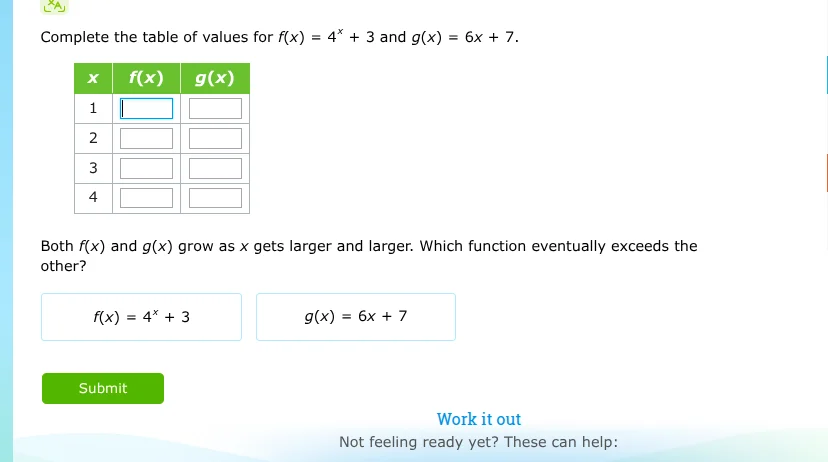
complete the table of values for $f(x) = 4^x + 3$ and $g(x) = 6x + 7$.
| $x$ | $f(x)$ | $g(x)$ |
|---|---|---|
| 2 | ||
| 3 | ||
| 4 |
both $f(x)$ and $g(x)$ grow as $x$ gets larger and larger. which function eventually exceeds the other?
$f(x) = 4^x + 3$
$g(x) = 6x + 7$
submit
work it out
not feeling ready yet? these can help:
Completing the Table of Values
First, we'll calculate the values of \( f(x) = 4^x + 3 \) and \( g(x) = 6x + 7 \) for \( x = 1, 2, 3, 4 \).
For \( x = 1 \):
- Calculating \( f(1) \):
Substitute \( x = 1 \) into \( f(x) \):
\( f(1) = 4^1 + 3 = 4 + 3 = 7 \)
- Calculating \( g(1) \):
Substitute \( x = 1 \) into \( g(x) \):
\( g(1) = 6(1) + 7 = 6 + 7 = 13 \)
For \( x = 2 \):
- Calculating \( f(2) \):
Substitute \( x = 2 \) into \( f(x) \):
\( f(2) = 4^2 + 3 = 16 + 3 = 19 \)
- Calculating \( g(2) \):
Substitute \( x = 2 \) into \( g(x) \):
\( g(2) = 6(2) + 7 = 12 + 7 = 19 \)
For \( x = 3 \):
- Calculating \( f(3) \):
Substitute \( x = 3 \) into \( f(x) \):
\( f(3) = 4^3 + 3 = 64 + 3 = 67 \)
- Calculating \( g(3) \):
Substitute \( x = 3 \) into \( g(x) \):
\( g(3) = 6(3) + 7 = 18 + 7 = 25 \)
For \( x = 4 \):
- Calculating \( f(4) \):
Substitute \( x = 4 \) into \( f(x) \):
\( f(4) = 4^4 + 3 = 256 + 3 = 259 \)
- Calculating \( g(4) \):
Substitute \( x = 4 \) into \( g(x) \):
\( g(4) = 6(4) + 7 = 24 + 7 = 31 \)
So the completed table is:
| \( x \) | \( f(x) \) | \( g(x) \) |
|---|---|---|
| 2 | 19 | 19 |
| 3 | 67 | 25 |
| 4 | 259 | 31 |
Determining Which Function Exceeds the Other
To determine which function eventually exceeds the other, we analyze the growth rates:
- \( f(x) = 4^x + 3 \) is an exponential function (base 4 > 1), so it grows exponentially.
- \( g(x) = 6x + 7 \) is a linear function (degree 1), so it grows linearly.
Exponential functions grow much faster than linear functions as \( x \) becomes large. From the table, we can see that for \( x = 3 \) and \( x = 4 \), \( f(x) \) is already larger than \( g(x) \) (and the gap will only increase as \( x \) gets larger).
So, the function \( f(x) = 4^x + 3 \) eventually exceeds \( g(x) = 6x + 7 \).
Final Answers
Completed Table:
| \( x \) | \( f(x) \) | \( g(x) \) |
|---|---|---|
| 2 | 19 | 19 |
| 3 | 67 | 25 |
| 4 | 259 | 31 |
Which function exceeds the other?
\( f(x) = 4^x + 3 \)

Snap & solve any problem in the app
Get step-by-step solutions on Sovi AI
Photo-based solutions with guided steps
Explore more problems and detailed explanations
Completing the Table of Values
First, we'll calculate the values of \( f(x) = 4^x + 3 \) and \( g(x) = 6x + 7 \) for \( x = 1, 2, 3, 4 \).
For \( x = 1 \):
- Calculating \( f(1) \):
Substitute \( x = 1 \) into \( f(x) \):
\( f(1) = 4^1 + 3 = 4 + 3 = 7 \)
- Calculating \( g(1) \):
Substitute \( x = 1 \) into \( g(x) \):
\( g(1) = 6(1) + 7 = 6 + 7 = 13 \)
For \( x = 2 \):
- Calculating \( f(2) \):
Substitute \( x = 2 \) into \( f(x) \):
\( f(2) = 4^2 + 3 = 16 + 3 = 19 \)
- Calculating \( g(2) \):
Substitute \( x = 2 \) into \( g(x) \):
\( g(2) = 6(2) + 7 = 12 + 7 = 19 \)
For \( x = 3 \):
- Calculating \( f(3) \):
Substitute \( x = 3 \) into \( f(x) \):
\( f(3) = 4^3 + 3 = 64 + 3 = 67 \)
- Calculating \( g(3) \):
Substitute \( x = 3 \) into \( g(x) \):
\( g(3) = 6(3) + 7 = 18 + 7 = 25 \)
For \( x = 4 \):
- Calculating \( f(4) \):
Substitute \( x = 4 \) into \( f(x) \):
\( f(4) = 4^4 + 3 = 256 + 3 = 259 \)
- Calculating \( g(4) \):
Substitute \( x = 4 \) into \( g(x) \):
\( g(4) = 6(4) + 7 = 24 + 7 = 31 \)
So the completed table is:
| \( x \) | \( f(x) \) | \( g(x) \) |
|---|---|---|
| 2 | 19 | 19 |
| 3 | 67 | 25 |
| 4 | 259 | 31 |
Determining Which Function Exceeds the Other
To determine which function eventually exceeds the other, we analyze the growth rates:
- \( f(x) = 4^x + 3 \) is an exponential function (base 4 > 1), so it grows exponentially.
- \( g(x) = 6x + 7 \) is a linear function (degree 1), so it grows linearly.
Exponential functions grow much faster than linear functions as \( x \) becomes large. From the table, we can see that for \( x = 3 \) and \( x = 4 \), \( f(x) \) is already larger than \( g(x) \) (and the gap will only increase as \( x \) gets larger).
So, the function \( f(x) = 4^x + 3 \) eventually exceeds \( g(x) = 6x + 7 \).
Final Answers
Completed Table:
| \( x \) | \( f(x) \) | \( g(x) \) |
|---|---|---|
| 2 | 19 | 19 |
| 3 | 67 | 25 |
| 4 | 259 | 31 |
Which function exceeds the other?
\( f(x) = 4^x + 3 \)