QUESTION IMAGE
Question
complete the text based on the map above.
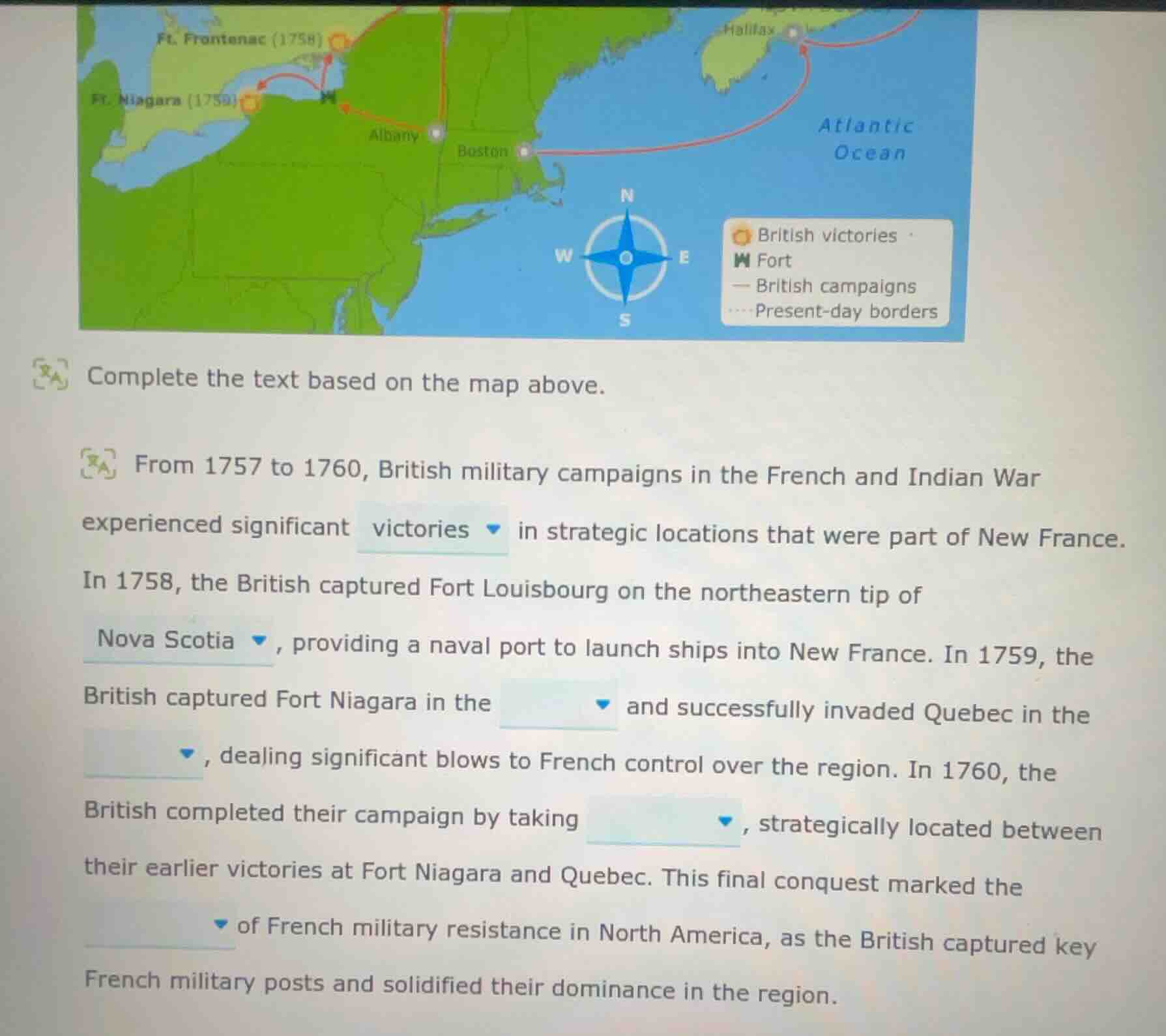
from 1757 to 1760, british military campaigns in the french and indian war experienced significant victories in strategic locations that were part of new france. in 1758, the british captured fort louisbourg on the northeastern tip of nova scotia, providing a naval port to launch ships into new france. in 1759, the british captured fort niagara in the ▼ and successfully invaded quebec in the ▼, dealing significant blows to french control over the region. in 1760, the british completed their campaign by taking ▼, strategically located between their earlier victories at fort niagara and quebec. this final conquest marked the ▼ of french military resistance in north america, as the british captured key french military posts and solidified their dominance in the region.
To solve this, we analyze the map and historical context of the French and Indian War:
Step 1: Fort Niagara’s Location
Fort Niagara is in the Great Lakes region (specifically near the Niagara River, part of the Great Lakes area).
Step 2: Quebec’s Location
Quebec is in Canada (eastern Canada, along the St. Lawrence River).
Step 3: 1760 Conquest
In 1760, the British captured Fort Frontenac (strategically between Fort Niagara and Quebec).
Step 4: End of French Resistance
The final conquest marked the end of French military resistance in North America.
Filled Text:
From 1757 to 1760, British military campaigns in the French and Indian War experienced significant victories in strategic locations that were part of New France. In 1758, the British captured Fort Louisbourg on the northeastern tip of Nova Scotia, providing a naval port to launch ships into New France. In 1759, the British captured Fort Niagara in the Great Lakes region and successfully invaded Quebec in the St. Lawrence Valley (or Canada) , dealing significant blows to French control over the region. In 1760, the British completed their campaign by taking Fort Frontenac , strategically located between their earlier victories at Fort Niagara and Quebec. This final conquest marked the end of French military resistance in North America, as the British captured key French military posts and solidified their dominance in the region.
(Note: For the dropdowns, the most accurate historical answers are:
- Fort Niagara’s location: Great Lakes region (or New York/Colonial America contextually)
- Quebec’s region: St. Lawrence Valley (or Canada)
- 1760 conquest: Fort Frontenac
- End of resistance: end )

Snap & solve any problem in the app
Get step-by-step solutions on Sovi AI
Photo-based solutions with guided steps
Explore more problems and detailed explanations
To solve this, we analyze the map and historical context of the French and Indian War:
Step 1: Fort Niagara’s Location
Fort Niagara is in the Great Lakes region (specifically near the Niagara River, part of the Great Lakes area).
Step 2: Quebec’s Location
Quebec is in Canada (eastern Canada, along the St. Lawrence River).
Step 3: 1760 Conquest
In 1760, the British captured Fort Frontenac (strategically between Fort Niagara and Quebec).
Step 4: End of French Resistance
The final conquest marked the end of French military resistance in North America.
Filled Text:
From 1757 to 1760, British military campaigns in the French and Indian War experienced significant victories in strategic locations that were part of New France. In 1758, the British captured Fort Louisbourg on the northeastern tip of Nova Scotia, providing a naval port to launch ships into New France. In 1759, the British captured Fort Niagara in the Great Lakes region and successfully invaded Quebec in the St. Lawrence Valley (or Canada) , dealing significant blows to French control over the region. In 1760, the British completed their campaign by taking Fort Frontenac , strategically located between their earlier victories at Fort Niagara and Quebec. This final conquest marked the end of French military resistance in North America, as the British captured key French military posts and solidified their dominance in the region.
(Note: For the dropdowns, the most accurate historical answers are:
- Fort Niagara’s location: Great Lakes region (or New York/Colonial America contextually)
- Quebec’s region: St. Lawrence Valley (or Canada)
- 1760 conquest: Fort Frontenac
- End of resistance: end )