QUESTION IMAGE
Question
complete the text.
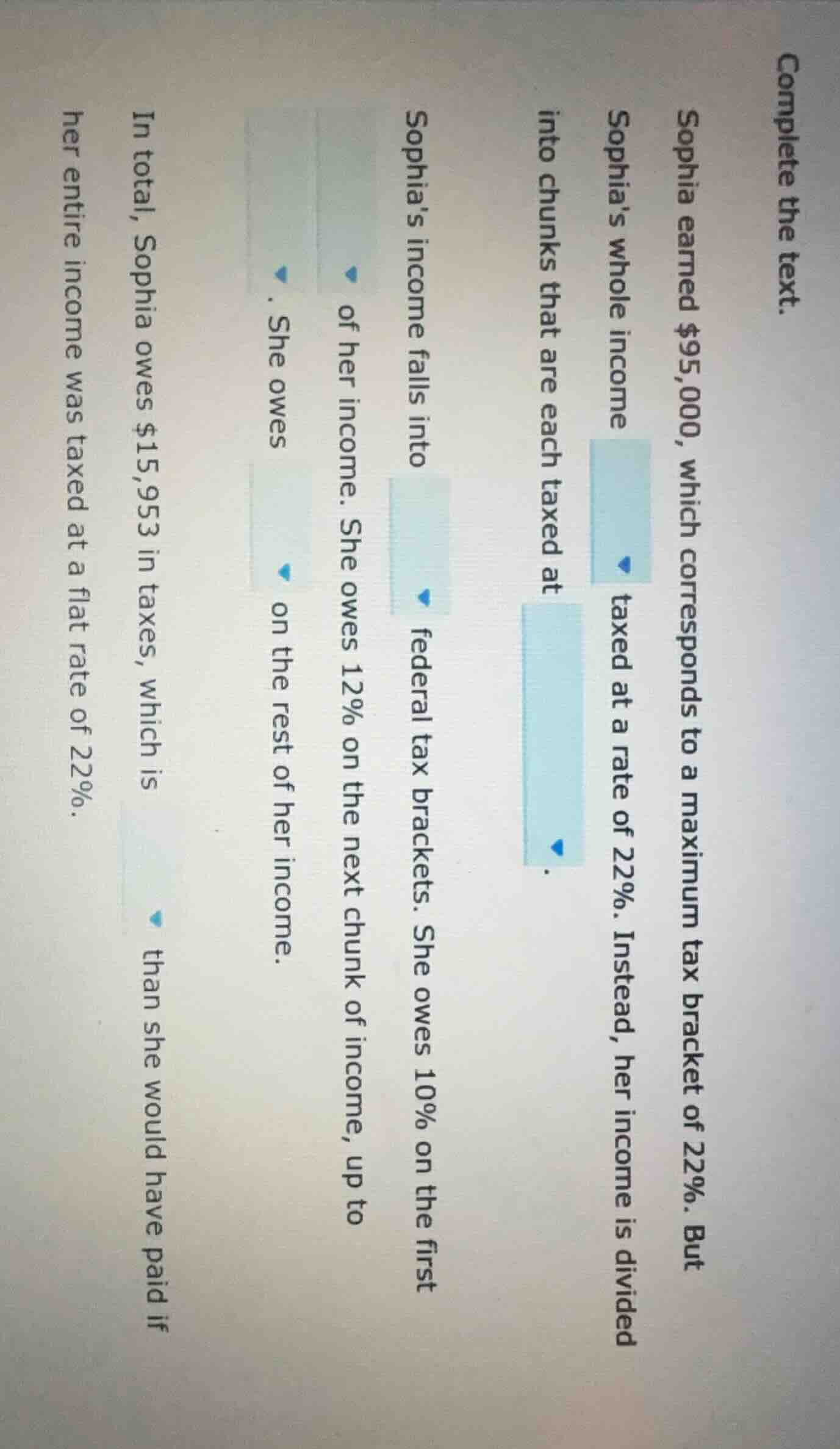
sophia earned $95,000, which corresponds to a maximum tax bracket of 22%. but sophia’s whole income taxed at a rate of 22%. instead, her income is divided into chunks that are each taxed at.
sophia’s income falls into federal tax brackets. she owes 10% on the first of her income. she owes 12% on the next chunk of income, up to. she owes on the rest of her income.
in total, sophia owes $15,953 in taxes, which is than she would have paid if her entire income was taxed at a flat rate of 22%.
To solve this, we analyze the context of income tax brackets (progressive taxation) and flat tax. Let's fill in the blanks logically:
- "But Sophia’s whole income isn’t taxed at a rate of 22%. Instead, her income is divided into chunks that are each taxed at different rates." (Progressive tax has brackets with different rates.)
- "Sophia’s income falls into multiple federal tax brackets. She owes 10% on the first chunk of her income. She owes 12% on the next chunk of income, up to a certain limit (e.g., standard bracket thresholds). She owes 22% on the rest of her income."
- "In total, Sophia owes $15,953 in taxes, which is less than she would have paid if her entire income was taxed at a flat rate of 22%." (Progressive tax is often less than flat tax on the same income, as lower brackets are taxed at lower rates.)
Filled Text:
Sophia earned $95,000, which corresponds to a maximum tax bracket of 22%. But Sophia’s whole income isn’t taxed at a rate of 22%. Instead, her income is divided into chunks that are each taxed at different rates.
Sophia’s income falls into multiple federal tax brackets. She owes 10% on the first chunk of her income. She owes 12% on the next chunk of income, up to $39,475 (example bracket threshold, or adjust per tax rules). She owes 22% on the rest of her income.
In total, Sophia owes $15,953 in taxes, which is less than she would have paid if her entire income was taxed at a flat rate of 22%.
(Note: Specific bracket thresholds (e.g., first chunk up to $9,875, next up to $40,125, etc., per US tax brackets) can replace the placeholder, but the key is explaining progressive vs. flat tax logic.)

Snap & solve any problem in the app
Get step-by-step solutions on Sovi AI
Photo-based solutions with guided steps
Explore more problems and detailed explanations
To solve this, we analyze the context of income tax brackets (progressive taxation) and flat tax. Let's fill in the blanks logically:
- "But Sophia’s whole income isn’t taxed at a rate of 22%. Instead, her income is divided into chunks that are each taxed at different rates." (Progressive tax has brackets with different rates.)
- "Sophia’s income falls into multiple federal tax brackets. She owes 10% on the first chunk of her income. She owes 12% on the next chunk of income, up to a certain limit (e.g., standard bracket thresholds). She owes 22% on the rest of her income."
- "In total, Sophia owes $15,953 in taxes, which is less than she would have paid if her entire income was taxed at a flat rate of 22%." (Progressive tax is often less than flat tax on the same income, as lower brackets are taxed at lower rates.)
Filled Text:
Sophia earned $95,000, which corresponds to a maximum tax bracket of 22%. But Sophia’s whole income isn’t taxed at a rate of 22%. Instead, her income is divided into chunks that are each taxed at different rates.
Sophia’s income falls into multiple federal tax brackets. She owes 10% on the first chunk of her income. She owes 12% on the next chunk of income, up to $39,475 (example bracket threshold, or adjust per tax rules). She owes 22% on the rest of her income.
In total, Sophia owes $15,953 in taxes, which is less than she would have paid if her entire income was taxed at a flat rate of 22%.
(Note: Specific bracket thresholds (e.g., first chunk up to $9,875, next up to $40,125, etc., per US tax brackets) can replace the placeholder, but the key is explaining progressive vs. flat tax logic.)