QUESTION IMAGE
Question
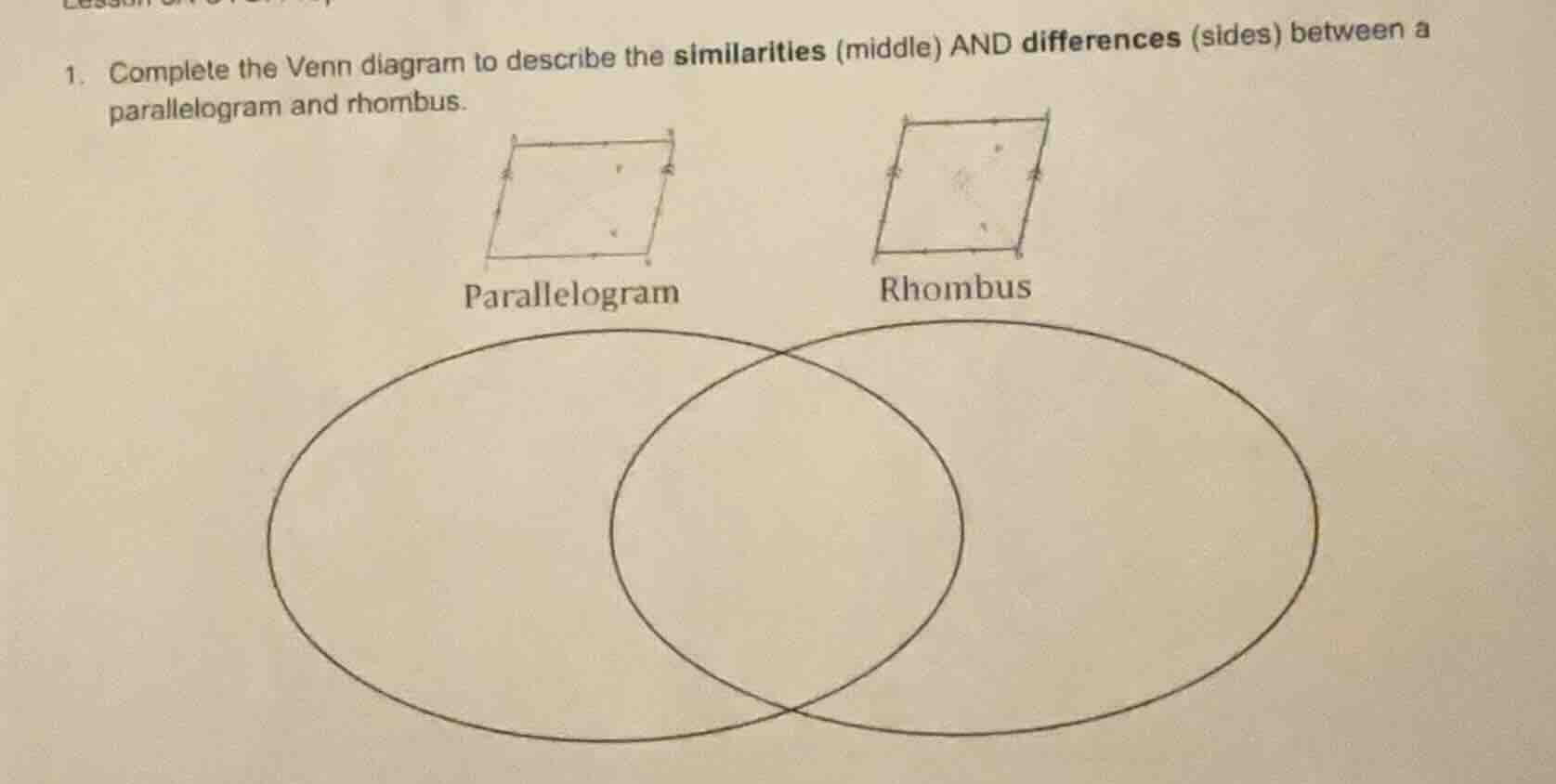
- complete the venn diagram to describe the similarities (middle) and differences (sides) between a parallelogram and rhombus. parallelogram rhombus
Brief Explanations
To complete the Venn diagram, we analyze the properties of parallelograms and rhombuses:
Similarities (Middle, Overlap):
- Both are quadrilaterals.
- Both have opposite sides parallel and equal (defining property of a parallelogram; a rhombus is a type of parallelogram).
- Both have opposite angles equal.
- The sum of interior angles is \( 360^\circ \).
Differences (Sides, Non - Overlap):
- Parallelogram (Left Circle, Not Overlapping):
- Opposite sides are equal, but adjacent sides can be of different lengths (e.g., a rectangle is a parallelogram with adjacent sides of different lengths, unless it is a square).
- Diagonals are equal in length only for special parallelograms (e.g., rectangles), not in general parallelograms.
- Rhombus (Right Circle, Not Overlapping):
- All four sides are equal in length (defining property of a rhombus).
- Diagonals are not equal in length (they bisect each other at right angles, but their lengths differ unless it is a square).

Snap & solve any problem in the app
Get step-by-step solutions on Sovi AI
Photo-based solutions with guided steps
Explore more problems and detailed explanations
Middle (Similarities):
- Quadrilateral
- Opposite sides parallel and equal
- Opposite angles equal
- Sum of interior angles \( 360^\circ \)
Parallelogram (Left, Differences):
- Adjacent sides may have different lengths
- Diagonals not necessarily equal (except in special cases like rectangles)
Rhombus (Right, Differences):
- All four sides are equal
- Diagonals are not equal in length (bisect at right angles)