QUESTION IMAGE
Question
a computer can now translate languages as well as a human
by vanessa bates ramirez (excerpt)
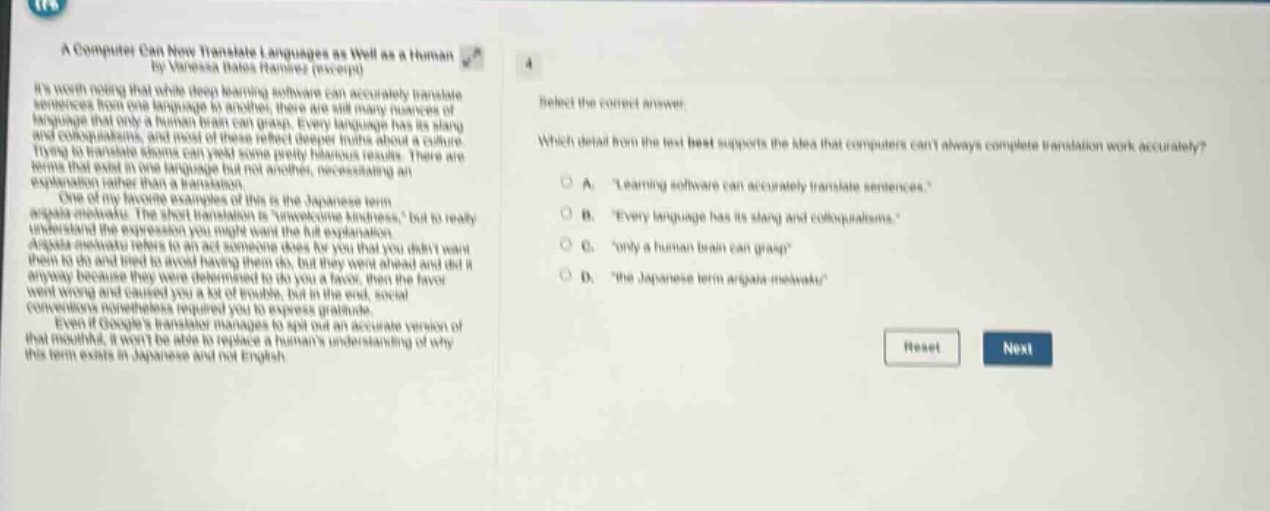
it’s worth noting that while deep learning software can accurately translate
sentences from one language to another, there are still many nuances of
language that only a human brain can grasp. every language has its slang
and colloquialisms, and most of these reflect deeper truths about a culture.
trying to translate idioms can yield some pretty hilarious results. there are
terms that exist in one language but not another, necessitating an
explanation rather than a translation.
one of my favorite examples of this is the japanese term
arigata-meiwaku. the short translation is “unwelcome kindness,” but to really
understand the expression you might want the full explanation.
arigata-meiwaku refers to an act someone does for you that you didn’t want
them to do and tried to avoid having them do, but they went ahead and did it
anyway because they were determined to do you a favor, then the favor
went wrong and they caused you a lot of trouble, but in the end, social
conventions nonetheless required you to express gratitude.
even if google’s translator manages to spit out an accurate version of
that mouthful, it won’t be able to replace a human’s understanding of why
the term exists in japanese and not english
4
select the correct answer.
which detail from the text best supports the idea that computers can’t always complete translation work accurately?
a. “learning software can accurately translate sentences.”
b. “every language has its slang and colloquialisms.”
c. “only a human brain can grasp”
d. “the japanese term arigata-meiwaku”
To determine which detail supports that computers can't always translate accurately, we analyze each option:
- Option A: States that learning software can translate accurately, which goes against the idea, so it's incorrect.
- Option B: Mentions that every language has slang and colloquialisms. However, this alone doesn't directly show that computers can't translate accurately; it's just a characteristic of languages.
- Option C: Says "only a human brain can grasp" (referring to nuances of language like slang, colloquialisms, etc.). Since computers can't grasp these like humans, this shows that there are aspects of language translation that computers can't handle accurately, as these nuances are part of translation work.
- Option D: Just mentions a Japanese term, which doesn't relate to the accuracy of computer translation.

Snap & solve any problem in the app
Get step-by-step solutions on Sovi AI
Photo-based solutions with guided steps
Explore more problems and detailed explanations
C. "only a human brain can grasp"