QUESTION IMAGE
Question
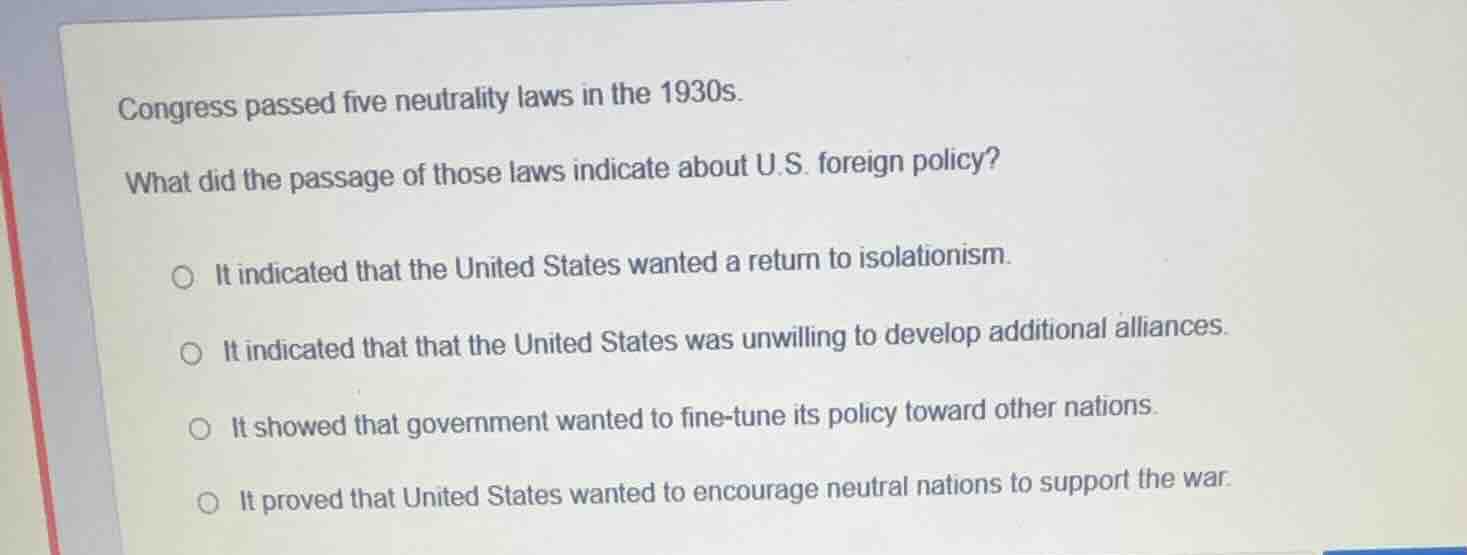
congress passed five neutrality laws in the 1930s.
what did the passage of those laws indicate about u.s. foreign policy?
it indicated that the united states wanted a return to isolationism.
it indicated that that the united states was unwilling to develop additional alliances.
it showed that government wanted to fine - tune its policy toward other nations.
it proved that united states wanted to encourage neutral nations to support the war.
Brief Explanations
To determine the correct answer, we analyze each option:
- Option 1: Isolationism in U.S. foreign policy (especially in the 1930s) involved avoiding foreign conflicts and staying out of international affairs. The Neutrality Acts were passed to prevent U.S. involvement in foreign wars, which aligns with isolationist tendencies.
- Option 2: The Neutrality Acts were more about avoiding war involvement rather than specifically about alliances. Isolationism is a broader concept about staying out of foreign affairs, while the "unwilling to develop alliances" is a narrower aspect and not the main indication of these laws.
- Option 3: "Fine - tuning" implies a minor adjustment, but the Neutrality Acts were a significant shift towards isolationism, not just a minor policy adjustment.
- Option 4: The Neutrality Acts were to keep the U.S. neutral and out of war, not to encourage neutral nations to support a war.

Snap & solve any problem in the app
Get step-by-step solutions on Sovi AI
Photo-based solutions with guided steps
Explore more problems and detailed explanations
A. It indicated that the United States wanted a return to isolationism.