QUESTION IMAGE
Question
are \\(\overline{fg}\\) and \\(\overline{cd}\\) congruent?
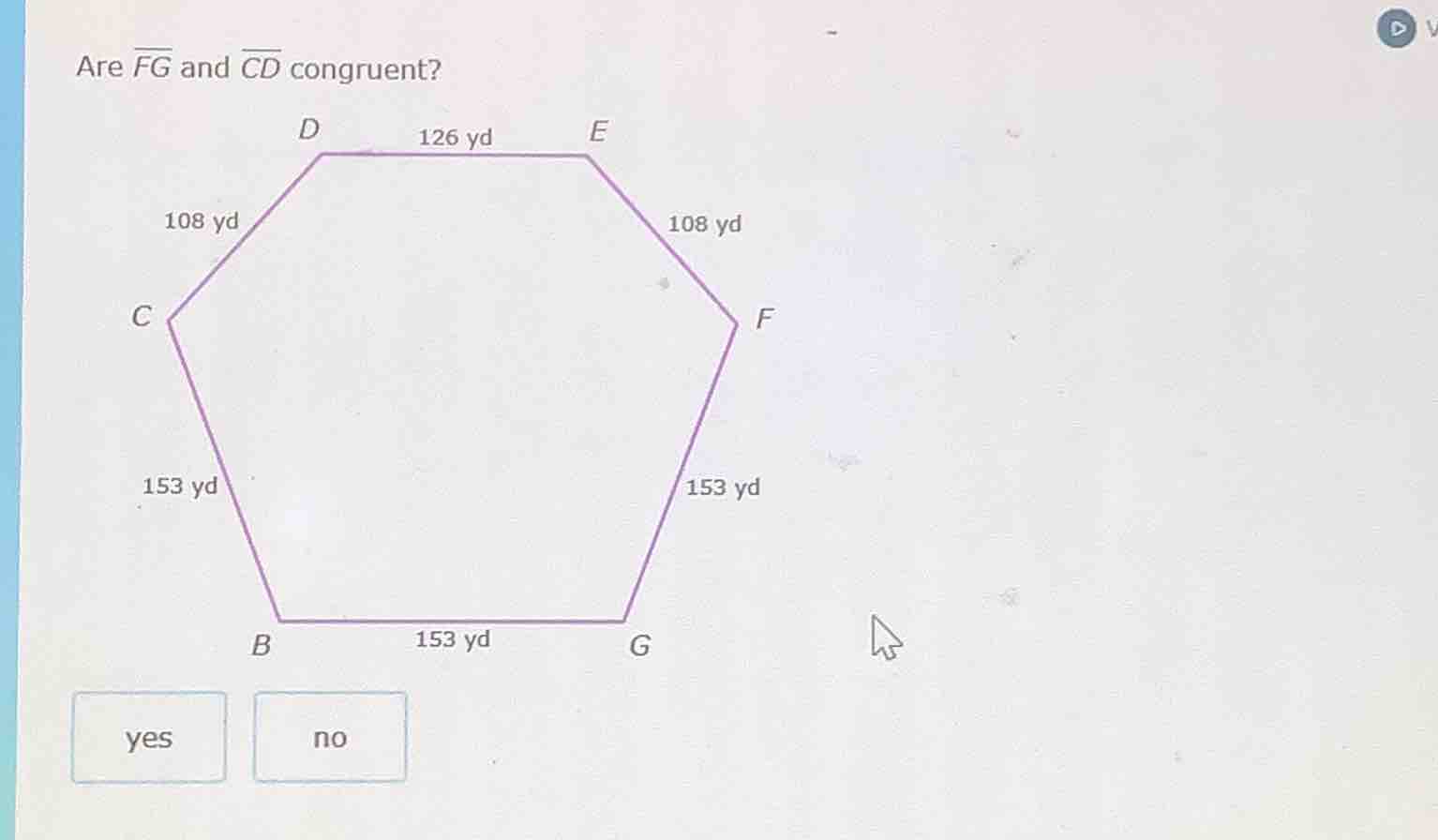
(the image shows a hexagon with labeled sides: d to e is 126 yd, d to c is 108 yd, c to b is 153 yd, b to g is 153 yd, g to f is 153 yd, f to e is 108 yd. there are two buttons: yes and no.)
Step1: Recall congruent segments
Congruent segments have the same length.
Step2: Find lengths of \( \overline{FG} \) and \( \overline{CD} \)
From the diagram, length of \( \overline{CD} = 108 \) yd, length of \( \overline{FG} = 153 \) yd? Wait, no, wait. Wait, let's check again. Wait, \( \overline{CD} \) is 108 yd? Wait no, wait the sides: \( CD \) is 108 yd? Wait no, \( DE \) is 126, \( EF \) is 108, \( FG \) is 153, \( GB \) is 153, \( BC \) is 153? Wait no, wait \( CD \): from \( C \) to \( D \) is 108 yd. \( FG \): from \( F \) to \( G \) is 153 yd? Wait no, that can't be. Wait, no, maybe I misread. Wait, \( BC \) is 153, \( BG \) is 153, \( FG \) is 153? Wait no, the diagram: \( CD = 108 \) yd, \( EF = 108 \) yd, \( FG = 153 \) yd, \( GB = 153 \) yd, \( BC = 153 \) yd? Wait no, no, let's look again. Wait, \( CD \): length 108 yd. \( FG \): length 153 yd? Wait, no, that's not. Wait, maybe I made a mistake. Wait, no, the problem is: are \( \overline{FG} \) and \( \overline{CD} \) congruent? Wait, \( CD \) is 108 yd, \( FG \) is 153 yd? Wait, no, that can't be. Wait, no, maybe the diagram: \( CD \) is 108, \( FG \) is 153? Wait, no, that would be no. But wait, maybe I misread. Wait, no, let's check the labels. The hexagon: vertices D, E, F, G, B, C? Wait, D to E is 126, E to F is 108, F to G is 153, G to B is 153, B to C is 153, C to D is 108. So \( CD = 108 \) yd, \( FG = 153 \) yd? Wait, that's different. So they are not congruent? Wait, no, wait, maybe I got the segments wrong. Wait, the question is \( \overline{FG} \) and \( \overline{CD} \). \( CD \): C to D, length 108. \( FG \): F to G, length 153. So 108 ≠ 153, so answer is no? Wait, but wait, maybe I made a mistake. Wait, no, let's check again. Wait, maybe \( FG \) is 108? No, the diagram shows \( FG = 153 \), \( CD = 108 \). So they are not congruent. Wait, but the options are yes or no. So the answer is no? Wait, but wait, maybe I misread the lengths. Wait, \( CD \): 108 yd, \( FG \): 153 yd. So 108 ≠ 153, so they are not congruent. So the answer is no. Wait, but wait, maybe the diagram is a regular hexagon? No, because DE is 126, others are 108 or 153. So no, it's not regular. So \( CD \) is 108, \( FG \) is 153, so not congruent. So the answer is no. Wait, but wait, maybe I messed up the segments. Wait, \( \overline{CD} \) and \( \overline{FG} \): \( CD \) length 108, \( FG \) length 153. So they are not equal, so not congruent. So the answer is no. Wait, but the options are yes or no. So the correct answer is no? Wait, but let me check again. Wait, the diagram: \( CD \) is 108, \( FG \) is 153. So 108 ≠ 153, so they are not congruent. So the answer is no.

Snap & solve any problem in the app
Get step-by-step solutions on Sovi AI
Photo-based solutions with guided steps
Explore more problems and detailed explanations
no