QUESTION IMAGE
Question
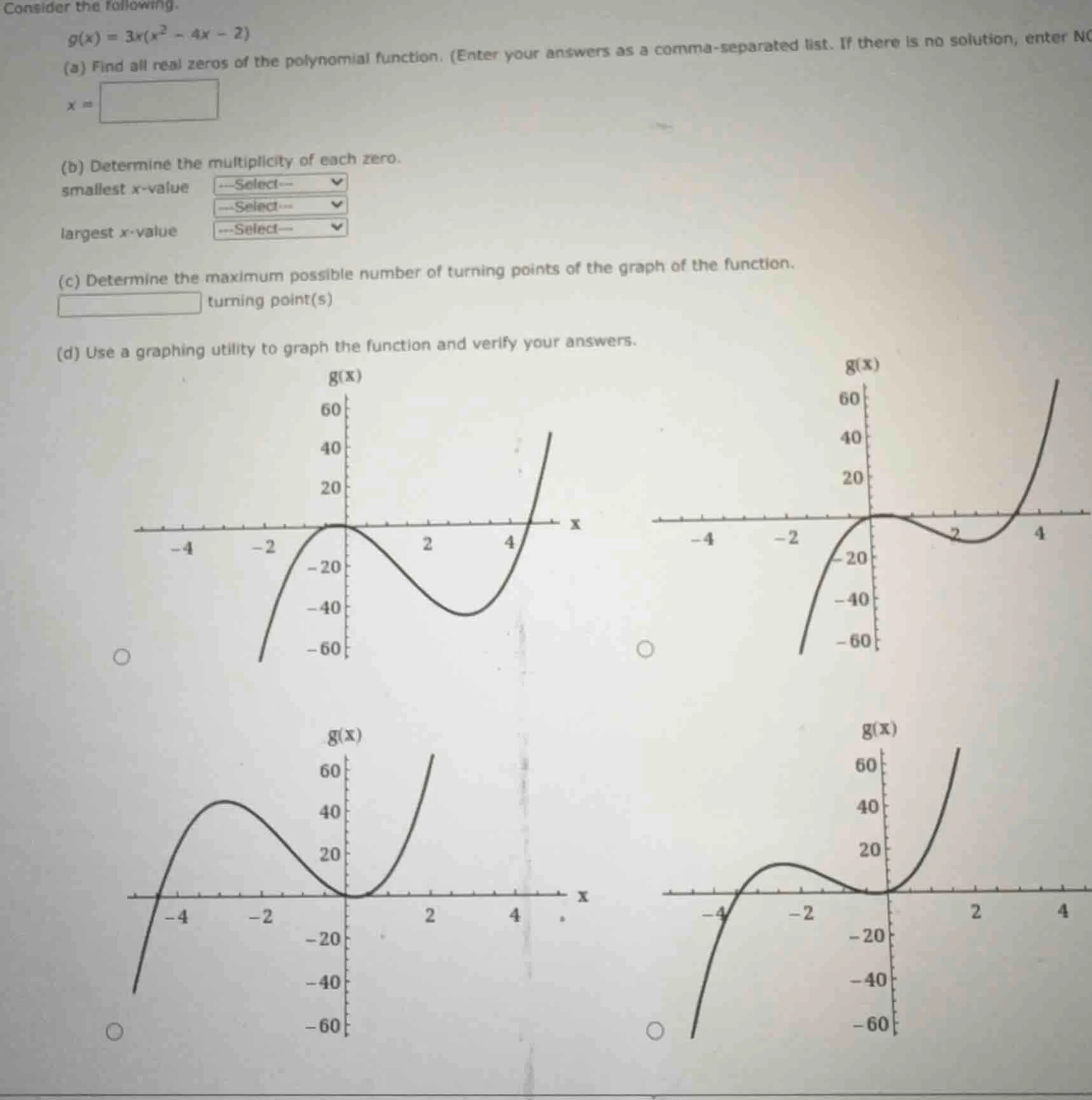
consider the following.\\( g(x) = 3x(x^2 - 4x - 2) \\)\\( \text{(a) find all real zeros of the polynomial function. (enter your answers as a comma-separated list. if there is no solution, enter no} \\)\\( x = \\)\\( \text{(b) determine the multiplicity of each zero.} \\)\\( \text{smallest } x\text{-value} \\) \\( \text{---select---} \\)\\( \text{---select---} \\)\\( \text{largest } x\text{-value} \\) \\( \text{---select---} \\)\\( \text{(c) determine the maximum possible number of turning points of the graph of the function.} \\)\\( \text{turning point(s)} \\)\\( \text{(d) use a graphing utility to graph the function and verify your answers.} \\)
Part (a)
Step1: Set \( g(x) = 0 \)
To find the real zeros of the polynomial function \( g(x)=3x(x^{2}-4x - 2) \), we set \( g(x) = 0 \). So we have the equation:
\[ 3x(x^{2}-4x - 2)=0 \]
Step2: Solve for \( x \)
Using the zero - product property, if \( ab = 0 \), then either \( a = 0 \) or \( b = 0 \).
- Case 1: \( 3x=0 \), then \( x = 0 \).
- Case 2: \( x^{2}-4x - 2=0 \). We use the quadratic formula \( x=\frac{-b\pm\sqrt{b^{2}-4ac}}{2a} \) for a quadratic equation \( ax^{2}+bx + c = 0 \). Here, \( a = 1 \), \( b=-4 \), \( c=-2 \).
\[
\]
Calculating the numerical values: \( \sqrt{6}\approx2.45 \), so \( 2+\sqrt{6}\approx4.45 \) and \( 2 - \sqrt{6}\approx - 0.45 \)
So the real zeros are \( x = 0,2-\sqrt{6},2 + \sqrt{6} \) (or in approximate form \( x=0, - 0.45,4.45 \))
Part (b)
The multiplicity of a zero of a polynomial function \( y = f(x) \) is the number of times the factor corresponding to that zero appears in the factored form of the polynomial.
- For the zero \( x = 2-\sqrt{6} \) (from the factor \( x-(2 - \sqrt{6}) \) which comes from \( x^{2}-4x - 2=(x-(2 - \sqrt{6}))(x-(2+\sqrt{6})) \)), the multiplicity is 1.
- For the zero \( x = 0 \) (from the factor \( 3x = 3\times x \)), the multiplicity is 1.
- For the zero \( x = 2+\sqrt{6} \) (from the factor \( x-(2+\sqrt{6}) \)), the multiplicity is 1.
Part (c)
Step1: Recall the formula for turning points
The maximum number of turning points of a polynomial function of degree \( n \) is \( n - 1 \).
Step2: Find the degree of \( g(x) \)
The polynomial \( g(x)=3x(x^{2}-4x - 2)=3x^{3}-12x^{2}-6x \) is a cubic polynomial, so the degree \( n = 3 \).
Step3: Calculate the number of turning points
Using the formula \( n - 1 \), we substitute \( n = 3 \). So the maximum number of turning points is \( 3-1=2 \)
Part (a) Answer: \( 0,2 - \sqrt{6},2+\sqrt{6} \) (or approximately \( 0,-0.45,4.45 \))
Part (b) Answer:
- For the smallest \( x \) - value (\( 2-\sqrt{6}\approx - 0.45 \)): multiplicity 1
- For \( x = 0 \): multiplicity 1
- For the largest \( x \) - value (\( 2+\sqrt{6}\approx4.45 \)): multiplicity 1
Part (c) Answer: 2

Snap & solve any problem in the app
Get step-by-step solutions on Sovi AI
Photo-based solutions with guided steps
Explore more problems and detailed explanations
Step1: Recall the formula for turning points
The maximum number of turning points of a polynomial function of degree \( n \) is \( n - 1 \).
Step2: Find the degree of \( g(x) \)
The polynomial \( g(x)=3x(x^{2}-4x - 2)=3x^{3}-12x^{2}-6x \) is a cubic polynomial, so the degree \( n = 3 \).
Step3: Calculate the number of turning points
Using the formula \( n - 1 \), we substitute \( n = 3 \). So the maximum number of turning points is \( 3-1=2 \)
Part (a) Answer: \( 0,2 - \sqrt{6},2+\sqrt{6} \) (or approximately \( 0,-0.45,4.45 \))
Part (b) Answer:
- For the smallest \( x \) - value (\( 2-\sqrt{6}\approx - 0.45 \)): multiplicity 1
- For \( x = 0 \): multiplicity 1
- For the largest \( x \) - value (\( 2+\sqrt{6}\approx4.45 \)): multiplicity 1