QUESTION IMAGE
Question
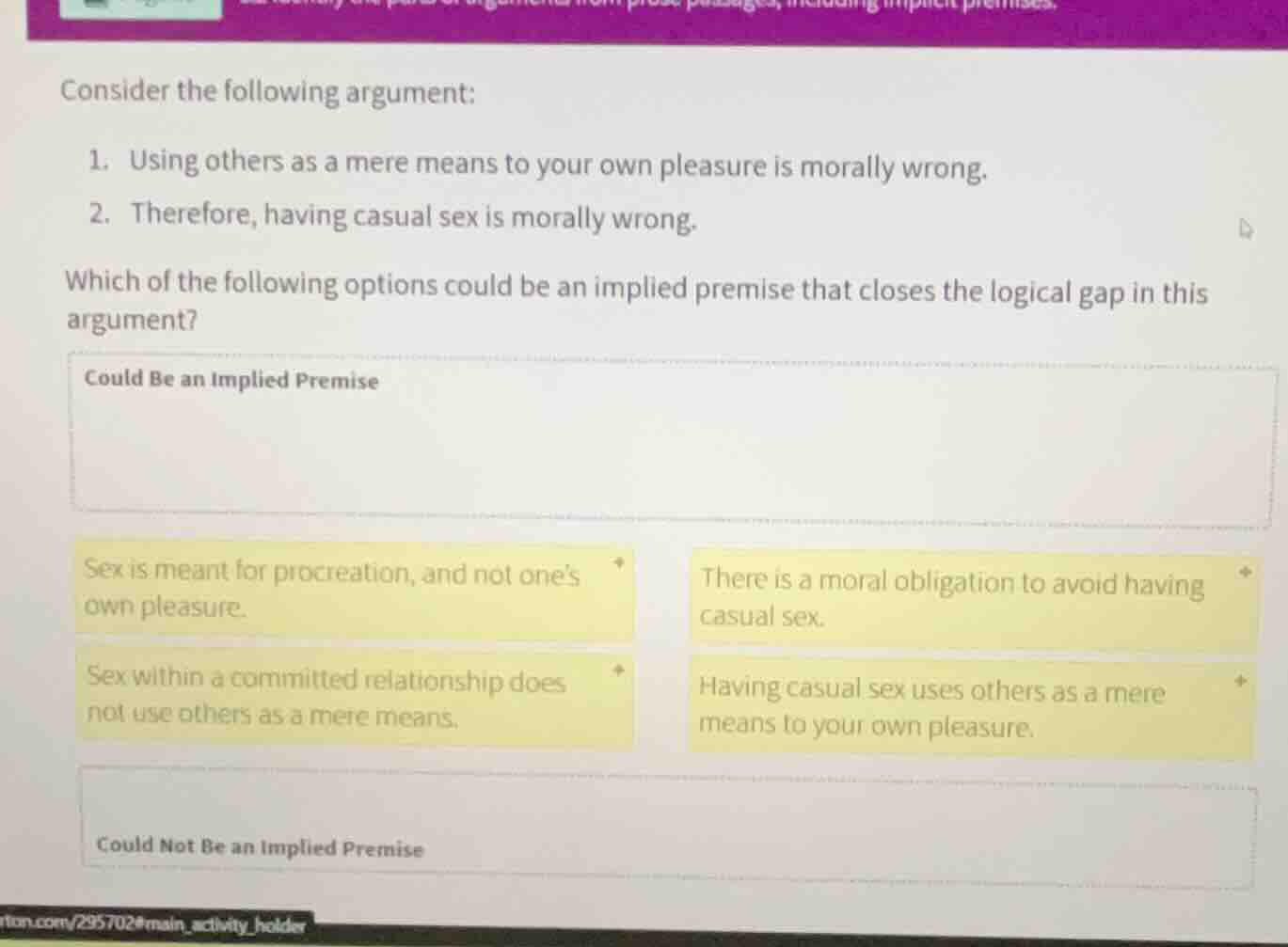
consider the following argument:
- using others as a mere means to your own pleasure is morally wrong.
- therefore, having casual sex is morally wrong.
which of the following options could be an implied premise that closes the logical gap in this argument?
could be an implied premise
sex is meant for procreation, and not one’s own pleasure. there is a moral obligation to avoid having casual sex.
sex within a committed relationship does not use others as a mere means. having casual sex uses others as a mere means to your own pleasure.
could not be an implied premise
An implied premise must connect the given premise (using others as a mere means for pleasure is wrong) to the conclusion (casual sex is wrong). It needs to link casual sex to the action described in the first premise.
- The statement "Having casual sex uses others as a mere means to your own pleasure" directly bridges this gap, making the argument logically complete.
- The other options either introduce unrelated moral claims, focus on committed relationships, or restate the conclusion, which do not close the logical gap between the given premise and conclusion.

Snap & solve any problem in the app
Get step-by-step solutions on Sovi AI
Photo-based solutions with guided steps
Explore more problems and detailed explanations
Could Be an Implied Premise
Having casual sex uses others as a mere means to your own pleasure.
Could Not Be an Implied Premise
Sex is meant for procreation, and not one's own pleasure.
There is a moral obligation to avoid having casual sex.
Sex within a committed relationship does not use others as a mere means.