QUESTION IMAGE
Question
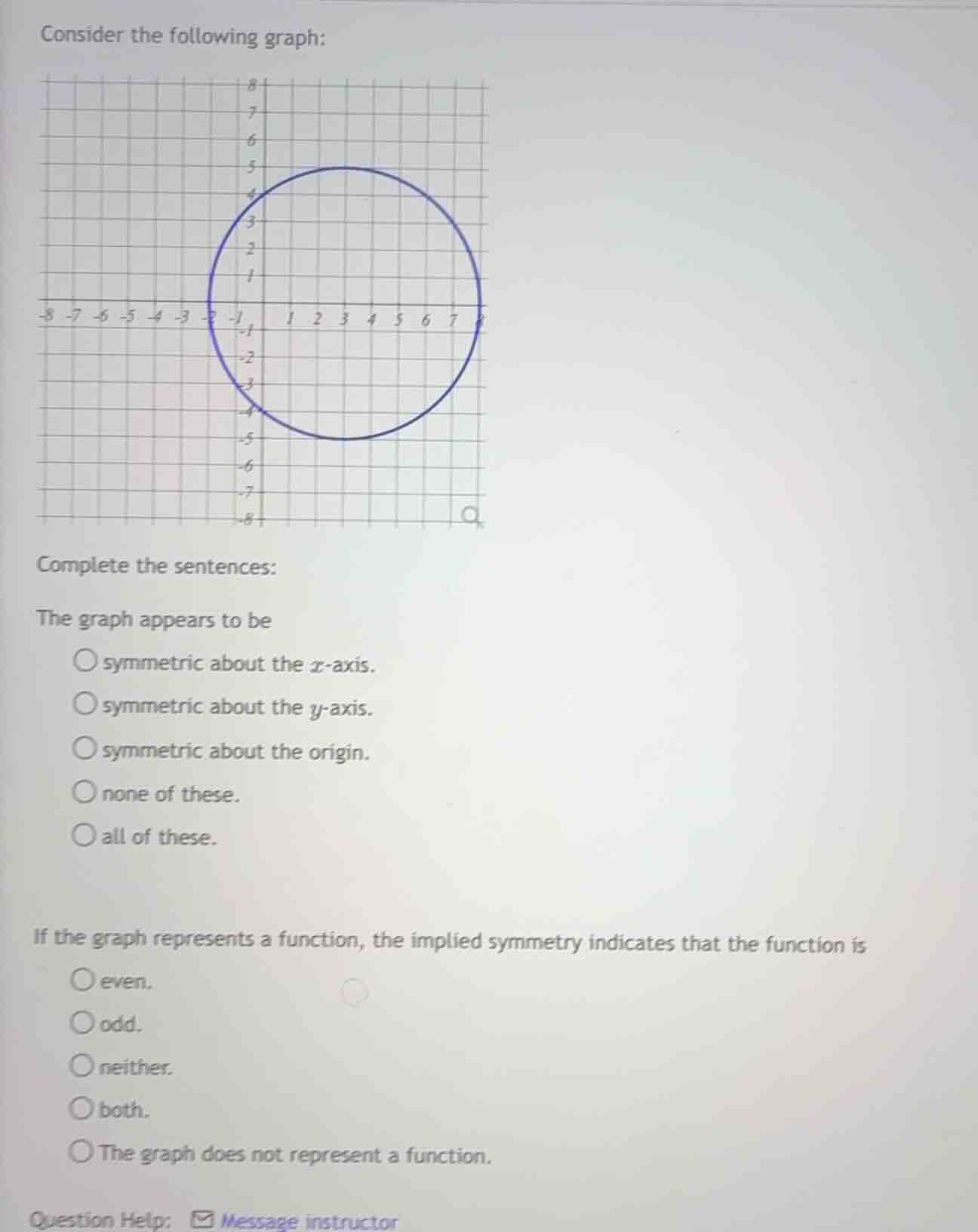
consider the following graph:complete the sentences:the graph appears to be\\(\bigcirc\\) symmetric about the \\(x\\)-axis.\\(\bigcirc\\) symmetric about the \\(y\\)-axis.\\(\bigcirc\\) symmetric about the origin.\\(\bigcirc\\) none of these.\\(\bigcirc\\) all of these.if the graph represents a function, the implied symmetry indicates that the function is\\(\bigcirc\\) even.\\(\bigcirc\\) odd.\\(\bigcirc\\) neither.\\(\bigcirc\\) both.\\(\bigcirc\\) the graph does not represent a function.question help: \\(\boldsymbol{\square}\\) message instructor
- For symmetry: A graph symmetric about the origin means that for every point $(x,y)$ on the graph, the point $(-x,-y)$ is also on the graph. Observing the circle, this property holds, while it is not symmetric about the x-axis or y-axis alone.
- For function type: First, using the vertical line test, a vertical line can intersect the circle at two points, so it does not represent a function.

Snap & solve any problem in the app
Get step-by-step solutions on Sovi AI
Photo-based solutions with guided steps
Explore more problems and detailed explanations
The graph appears to be
$\boldsymbol{\circ}$ symmetric about the origin.
If the graph represents a function, the implied symmetry indicates that the function is
$\boldsymbol{\circ}$ The graph does not represent a function.