QUESTION IMAGE
Question
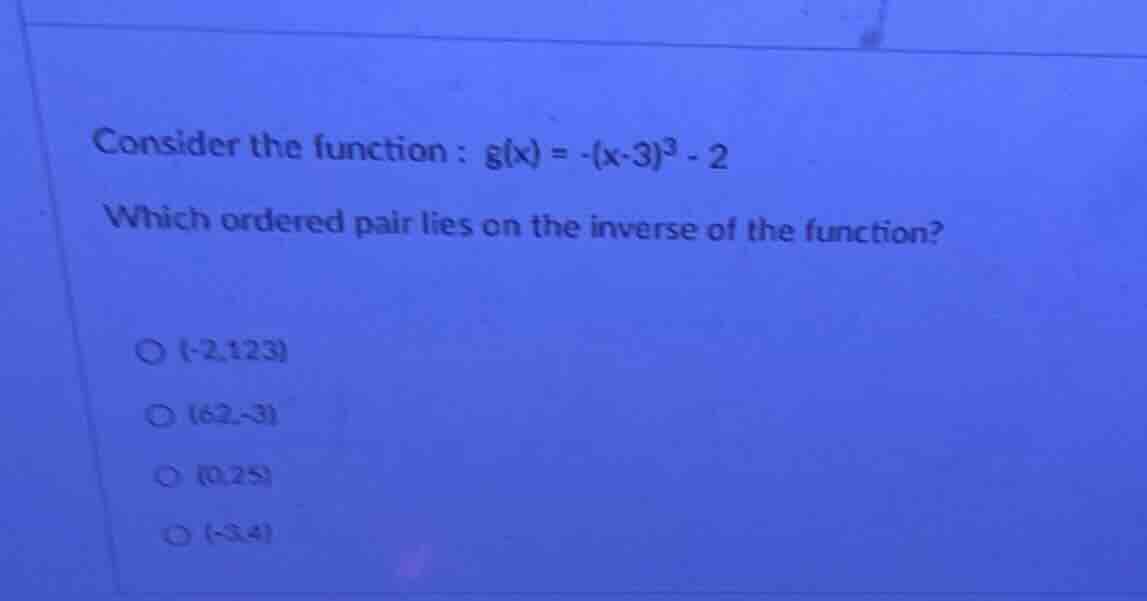
consider the function : g(x) = -(x - 3)^3 - 2
which ordered pair lies on the inverse of the function?
○ (-2,123)
○ (62,-3)
○ (0,25)
○ (-3,4)
Step1: Recall the property of inverse functions
If \((a, b)\) lies on \(g(x)\), then \((b, a)\) lies on \(g^{-1}(x)\). So we can check each option by plugging the \(y\)-value into \(g(x)\) and see if we get the \(x\)-value.
Step2: Check option \((-2, 123)\)
Plug \(y = -2\) into \(g(x)=-(x - 3)^3-2\):
\[
-2=-(x - 3)^3-2
\]
Add 2 to both sides:
\[
0=-(x - 3)^3
\]
Multiply both sides by - 1:
\[
0=(x - 3)^3
\]
Take cube - root of both sides: \(x-3 = 0\Rightarrow x = 3
eq123\). So \((-2,123)\) does not lie on the inverse.
Step3: Check option \((62,-3)\)
Plug \(y = 62\) into \(g(x)=-(x - 3)^3-2\):
\[
62=-(x - 3)^3-2
\]
Add 2 to both sides:
\[
64=-(x - 3)^3
\]
Multiply both sides by - 1:
\[
- 64=(x - 3)^3
\]
Take cube - root of both sides: \(x - 3=\sqrt[3]{-64}=-4\)
Then \(x=-4 + 3=-1
eq - 3\). Wait, we made a mistake. Let's plug \(x=-3\) into \(g(x)\):
\(g(-3)=-(-3 - 3)^3-2=-(-6)^3-2=216 - 2=214
eq62\). Wait, let's use the inverse property correctly. If \((x,y)\) is on \(g^{-1}\), then \((y,x)\) is on \(g\). Let's check for \((62,-3)\), we need to check if \(g(-3)=62\). \(g(-3)=-(-3 - 3)^3-2=-(-6)^3-2 = 216-2=214
eq62\). Wait, maybe we should check the other way. Let's find the inverse function.
Let \(y=-(x - 3)^3-2\)
Swap \(x\) and \(y\): \(x=-(y - 3)^3-2\)
Solve for \(y\):
\(x + 2=-(y - 3)^3\)
\(-(x + 2)=(y - 3)^3\)
\(y-3=\sqrt[3]{-(x + 2)}=-\sqrt[3]{x + 2}\)
\(y=3-\sqrt[3]{x + 2}\)
Now check option \((-3,4)\):
Plug \(x=-3\) into \(y = 3-\sqrt[3]{x + 2}\)
\(y=3-\sqrt[3]{-3 + 2}=3-\sqrt[3]{-1}=3+1 = 4\). Wait, the option is \((-3,4)\)? Wait, the original options: one of the options is \((-3,4)\)? Wait, the user's options: \((-2,123)\), \((62,-3)\), \((0,25)\), \((-3,4)\). Let's re - check.
Wait, let's use the property of inverse functions: If \((a,b)\) is on \(g(x)\), then \((b,a)\) is on \(g^{-1}(x)\). Let's find \(g(4)\):
\(g(4)=-(4 - 3)^3-2=-(1)^3-2=-1 - 2=-3\)
So since \((4,-3)\) is on \(g(x)\), then \((-3,4)\) is on \(g^{-1}(x)\).

Snap & solve any problem in the app
Get step-by-step solutions on Sovi AI
Photo-based solutions with guided steps
Explore more problems and detailed explanations
\((-3,4)\) (assuming the option is \((-3,4)\))