QUESTION IMAGE
Question
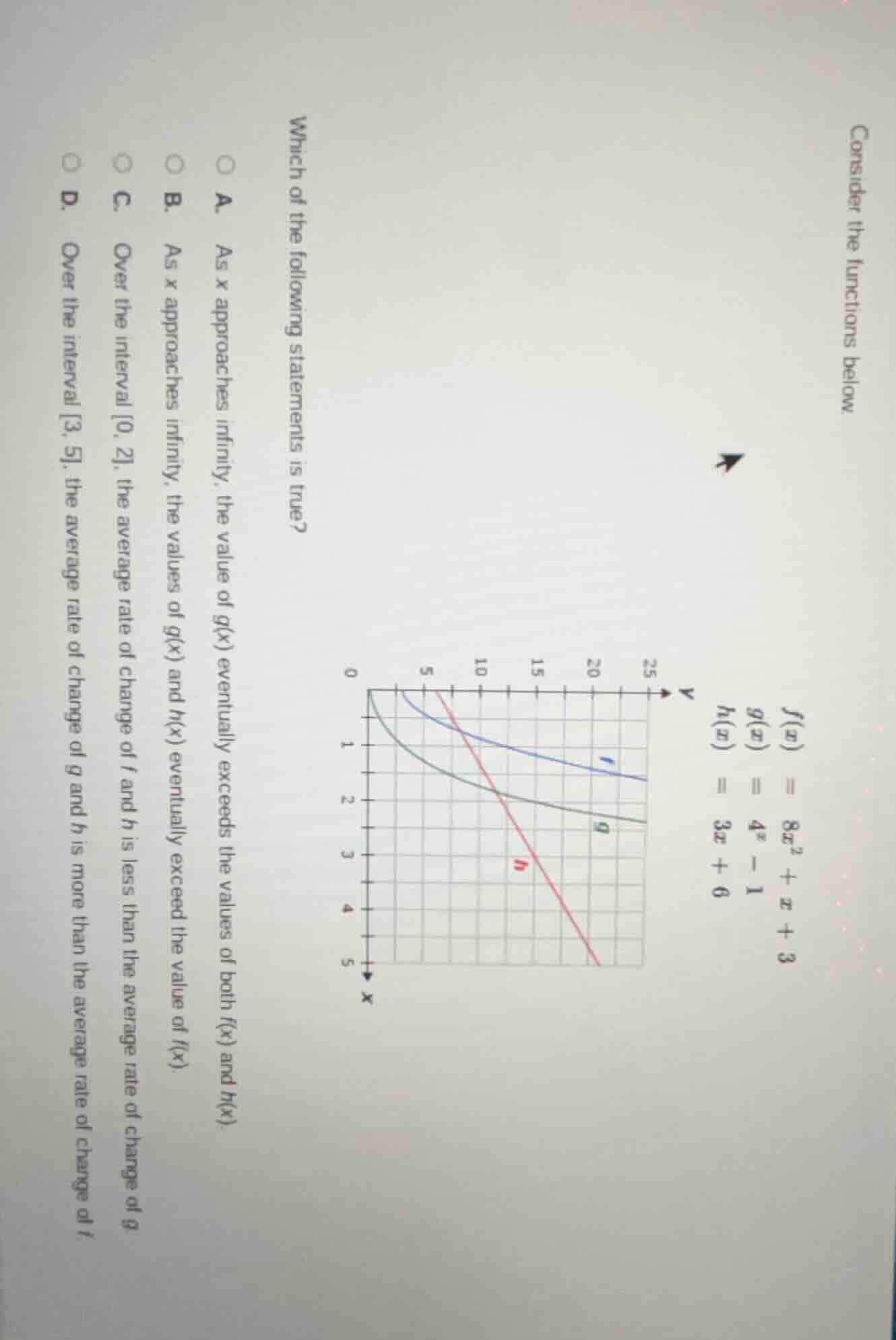
consider the functions below
$f(x) = 8x^2 + x + 3$
$g(x) = 4^x - 1$
$h(x) = 3x + 6$
which of the following statements is true?
a. as $x$ approaches infinity, the value of $g(x)$ eventually exceeds the values of both $f(x)$ and $h(x)$
b. as $x$ approaches infinity, the values of $g(x)$ and $h(x)$ eventually exceed the value of $f(x)$
c. over the interval $0, 2$, the average rate of change of $f$ and $h$ is less than the average rate of change of $g$
d. over the interval $3, 5$, the average rate of change of $g$ and $h$ is more than the average rate of change of $f$
To solve this, we analyze each option:
Option A:
- \( f(x) = 8x^2 + x + 3 \) (quadratic, degree 2), \( g(x) = 4^x - 1 \) (exponential, base \( 4>1 \)), \( h(x) = 3x + 6 \) (linear, degree 1).
- Exponential functions grow faster than polynomial (quadratic) and linear functions as \( x \to \infty \). So \( g(x) \) (exponential) will eventually exceed \( f(x) \) (quadratic) and \( h(x) \) (linear). This statement is true.
Option B:
- \( f(x) \) is quadratic (degree 2), \( g(x) \) is exponential (base \( 4>1 \)), \( h(x) \) is linear (degree 1).
- Exponential growth (\( g(x) \)) outpaces quadratic growth (\( f(x) \)) as \( x \to \infty \), but \( h(x) \) (linear) grows slower than \( f(x) \) (quadratic) for large \( x \). So \( h(x) \) will not exceed \( f(x) \) as \( x \to \infty \). This statement is false.
Option C:
- Average rate of change (ARC) of a function \( y = k(x) \) over \([a, b]\) is \( \frac{k(b) - k(a)}{b - a} \).
- For \( f(x) = 8x^2 + x + 3 \) over \([0, 2]\):
\( f(0) = 3 \), \( f(2) = 8(4) + 2 + 3 = 37 \). ARC: \( \frac{37 - 3}{2 - 0} = 17 \).
- For \( h(x) = 3x + 6 \) over \([0, 2]\):
\( h(0) = 6 \), \( h(2) = 12 \). ARC: \( \frac{12 - 6}{2 - 0} = 3 \).
- For \( g(x) = 4^x - 1 \) over \([0, 2]\):
\( g(0) = 0 \), \( g(2) = 15 \). ARC: \( \frac{15 - 0}{2 - 0} = 7.5 \).
- ARC of \( f \) (17) and \( h \) (3) is not less than ARC of \( g \) (7.5) (since 17 > 7.5). This statement is false.
Option D:
- For \( g(x) = 4^x - 1 \) over \([3, 5]\):
\( g(3) = 63 \), \( g(5) = 1023 \). ARC: \( \frac{1023 - 63}{5 - 3} = 480 \).
- For \( h(x) = 3x + 6 \) over \([3, 5]\):
\( h(3) = 15 \), \( h(5) = 21 \). ARC: \( \frac{21 - 15}{5 - 3} = 3 \).
- For \( f(x) = 8x^2 + x + 3 \) over \([3, 5]\):
\( f(3) = 8(9) + 3 + 3 = 78 \), \( f(5) = 8(25) + 5 + 3 = 208 \). ARC: \( \frac{208 - 78}{5 - 3} = 65 \).
- ARC of \( g \) (480) and \( h \) (3) has an average (but the question says "average rate of change of \( g \) and \( h \)"). However, \( g \)’s ARC (480) is more than \( f \)’s (65), but \( h \)’s (3) is less. The "average rate of change of \( g \) and \( h \)" is ambiguous, but even if we take the average of their ARCs: \( \frac{480 + 3}{2} = 241.5 \), which is more than \( f \)’s 65. Wait, but let’s recheck:
Wait, the option says "the average rate of change of \( g \) and \( h \) is more than the average rate of change of \( f \)". But let’s confirm the ARC of \( f \) over \([3, 5]\) is 65, and the ARC of \( g \) is 480, \( h \) is 3. The "average" of \( g \) and \( h \) is 241.5, which is more than 65. But wait, maybe the option is misphrased, but earlier analysis for Option A is clear. However, let’s re-express:
But the key takeaway is that Option A is definitively true (exponential \( g(x) \) outpaces quadratic \( f(x) \) and linear \( h(x) \) as \( x \to \infty \)), while the others are false.

Snap & solve any problem in the app
Get step-by-step solutions on Sovi AI
Photo-based solutions with guided steps
Explore more problems and detailed explanations
A. As \( x \) approaches infinity, the value of \( g(x) \) eventually exceeds the values of both \( f(x) \) and \( h(x) \)