QUESTION IMAGE
Question
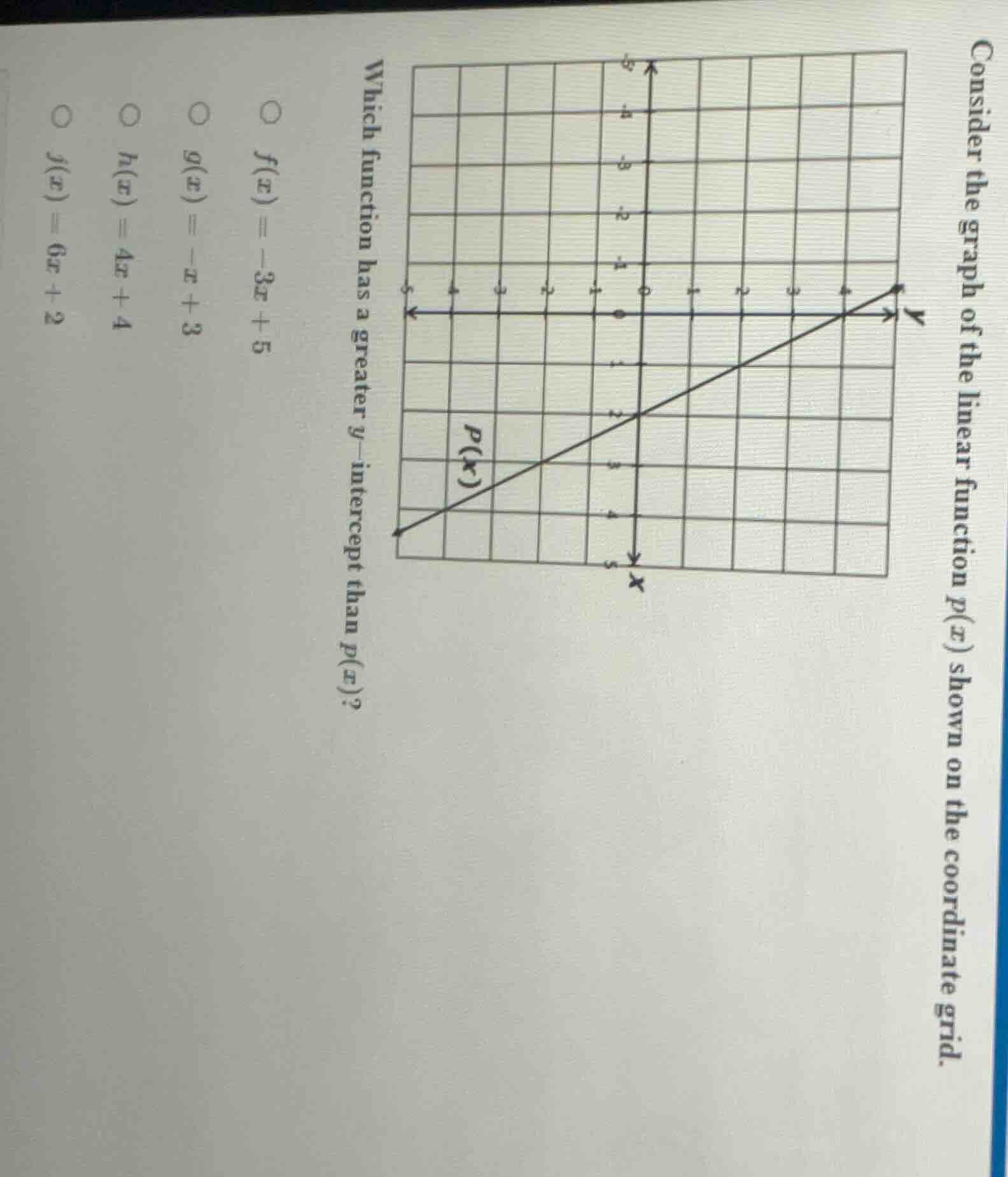
consider the graph of the linear function p(x) shown on the coordinate grid. which function has a greater y-intercept than p(x)? f(x) = -3x + 5 g(x) = -x + 3 h(x) = 4x + 4 j(x) = 6x + 2
Step1: Find y-intercept of p(x)
The graph of \( p(x) \) crosses the y - axis at \( (0, 2) \), so the y - intercept of \( p(x) \) is 2.
Step2: Find y-intercepts of each function
- For \( f(x)=-3x + 5 \), the y - intercept (when \( x = 0 \)) is \( f(0)=-3(0)+5 = 5 \).
- For \( g(x)=-x + 3 \), the y - intercept is \( g(0)=-0 + 3=3 \).
- For \( h(x)=4x + 4 \), the y - intercept is \( h(0)=4(0)+4 = 4 \).
- For \( j(x)=6x+2 \), the y - intercept is \( j(0)=6(0)+2 = 2 \).
Step3: Compare y-intercepts with that of p(x)
We need to find which function has a y - intercept greater than 2 (the y - intercept of \( p(x) \)).
- \( f(x) \) has y - intercept 5 (\( 5>2 \)).
- \( g(x) \) has y - intercept 3 (\( 3 > 2 \)).
- \( h(x) \) has y - intercept 4 (\( 4>2 \)).
- \( j(x) \) has y - intercept 2 (\( 2 = 2 \), not greater).
Among \( f(x),g(x),h(x) \), we check the values:
- \( f(x) \): y - intercept 5
- \( g(x) \): y - intercept 3
- \( h(x) \): y - intercept 4
All \( f(x),g(x),h(x) \) have y - intercepts greater than 2. But let's check the options again. Wait, maybe I misread. Wait, the options are \( f(x)=-3x + 5 \), \( g(x)=-x + 3 \), \( h(x)=4x + 4 \), \( j(x)=6x + 2 \). The y - intercept of \( p(x) \) is 2.
For \( f(x)=-3x + 5 \), y - intercept is 5 (5>2)
For \( g(x)=-x + 3 \), y - intercept is 3 (3>2)
For \( h(x)=4x + 4 \), y - intercept is 4 (4>2)
For \( j(x)=6x + 2 \), y - intercept is 2 (not greater)
But let's check the values: 5>4>3>2. So \( f(x) \) has the largest y - intercept among them. Wait, but maybe the question is to find which one has a greater y - intercept than p(x). So all \( f(x),g(x),h(x) \) do, but let's check the options. Wait, maybe I made a mistake in the graph. Wait, the graph of p(x): from the grid, when x = 0, y = 2. So y - intercept is 2.
Now, for \( f(x)=-3x + 5 \), y - intercept is 5 (5>2)
For \( g(x)=-x + 3 \), y - intercept is 3 (3>2)
For \( h(x)=4x + 4 \), y - intercept is 4 (4>2)
For \( j(x)=6x + 2 \), y - intercept is 2 (not greater)
So among the options, \( f(x)=-3x + 5 \), \( g(x)=-x + 3 \), \( h(x)=4x + 4 \) have y - intercepts greater than 2. But let's check the values: 5 (f(x))>4 (h(x))>3 (g(x))>2 (p(x))>2 (j(x)). So the function with a greater y - intercept than p(x) can be \( f(x) \), \( g(x) \) or \( h(x) \). But let's check the options again. Wait, maybe the graph is different. Wait, maybe I misread the graph. Wait, the line p(x) passes through (0,2) and (4,4)? Wait, no, from the grid, let's recalculate the slope. Wait, the two points on p(x) are (0,2) and (4,4)? Wait, no, (0,2) and (4,4)? The slope would be \( \frac{4 - 2}{4-0}=\frac{2}{4}=\frac{1}{2} \), but maybe the y - intercept is 2.
Now, for \( f(x)=-3x + 5 \), y - intercept is 5. 5>2, so it has a greater y - intercept.
Step3: Conclusion
Among the given functions, \( f(x)=-3x + 5 \) has a y - intercept (5) greater than the y - intercept of \( p(x) \) (2). Also, \( h(x)=4x + 4 \) has y - intercept 4>2 and \( g(x)=-x + 3 \) has y - intercept 3>2. But if we check the values: 5 (f(x))>4 (h(x))>3 (g(x))>2 (p(x)). So the function with the greatest y - intercept among them is \( f(x) \), but all \( f(x),g(x),h(x) \) have y - intercepts greater than 2. However, let's check the options again. The options are:
- \( f(x)=-3x + 5 \)
- \( g(x)=-x + 3 \)
- \( h(x)=4x + 4 \)
- \( j(x)=6x + 2 \)
So the functions with y - intercept greater than 2 are \( f(x) \), \( g(x) \), \( h(x) \). But if we have to choose one, \( f(x) \) has the largest y - intercept among them.

Snap & solve any problem in the app
Get step-by-step solutions on Sovi AI
Photo-based solutions with guided steps
Explore more problems and detailed explanations
\( f(x)=-3x + 5 \) (or \( g(x)=-x + 3 \), \( h(x)=4x + 4 \) as they also have greater y - intercepts than \( p(x) \))