QUESTION IMAGE
Question
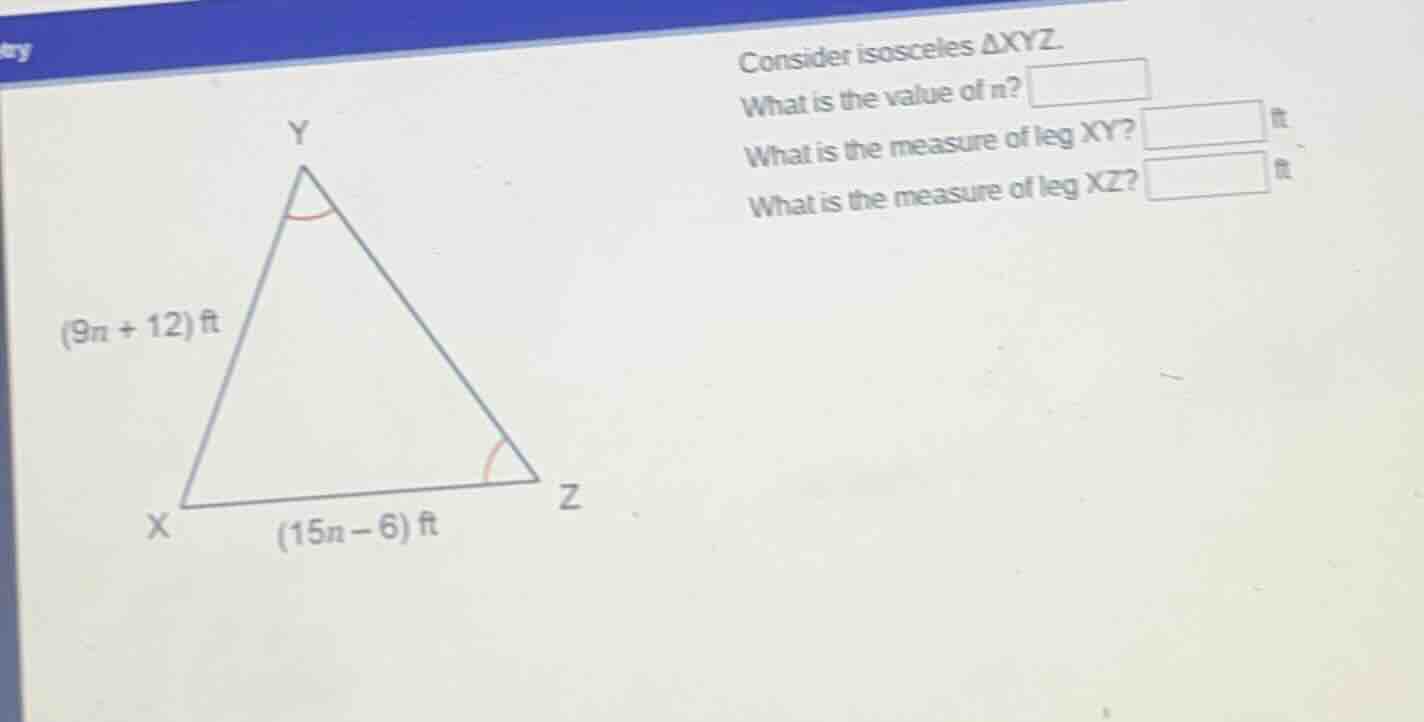
consider isosceles δxyz. what is the value of n? what is the measure of leg xy? ft what is the measure of leg xz? ft (9n + 12) ft (15n − 6) ft
Step1: Set equal sides (isosceles triangle)
In an isosceles triangle, the sides opposite equal angles are equal. Here, \( XY = XZ \)? Wait, no, looking at the angles: angle \( Y \) and angle \( Z \) are marked equal? Wait, the side \( XY \) is \( (9n + 12) \) ft, and side \( XZ \)? Wait, no, the base is \( XZ \)? Wait, no, the triangle is \( \triangle XYZ \), with \( XY \) and \( YZ \) as legs? Wait, no, the angles at \( Y \) and \( Z \) are equal (marked with red arcs), so the sides opposite them are equal. The side opposite angle \( Y \) is \( XZ \), and the side opposite angle \( Z \) is \( XY \). Wait, no, angle at \( Y \) is vertex \( Y \), so sides: \( XY \) and \( YZ \)? Wait, maybe I misread. Wait, the side \( XY \) is \( (9n + 12) \) ft, and the side \( XZ \) is \( (15n - 6) \) ft? No, wait, the base is \( XZ \), length \( (15n - 6) \) ft, and \( XY \) is \( (9n + 12) \) ft. Wait, no, in an isosceles triangle with equal angles at \( Y \) and \( Z \), the sides \( XY \) and \( XZ \) are equal? Wait, no, angle at \( Y \) and angle at \( Z \): side opposite angle \( Y \) is \( XZ \), side opposite angle \( Z \) is \( XY \). So \( XY = XZ \)? Wait, no, \( XY \) is \( (9n + 12) \), \( XZ \) is \( (15n - 6) \)? Wait, maybe the equal sides are \( XY \) and \( YZ \)? Wait, maybe I made a mistake. Wait, the problem: in \( \triangle XYZ \), isosceles, so two sides are equal. Let's assume that \( XY = YZ \)? No, the given sides: \( XY = (9n + 12) \), and the other leg (if \( XZ \) is the base) no, the base is \( XZ \) with length \( (15n - 6) \), and \( XY \) is a leg. Wait, maybe the equal sides are \( XY \) and \( XZ \)? Wait, no, let's check the angles. The angles at \( Y \) and \( Z \) are equal, so the sides opposite them are equal. So side opposite angle \( Y \) is \( XZ \), side opposite angle \( Z \) is \( XY \). Therefore, \( XY = XZ \)? Wait, \( XY = 9n + 12 \), \( XZ = 15n - 6 \)? No, that can't be. Wait, maybe the equal sides are \( XY \) and \( YZ \), but \( YZ \) is not given. Wait, maybe the problem is that \( XY \) and \( XZ \) are the legs? Wait, no, the diagram: \( X \) is the base vertex, \( Y \) is the top, \( Z \) is the other base vertex. So \( XY \) and \( YZ \) are the legs, and \( XZ \) is the base. So angles at \( Y \) and \( Z \)? No, angles at \( X \) and \( Z \)? Wait, the red arcs are at \( Y \) and \( Z \), so angles at \( Y \) and \( Z \) are equal, so sides \( XY \) and \( XZ \) are equal? Wait, no, side \( XY \) is from \( X \) to \( Y \), side \( YZ \) is from \( Y \) to \( Z \), side \( XZ \) is from \( X \) to \( Z \). So if angles at \( Y \) and \( Z \) are equal, then sides \( XY \) and \( XZ \) are equal? Wait, no, the side opposite angle \( Y \) is \( XZ \), and the side opposite angle \( Z \) is \( XY \). So \( XZ = XY \). Therefore, \( 9n + 12 = 15n - 6 \).
Step2: Solve for \( n \)
\( 9n + 12 = 15n - 6 \)
Subtract \( 9n \) from both sides: \( 12 = 6n - 6 \)
Add 6 to both sides: \( 18 = 6n \)
Divide by 6: \( n = 3 \)
Step3: Find \( XY \)
Substitute \( n = 3 \) into \( 9n + 12 \): \( 9(3) + 12 = 27 + 12 = 39 \) ft
Step4: Find \( XZ \)
Since \( XY = XZ \) (from isosceles triangle property), \( XZ = 39 \) ft. Wait, but let's check with \( 15n - 6 \): \( 15(3) - 6 = 45 - 6 = 39 \) ft. Yes, that matches.

Snap & solve any problem in the app
Get step-by-step solutions on Sovi AI
Photo-based solutions with guided steps
Explore more problems and detailed explanations
Value of \( n \): \( \boldsymbol{3} \)
Measure of leg \( XY \): \( \boldsymbol{39} \) ft
Measure of leg \( XZ \): \( \boldsymbol{39} \) ft